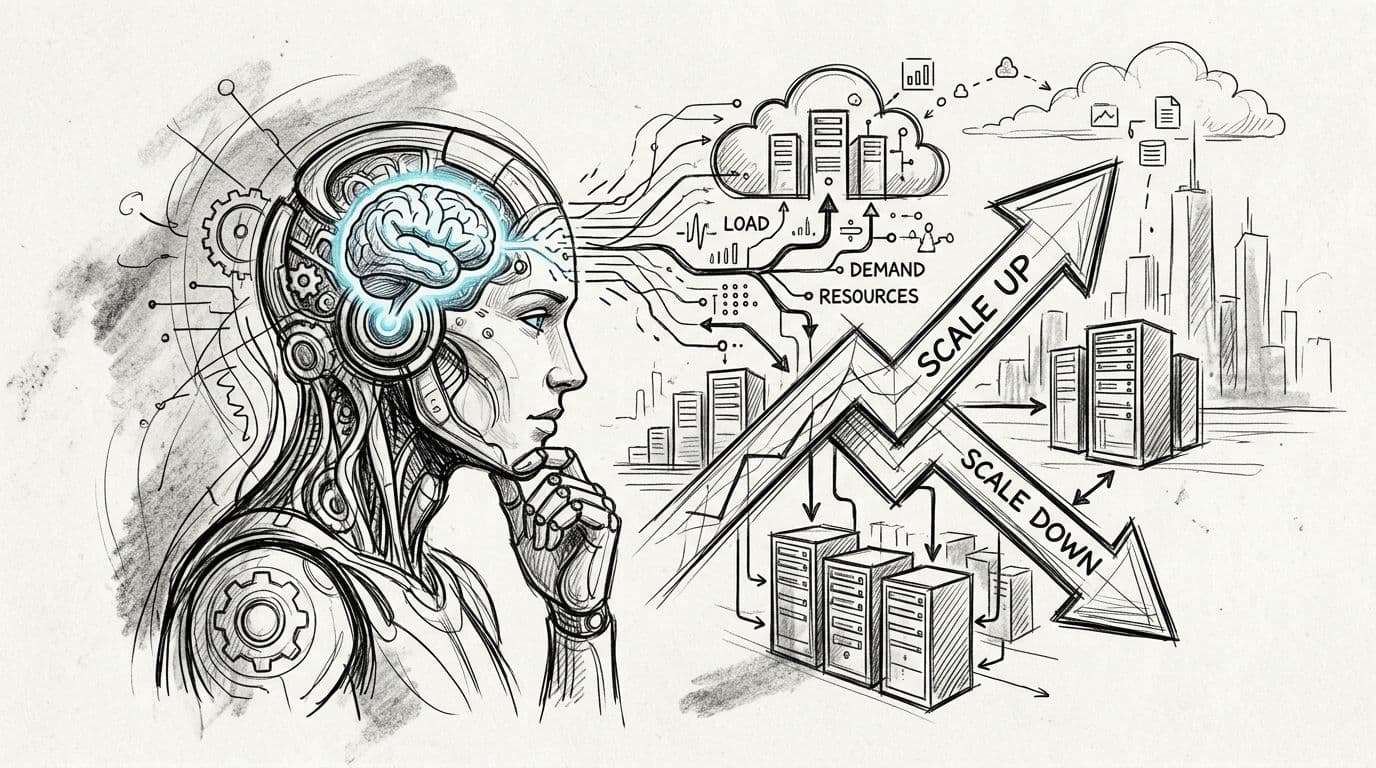
Partially — AI can automate the analysis and recommendation layers of infrastructure scaling in 2026, but full autonomy over scaling decisions is rare outside narrow, well-instrumented systems. Autoscalers have run on rules for a decade, and the 2026 wave adds models that predict load and recommend capacity changes. What AI cannot safely own is the accountability layer: a scaling decision that prices your cloud bill, drops customer traffic, or breaks a compliance boundary is a business decision with a human name on it. The practical 2026 setup is AI-recommended, human-approved — with full autonomy only inside hard budget and safety guardrails.
TL;DR
- AI automates load forecasting and scaling recommendations reliably in 2026.
- Fully autonomous scaling works only inside strict budget and safety guardrails.
- The cost, capacity, and reliability trade-off is a business call, not a math problem.
- Poor telemetry is the top reason AI scaling fails — data quality comes first.
- Prizmstack builds the data infrastructure and guardrails that make AI scaling safe.
Why this matters
Scaling decisions sit where engineering meets money. Over-provision and you burn budget on idle capacity; under-provision and you drop customers at your highest-traffic moment. Teams wondering whether to hand this layer to AI are really asking two different questions — can a model read the telemetry well enough to act, and who is accountable when it acts wrong — and the answers differ.
Can AI automate infrastructure scaling decisions?
The honest answer is a split by decision layer:
| Scaling decision | Can AI own it in 2026? | Why |
|---|---|---|
| Reactive autoscaling (CPU, memory thresholds) | Yes — mature, standard | Rule-based for a decade; AI refines thresholds |
| Predictive scaling from load patterns | Yes, with monitoring | Models forecast traffic and pre-warm capacity |
| Cost-aware right-sizing recommendations | Yes — as recommendations | Analysis is automatable; the spend call is not |
| Scaling within hard guardrails | Mostly | Works when budgets and limits are pre-set |
| Capacity planning tied to business commitments | No | Cost and SLA trade-offs need a human owner |
| Emergency decisions during incidents | Partially | AI proposes, humans decide under pressure |
Verdict: automate the sensing and the recommendation, keep the accountability human. This is the same split that applies across AI automation generally — AI accelerates inputs, humans own decisions with money and customers attached.
Where AI scaling genuinely works today
- Load prediction. Models trained on your traffic history forecast the 9am spike or the Monday report rush and pre-scale before thresholds trip. This is the most mature AI layer in the stack.
- Right-sizing recommendations. Continuous analysis of utilization across compute, database, and storage tiers — surfacing the oversized instance nobody remembered to downsize.
- Anomaly detection. Spotting the traffic pattern that is an attack, a stuck retry loop, or a runaway batch job before the autoscaler politely scales up to serve it.
- Cost anomaly alerts. Flagging the deploy that tripled your compute spend overnight — cheaper to catch in hour one than at invoice time.
These deliver real value because they are analysis over good telemetry with a human reviewing the actions.
What still requires a human
The cost-reliability trade-off
Every scaling policy encodes a business choice: how much to pay to stay fast during a spike, which customer tier gets capacity first, when a slower response is acceptable. AI can model the options; it cannot own the trade-off, because the consequences land on revenue and trust, not on a metric dashboard.
Guardrail design
The irony of autonomous scaling is that making it safe is itself a human decision: spend ceilings, hard capacity limits, blackout windows during migrations, escalation paths. The guardrails define what the AI is allowed to decide — someone has to write them.
Incident accountability
When production is down, an AI recommendation can speed the response, but the decision to scale up aggressively, roll back, or fail over is made by an engineer who will explain it to customers afterward. Accountability does not delegate to a model.
The realistic 2026 setup: AI-recommended, human-approved
- Fix telemetry first. AI scaling is only as good as its data — metrics, logs, and cost signals with consistent labels. This is data infrastructure work before it is AI work; teams with weak pipelines get confident nonsense. Prizmstack treats this as the prerequisite: data infrastructure and pipelines are built before any automation sits on top.
- Start with recommendations, not actions. Let the AI propose right-sizing and predictive scaling for two weeks; approve or reject each one and you will learn where the model is trustworthy in your environment.
- Codify guardrails, then widen autonomy. Hard spend ceilings and capacity limits, set by humans. Inside them, let closed-loop scaling act; outside them, escalate.
- Review monthly. Did the AI's actions match how the business actually performed? Scaling policy drifts as the product changes; a monthly check keeps the automation aligned with reality.
Common mistakes teams make
- Deploying AI scaling on broken telemetry. Bad labels produce confident wrong decisions at machine speed.
- No guardrails before autonomy. The first run of an unbounded scaler is how one team paid for a month of idle GPU capacity.
- Confusing prediction with accountability. A forecast is not an owner; every policy still needs a name attached.
- Optimizing cost alone. A scaler that saves 20% of compute but adds two seconds of latency during peak has made a business decision nobody authorized.
Related questions
Is AI scaling the same as cloud autoscaling?
No. Classic autoscaling reacts to thresholds you set; AI scaling predicts and recommends — and sometimes acts — based on learned patterns. The best 2026 setups layer AI prediction on top of proven rule-based autoscaling rather than replacing it.
What data does AI scaling need?
Consistent metrics and logs, request-level latency, traffic history long enough to cover seasonality, and cost signals tied to the same labels as your infrastructure. Without those, recommendations are guesses with extra confidence.
FAQ
Can AI automate infrastructure scaling decisions?
Partially. AI reliably automates load prediction, right-sizing analysis, and anomaly detection in 2026. Full autonomy works only inside pre-set budget and safety guardrails — the cost and reliability trade-offs stay human decisions.
Will AI scaling replace DevOps engineers?
No. It removes reactive tuning work, but someone still designs the guardrails, validates the recommendations, and owns decisions during incidents. The role shifts from threshold-tuning to supervision.
What are the risks of AI-driven autoscaling?
Decisions on poor-quality telemetry, runaway spend without guardrails, and optimizing one metric at the expense of reliability. Every AI scaling action needs a ceiling, a log, and a human review loop.
How do I start with AI scaling safely?
Fix telemetry first, run AI in recommendation mode for a few weeks, then grant autonomy inside hard spend and capacity limits. Review the actions monthly against business outcomes.
Does predictive scaling actually save money?
It can — pre-scaling for known peaks lets you run smaller steady-state capacity instead of over-provisioning all day. Savings depend on how predictable your traffic actually is.
What should never be automated in infrastructure scaling?
Capacity commitments tied to contracts or SLAs, security boundaries, and emergency failovers during major incidents. Automate the recommendation; keep the decision human.
One last thing
The prerequisite for AI scaling is not a model — it is infrastructure you can see. Teams with messy telemetry get confident nonsense from expensive tools; teams with clean pipelines get useful recommendations on day one. That is the order Prizmstack builds in: data infrastructure and pipelines first, automation second, with guardrails designed so every AI action has a budget ceiling and a human owner. Hand a scaling decision to AI only after you would trust the data it is reading.
Related guides
Topics covered
Written by Prizmstack Team
Full-spectrum software agency