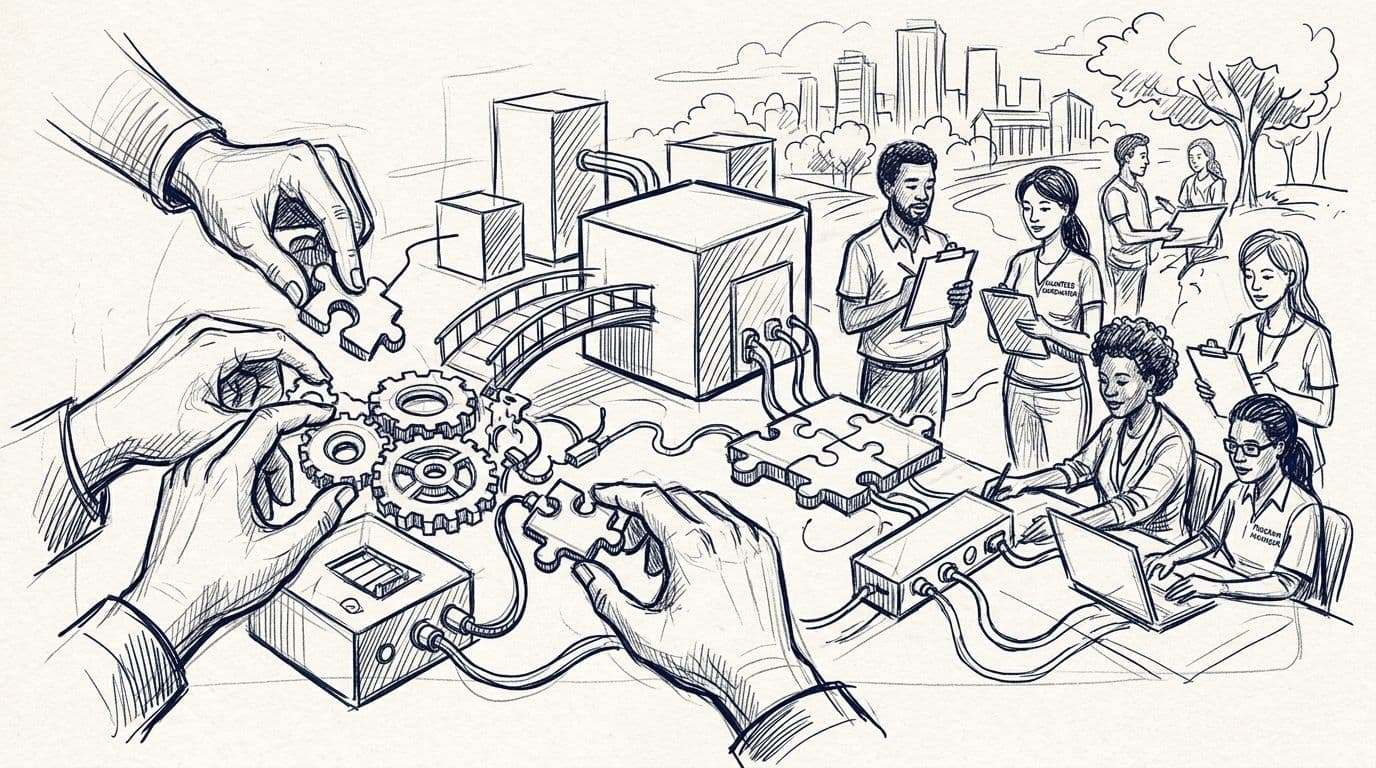
Custom software for nonprofits means building or integrating the donor, program, volunteer, and reporting systems a mission actually runs on — and the sector's data says the problem is fragmentation, not missing tools. According to the Blackbaud Institute, 73% of nonprofits use four or more separate data systems to track program outcomes: a CRM for donors, a separate database for program metrics, spreadsheets for volunteer hours, accounting software for finances, and an email platform for communications. Every hand-built spreadsheet bridge between those systems is staff time that doesn't reach the mission.
TL;DR
- Nonprofit technology budgets average 3.2% of total operating budget (Blackbaud Institute) — about $64,000 for a $2M organization.
- 73% of nonprofits run four or more separate data systems for program outcomes (Blackbaud Institute).
- 45% of nonprofits say they aren't spending enough on technology; 77% cite budget as the barrier (NTEN 2024).
- 41% of nonprofits name lack of process automation as their top internal challenge (Sage, 2025).
- 60% of nonprofit executives cite cost as their primary technology challenge (Wipfli, 2026).
Why nonprofits build custom software in 2026
The constraint is real and quantified: technology investment averages 3.2% of operating budgets (Blackbaud Institute), so a $2M organization has roughly $64,000 per year for everything — hardware, software, and staff time. Within that constraint, 45% of nonprofits say they aren't spending enough on technology, with 77% citing budget as the primary barrier (NTEN 2024). Underspending has its own cost: manual workarounds consume staff hours that the software would have cost less than.
Custom software is not the answer to every nonprofit need — but when off-the-shelf CRMs can't represent how your programs actually work, or when your staff spends hours each month reconciling systems that should talk to each other, a scoped custom build beats another spreadsheet. The decision framework below is how to tell the difference.
Buy or build: the honest test
Most nonprofit needs — donor management, email, event registration, basic CRM — are served well by existing platforms, and the ranked 2026 list of custom software development companies is useful mainly when they're not. Build custom when at least one of these is true:
- Your program model doesn't map to any CRM's data model — outcome tracking that doesn't fit donor/contact schemas
- You need reporting that joins systems nobody integrates (program data + financials + outcomes for a funder)
- The manual reconciliation between systems consumes measurable staff hours every month
- Grant compliance requires data capture your current tools can't record
Verdict: buy for standard donor operations, build for the joins between systems. The custom work lives where your mission differs from everyone else's.
Step 1: Map the data you already have (and where it breaks)
Document every system holding nonprofit-critical data and how staff move information between them. The 73% fragmentation statistic plays out the same way everywhere: someone exports a CSV, fixes it in a spreadsheet, and re-imports it somewhere else.
- List each system: donor CRM, program database, volunteer tracker, accounting, email platform
- For each, record who maintains it, how often data moves, and what breaks in the handoff
- Count the monthly staff hours spent on exports, reconciliation, and re-entry — this is your automation budget baseline
Step 2: Define the reporting you actually owe people
Funders define your data requirements. A program outcome report, a grant compliance filing, and a board dashboard have different shapes — and most custom software projects for nonprofits start because one report takes a week of staff time to assemble by hand.
- Inventory every recurring report and its source systems
- Note which fields are collected today versus which funders ask for
- Prioritize the report whose assembly consumes the most staff hours
Verdict: build around the reports you owe, not the data you wish you had. Scope follows accountability.
Step 3: Scope the smallest system that retires the biggest manual process
Nonprofit budgets can't absorb a two-year platform project. The working pattern is a narrow first build: one integration, one report, one manual process retired.
- Phase 1: connect the two systems that require the most manual reconciliation
- Phase 2: automate the highest-volume recurring report
- Phase 3: extend to volunteer tracking or program metrics once the foundation holds
Each phase should be independently useful — if phase two never happens, phase one still saved staff hours every month.
Step 4: Choose the delivery model that fits a 3.2% budget
At $64,000 per year for all technology in a $2M organization (Blackbaud Institute), the delivery model matters more than the hourly rate.
| Option | Fits when | Trade-off |
|---|---|---|
| Configure an existing CRM | Standard donor workflows | Data model may not fit your programs |
| Embedded development partner | Custom builds with limited internal IT | Requires scoping discipline |
| Volunteer developers / hackathons | Simple, well-defined tools | No maintenance after launch — the common failure |
| In-house technical hire | Ongoing systems ownership | Salary competes directly with program spend |
Verdict: an embedded partner with post-launch support fits the budget reality — you pay for scope you use, and someone stays on the system after launch. Ask every vendor how maintenance is handled; volunteer-built tools that nobody maintains are the sector's most common software regret.
Step 5: Budget for what software actually costs
Sticker prices mislead. Nonprofit CRM software typically runs $100–$500 per month for small and mid-sized organizations, but the advertised price rarely reflects the total (LiveImpact, 2026) — implementation, data migration, and admin time hide the rest. For custom builds, budget three lines: the build itself, the integration work, and post-launch maintenance. A tool that decays for lack of an owner costs more than one maintained properly.
- Ask vendors to price implementation and data migration separately from licenses
- For custom work, require the maintenance line in writing before signing
- Reconcile the total against the 3.2% benchmark — if software consumes half your tech budget, it must retire real staff hours to pay for itself
Step 6: Plan adoption and the first 90 days
Software a small staff doesn't adopt is a donation to a vendor. Involve the program staff who will use it in design decisions, train on real workflows rather than features, and set a 90-day checkpoint: hours saved, reports automated, workarounds retired. Budget iteration time — the first quarter of real usage always generates a rework list.
Common mistakes nonprofits make
- Building what a $200/month platform already does. Custom only where the mission genuinely differs.
- No maintenance plan. Software without an owner decays within a year.
- Copying the corporate CRM model. Donor schemas that don't fit program data force the spreadsheets back.
- Buying on sticker price. Implementation and admin time are the real cost (60% of executives cite cost as the top challenge — Wipfli 2026 — usually because pricing structures obscure it).
- Skipping the staff-hours baseline. Without it, you can't prove the build paid for itself.
Where AI fits for nonprofits in 2026
The sector's top internal challenge is lack of process automation and organizational efficiency — 41% of nonprofits name it (Sage, 2025). The practical AI uses are unglamorous: donor thank-you drafting, grant report assembly from existing data, volunteer scheduling, and email segmentation. Automation of routine workflows is the entry point, not chatbots.
FAQ
How much should a nonprofit spend on technology?
Nonprofit technology budgets average 3.2% of total operating budgets (Blackbaud Institute) — about $64,000 per year for a $2M organization. Yet 45% of nonprofits say they aren't spending enough (NTEN 2024), usually because manual work costs more in staff time.
Should a nonprofit buy software or build custom?
Buy for standard donor and CRM needs. Build custom when program data doesn't fit CRM schemas, when systems must join for funder reporting, or when monthly manual reconciliation consumes measurable staff hours.
What does custom software cost for a nonprofit?
It depends on scope — integrations, reporting, and user count. Budget three lines: build, integration, and maintenance. A narrow first build (one integration, one report) keeps the cost inside a 3.2% tech budget.
How many systems does the average nonprofit run?
73% of nonprofits use four or more separate data systems for program outcomes (Blackbaud Institute) — donor CRM, program database, volunteer spreadsheets, accounting, and email platforms.
What's the biggest technology challenge for nonprofits?
41% name lack of process automation and organizational efficiency as their top internal challenge (Sage, 2025), and 60% of executives cite cost (Wipfli, 2026).
How do we get board approval for a software budget?
Bring the staff-hours baseline: what manual reconciliation costs per month, and what retiring it frees for programs. Boards fund measured trade-offs, not software.
One last thing
Count the CSV exports. Every month, your staff moves data between systems by hand — each export-reconcile-import cycle is the exact scope of your first custom build, and the number of hours it consumes is the business case.
Related guides
Topics covered
Written by Prizmstack Team
Full-spectrum software agency