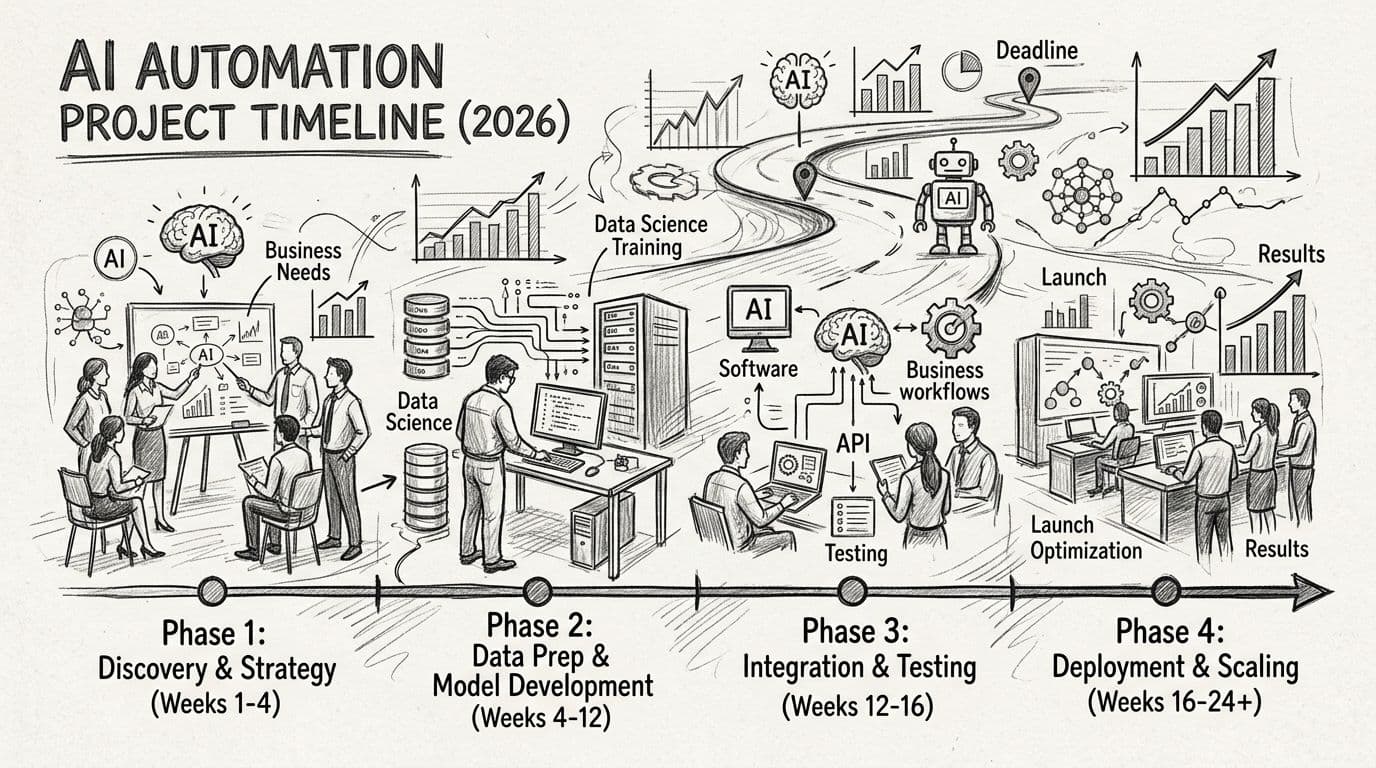
An AI automation project typically takes 2 to 12 weeks from kickoff to a working system in 2026, depending on scope: a single-workflow automation lands in 2-4 weeks, a multi-integration build in 6-10 weeks, and an enterprise-wide platform in 3-12 months. The model is rarely the constraint — data preparation is, and it is the phase every estimate undercounts.
Those ranges come from published industry timelines for AI implementations (AIDOLS implementation guide, 2026; McKinsey enterprise AI benchmarks, 2024), and they match what actually happens in delivery: the schedule bends on integrations and data quality, not on cleverness. Here is how the phases break down, what stretches each one, and how to keep your own timeline honest.
TL;DR
- Single-workflow AI automation: 2-4 weeks to production in 2026.
- Multi-integration builds run 6-10 weeks; enterprise rollouts 12+ weeks to months.
- Data preparation eats 40-60% of project time — the most underestimated phase.
- The strongest predictor of duration is project type, not company size.
How long does an AI automation project take?
The realistic range by project type, from published industry benchmarks and agency delivery data:
| Project type | Typical timeline | What it includes |
|---|---|---|
| Proof of concept | 2-4 weeks | One workflow, real data, internal users only |
| Single-workflow automation | 4-8 weeks | Production system, one integration, monitoring |
| Multi-process system | 8-16 weeks | 2-4 integrations, dashboards, multiple teams |
| Enterprise platform | 16-24+ weeks | Compliance review, on-prem hosting, org-wide rollout |
A focused pilot going live in 6-10 weeks and an enterprise ML system taking 12-18 months are both "normal" — the difference is scope. When a vendor quotes you one number without asking how many systems your automation touches, the estimate is a guess wearing a suit.
The phases, and what each one actually takes
Nearly every AI automation project runs through the same six phases. The durations below reflect the mid-range build (8-12 weeks):
- Discovery and scoping — 1 week. Map the workflow, the systems it touches, and the data it reads. Skipping this costs triple later: a workflow you cannot describe in one paragraph is not scoped yet.
- Design — 1 week. Solution architecture, integration contracts, and the failure paths. Design before code removes the rework cycles that quietly double timelines.
- Data preparation — 1 to 3 weeks. Access, cleaning, mapping, and structuring. Per Gartner's AI implementation survey, data preparation consumes 40-60% of total project time — the single most underestimated line on any schedule.
- Model and pipeline development — 2 weeks. Building the automation logic, prompts or model integration, and the evaluation harness that proves output quality.
- Integration and testing — 1-2 weeks. Wiring into production systems, edge-case testing, permission boundaries, and billing or reporting hooks if the system touches them.
- Deployment and stabilization — 1 week. Staged rollout, human-review path for low-confidence outputs, monitoring, and handover into a post-launch optimization cadence.
What stretches an AI automation timeline
The gap between a 3-week project and a 12-week project almost never comes from the model. It comes from:
- Data quality nobody audited. Inconsistent records, missing access, undocumented schemas. Every one of these surfaces in phase 3 and pushes everything after it.
- Integration count. Each additional system adds API contracts, auth flows, and test surface. A two-system build is a different project from a six-system build.
- Compliance and security review. Regulated data adds legal sign-off to the critical path. Build it into the schedule, not around it.
- Decision latency on the client side. A founder who answers questions weekly keeps a build moving; one who answers monthly adds that latency to every phase.
- Scope creep dressed as "one more feature." Every "small addition" restarts the design-test cycle. The fix is a fixed v1 definition, agreed before kickoff.
What compresses it
- One workflow, done completely. Prove value on the narrowest valuable automation, then expand.
- Data mapping during discovery. One week of mapping before quoting prevents the phase-3 surprise that costs three.
- Senior decisions early. Architecture calls made by senior people up front avoid rebuilds — direct senior access during scoping is cheaper than re-architecture under load.
- A QA plan for non-deterministic output. Golden datasets and edge-case suites defined early keep testing a phase, not a swamp.
How to get an honest timeline for your project
Any firm worth hiring will scope before quoting. The checklist that takes an estimate from fiction to fact:
- Name the workflow, the systems it touches, and the data it reads.
- Ask what phase gets underestimated — the honest answer is always data preparation.
- Ask what stays manual in v1, and who approves outputs.
- Get the post-launch plan in writing: monitoring, drift handling, and iteration cadence. Systems drift as usage patterns change, and a partner that stays invested after launch — monitoring and optimizing rather than handing over a repo — is what keeps the timeline from quietly restarting after go-live.
Related questions
How long does AI automation take for a small business?
A small business automating one workflow — quote generation, document extraction, support triage — typically reaches production in 2-6 weeks with a scoped partner, assuming data access is ready on day one. Multi-department rollouts take longer because integration count, not company size, drives duration.
Why do AI projects take longer than estimated?
Almost always data preparation and integration surprises, not model work. Estimates built on clean demo data meet real, messy production data in week three — and the schedule adjusts.
Can an AI automation project be done in a week?
A thin proof of concept on a single clean data source, yes. A production system with monitoring, error handling, and user access controls is a multi-week build regardless of who delivers it — anyone promising production in five days is describing a demo.
FAQ
How long does an AI automation project take in 2026?
Single-workflow automation reaches production in 2-8 weeks, multi-integration builds in 6-10 weeks, and enterprise platforms in 16-24 weeks or more. Data preparation is the longest phase at 40-60% of project time.
What is the fastest an AI automation can go live?
A focused pilot on one clean workflow with ready data access can go live in 2-4 weeks. Production systems with monitoring and error handling take longer regardless of vendor.
Why do AI projects get delayed?
Data quality issues, uncounted integration work, compliance review on the critical path, and slow client decisions delay AI projects far more than model complexity does.
How long is data preparation in an AI project?
Per Gartner's AI implementation survey, data preparation consumes 40-60% of total project time. One week of data mapping during discovery prevents most of the overrun.
Does a bigger company mean a longer AI project?
No — project type is the strongest predictor of duration, not company size. A mid-size firm automating one workflow ships faster than a five-person team integrating six systems.
What happens after an AI automation launches?
Monitoring, drift handling, and iterative improvement. AI systems change behavior as usage patterns shift, so budget for post-launch optimization from the start.
One last thing
Ask any vendor for the timeline of a project they shipped that looked like yours — same workflow count, same systems. A firm that can name one, with dates and phases, has a delivery process. A firm that answers with a range and a discount is selling you the range.
Topics covered
Written by Prizmstack Team
Full-spectrum software agency