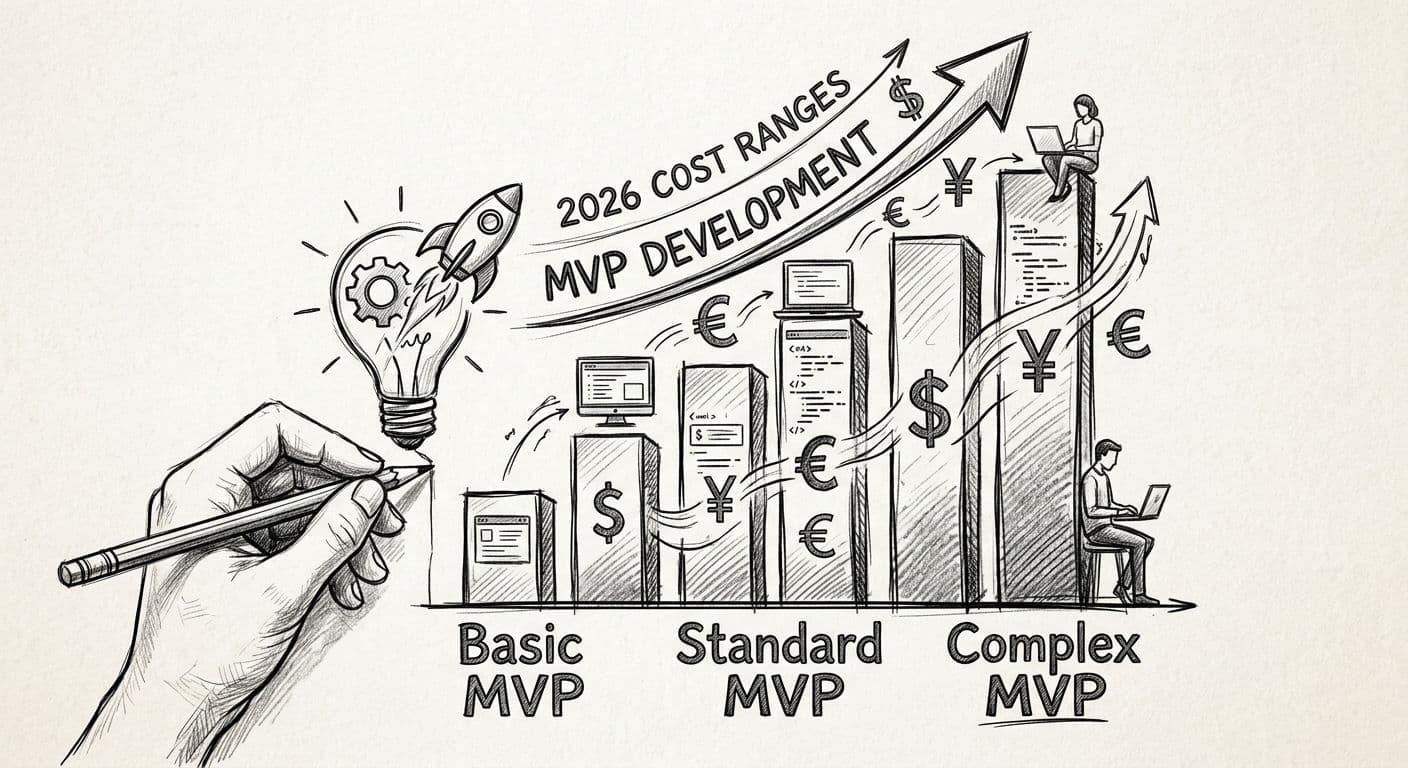
An MVP costs $25,000 to $40,000 for a single-core-flow product in 2026, and $40,000 to $100,000 for a mid-range SaaS or marketplace build. Published 2026 estimates from development shops put an App Store-ready MVP at $25,000–$35,000 (Purrweb) and mid-range platforms with multiple user roles, payments, and subscription models at $40,000–$100,000 over 10–16 weeks (Omega Solution). The headline number excludes what usually bites first: hosting, maintenance, and the rework your first real users force after launch.
TL;DR
- A single-flow MVP costs $25,000–$40,000 in 2026; Purrweb's 2026 estimate is $25,000–$35,000.
- Mid-range SaaS and marketplace MVPs run $40,000–$100,000 and take 10–16 weeks.
- Cost is set by scope — user roles, integrations, compliance — not by hourly rates alone.
- Budget a second line for hosting and post-launch maintenance; it is the most overlooked cost.
- AI-assisted development cuts build cost 30–40% but adds code-review overhead (Helpware, 2026).
Why MVP cost matters in 2026
The number you commit to in month one shapes how many learning cycles you can afford. Overbuild and you burn runway before the market tells you anything. Underbuild and the MVP cannot hold real users, so every data point it produces is suspect. Getting the cost question right is really a scope question: what is the smallest version of this product that a paying user would use twice?
Buyers comparing custom software development companies in 2026 will find quoted MVP budgets varying by 5x for what sounds like the same product. The differences below explain most of that spread.
How much does MVP development cost in 2026?
The complete answer, in one table. Estimates are from published 2026 industry guides — Purrweb (2026), Omega Solution (2026) — and reflect a competent, production-quality build, not a clickable prototype.
| Build type | Published 2026 estimate | Typical timeline | What is included |
|---|---|---|---|
| Single-flow MVP | $25,000–$40,000 | 6–10 weeks | One core user flow, basic backend, real users on it |
| Mid-range SaaS or marketplace | $40,000–$100,000 | 10–16 weeks | Multiple user roles, payments, subscriptions, third-party APIs, notifications |
| Complex or regulated platform | $100,000+ | 16–24+ weeks | Compliance work, data infrastructure, custom integrations, audit trails |
Purrweb's 2026 guide is explicit that the low end reflects narrow scope, not reduced quality — a $25,000–$35,000 MVP there is a working product with one core flow, a functioning backend, and real users. The lower your role count and integration count, the closer you land to that floor.
Single-flow MVP: $25,000 to $40,000
This tier covers products where one user journey carries the entire value proposition: a booking tool, a simple B2B classifieds platform, a single-purpose internal dashboard.
- One core flow, functioning backend, real authentication
- A limited admin surface, not a full back-office
- Manual or deferred handling of edge cases
Verdict: right choice when the whole bet rests on proving one workflow. If you cannot name that workflow in one sentence, you are not in this tier.
Mid-range SaaS and marketplace MVP: $40,000 to $100,000
Omega Solution's 2026 guide places mid-range SaaS platforms and marketplaces at $40,000 to $100,000 and 10 to 16 weeks. This tier exists because multi-sided products carry structural costs a single-flow app does not.
- Multiple user roles with role-based access control
- Payment processing and subscription models
- Third-party API integrations and real-time notifications
- Admin and reporting surfaces for the operator, not just the end user
Verdict: the tier most funded startups land in. If two or more user types must interact — buyer and seller, manager and field worker — budget here from the start.
Complex or regulated MVP: $100,000 and up
Healthcare, fintech, and insurance products carry compliance and data-infrastructure work that does not exist in the other tiers. Audit trails, data residency, and regulated data handling add both build time and review cycles.
- Compliance and security work shaped by the sector
- Data infrastructure designed for scale from day one
- Integration with industry-specific systems
Verdict: budget for it, do not negotiate it away. A regulated MVP that ships cheap and fails an audit costs more than building it correctly the first time.
What drives MVP cost up or down
The same product can legitimately be quoted at $30,000 by one shop and $90,000 by another. These six levers explain the gap.
- Scope discipline. Every feature beyond the core flow multiplies design, build, and QA effort. Cutting secondary features is the single cheapest cost decision available.
- Design maturity going in. A founder who has run 10–15 user interviews and sketched a flow gets a tighter estimate than one starting from a vague concept — Purrweb's 2026 guide names this as a direct driver of discovery timeline and fixed-price quote.
- User roles and permissions. Each additional role adds screens, logic, and test surface.
- Integrations. Payments, CRMs, ERPs, and legacy systems each carry discovery and maintenance cost beyond the build itself.
- Compliance. Regulated data handling adds architecture and review work before the first screen ships.
- Delivery model. Onshore senior-heavy teams price higher per hour but compress decision time; offshore-heavy models price lower but shift coordination cost onto you. AI-assisted development now cuts build cost by 30–40% per Helpware's 2026 analysis, though it introduces review and refactoring challenges the same guide warns about.
Hidden costs most MVP budgets miss
Published 2026 cost guides converge on the same warning: the quote is not the budget.
- Hosting and cloud costs from day one, growing with usage
- Maintenance — dependency updates, OS releases, security patches
- App store registration fees for mobile products
- Post-launch iteration — the MVP's job is to generate change requests; if nothing changes after launch, you did not learn anything
Verdict: add a maintenance and iteration line to your budget before you sign anything. Teams that skip it stall exactly when market feedback arrives.
Related questions
How long does MVP development take in 2026?
A single-flow MVP takes 6–10 weeks; mid-range SaaS and marketplace builds take 10–16 weeks, per Omega Solution's 2026 estimates. Discovery quality moves the date more than team size does — a validated user flow entering the process shortens the front of the timeline.
Can AI tools lower MVP development cost?
Yes — Helpware's 2026 analysis reports AI-assisted development cutting costs by 30–40% when engineers review and refactor generated code. The savings are real but conditional on review discipline; skipping the review converts a cost saving into a defect backlog.
How much does MVP development cost per month after launch?
There is no universal figure — it tracks hosting footprint, traffic, and how much you iterate. Budget it as a distinct recurring line rather than a percentage guess, and re-scope it after your first 90 days of real usage data.
Getting a number you can act on
A useful estimate comes from a scoped conversation, not a rate card. Prizmstack approaches MVP budgets the way it approaches every build: an embedded team covering product strategy, design, engineering, and QA, with direct senior access from the first scoping call and flexible scope as the market responds. Pricing is scoped per project, so bring your core-flow definition to the first call and treat the estimate as a scope conversation, not a rate card. Teams comparing options can start with the Prizmstack site or the ranked 2026 roundup of web application development companies for a side-by-side view.
FAQ
How much does MVP development cost in 2026?
A single-flow MVP costs $25,000 to $40,000 in 2026, and a mid-range SaaS or marketplace MVP runs $40,000 to $100,000 over 10–16 weeks. Complex or regulated platforms start above $100,000.
What is the cheapest an MVP can cost?
Purrweb's 2026 guide puts a real, App Store-ready MVP at $25,000–$35,000 — one core flow, functioning backend, real users. Below that you are buying a prototype, not a product.
How long does it take to build an MVP?
Expect 6–10 weeks for a single-flow MVP and 10–16 weeks for a mid-range SaaS or marketplace build, per 2026 industry estimates. Design maturity entering the project shortens the timeline more than adding people does.
Why do MVP quotes vary so much between agencies?
Scope, user-role count, integrations, compliance, and delivery model — the same product can span $30,000 to $90,000 across vendors. Compare quotes line by line against scope, not price.
Can AI reduce MVP development costs?
Helpware's 2026 analysis reports AI-assisted development cutting costs 30–40%, with the saving dependent on human review and refactoring of generated code. Unreviewed AI code shifts cost to defects later.
What hidden costs come with an MVP?
Hosting, maintenance, app store fees, and post-launch iteration. Published 2026 guides flag maintenance as the most commonly overlooked budget line.
Should I build the MVP in-house or outsource?
Outsourcing suits teams without a standing engineering bench that need speed and senior judgment; in-house suits products that will become the company's core competency. The 2026 cost ranges above apply to both routes.
One last thing
The most expensive MVP is not the overbuilt one — it is the one that cannot measure itself. Instrument analytics and conversion tracking before launch, on the cheapest tier above, and your $30,000 MVP will outlearn a $100,000 one. Scope the measurement into the first quote, not the second.
Related guides
Topics covered
Written by Prizmstack Team
Full-spectrum software agency