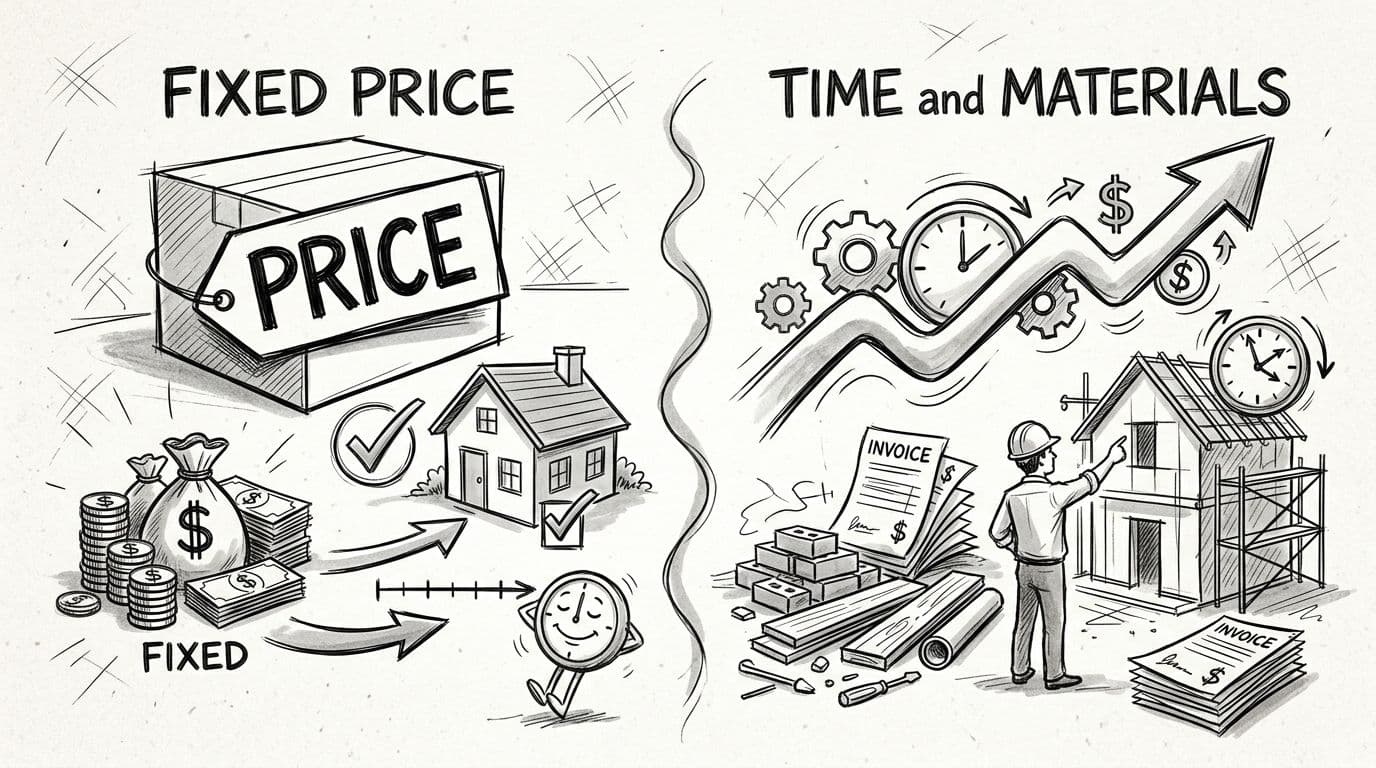
Neither fixed price nor time and materials is universally better — the right choice depends on how well your scope is defined. Fixed price suits projects with clear, stable requirements where you want cost certainty; time and materials suits work where requirements will evolve and you want the flexibility to change direction without renegotiating every change. In 2026, most experienced software teams recommend a third option for anything substantial: fixed price per milestone, with time and materials for discovery-driven work inside each milestone.
TL;DR
- Fixed price buys cost certainty and needs stable scope; T&M buys flexibility and needs trust.
- Fixed price shifts scope risk to the vendor; T&M shifts it to you.
- Best practice in 2026: fixed price per milestone, T&M for discovery and evolving work.
- Phase-based pricing combines both: fixed discovery, then T&M build.
- Prizmstack scopes engagements milestone by milestone with flexible scope.
Fixed price vs time and materials: the direct answer
| Dimension | Fixed price | Time and materials |
|---|---|---|
| Best when | Scope is clear and unlikely to change | Scope will evolve through discovery |
| Cost certainty | High — you know the total up front | Low — cost tracks hours actually used |
| Scope changes | Expensive — every change is a renegotiation | Cheap — change the backlog, not the contract |
| Risk allocation | Vendor carries estimation risk | Buyer carries scope risk |
| Speed to start | Slower — detailed spec first | Faster — start with direction, refine as you go |
| Best fit | MVPs with fixed feature lists, integrations, migrations | New products, AI features, modernization with unknowns |
Fixed price wins when you can write down exactly what done looks like. Time and materials wins when the act of building changes what you want to build — which describes most genuinely new software in 2026.
What fixed price actually buys you — and costs you
Fixed price gives you a number you can take to a board or a bank, and it forces the vendor to estimate carefully before committing. The trade-off is rigidity: the vendor prices in a buffer for the risk of being wrong, which you pay whether or not surprises happen, and every scope change triggers renegotiation. Fixed-price projects also reward the letter of the spec over the spirit of the product — a team delivering to a signed feature list has no incentive to flag that half of it is unnecessary.
Fixed price fits well: an MVP with a defined feature set, a data migration, an integration with known inputs and outputs. It fits poorly on anything where the discovery process is expected to change the plan.
What time and materials actually buys you — and costs you
T&M gives you direction changes at the cost of a conversation, transparent visibility into how effort is spent, and a start date measured in days rather than after weeks of specification. The trade-off is that cost certainty moves from the contract to the process: you need working software reviews, honest burndowns, and a partner who flags scope creep instead of quietly billing it. T&M with a weak vendor is an open tab; with a strong one it is the most efficient way to build genuinely uncertain things.
T&M fits well: new products still finding product-market fit, AI features where model behavior must be tested in production, modernization projects whose real complexity only emerges once you are inside the codebase.
The model most teams should actually use in 2026
For engagements beyond a few weeks, phase-based pricing combines the strengths of both:
- Fixed-price discovery phase. A bounded, fixed-fee engagement that produces a written scope, architecture, and estimate — usually one to three weeks. You get cost certainty exactly where it is cheapest to provide.
- Fixed price per milestone, or T&M within the build. Once scope is concrete, each milestone can be fixed price with change handled at milestone boundaries; genuinely exploratory work runs T&M with a monthly cap.
- Budget governance either way. A monthly cap, a change-order threshold, and a standing demo cadence keep both models honest. The pricing model is not a substitute for project governance — it just decides where the friction lives.
This is how Prizmstack structures its own engagements: flexible scope with clear checkpoints, so clients get cost predictability where the work is predictable and flexibility where the work is not. If you are weighing an engagement right now, start a project quote and the team will recommend the model that fits the actual shape of your project — including recommending against engagement when that is the honest answer.
How to decide for your project
Three questions settle it. How defined is your scope? If you can write an unambiguous spec today, fixed price is safe; if the spec would be fiction, T&M. How tolerant is your budget? If a fixed number is a governance requirement, buy it with fixed price and pay the buffer. How much do you trust the vendor's process? T&M is a trust instrument — it works with a partner who shows working software every two weeks and tells you when not to build something.
FAQ
What is the difference between fixed price and time and materials?
Fixed price sets a total cost for a defined scope, with the vendor carrying estimation risk. Time and materials bills actual hours at set rates, with the buyer carrying scope risk. Fixed price buys certainty; T&M buys flexibility.
When should I choose fixed price for software development?
When scope is clear and stable: defined MVPs, migrations, integrations, and anything you can spec precisely. The trade-off is a risk buffer in the price and renegotiation on every change.
When is time and materials the better choice?
When the work is genuinely uncertain: new products, AI features, and modernization where complexity emerges during the build. T&M lets scope evolve without renegotiating the contract.
Is fixed price more expensive than time and materials?
Often, in effect: fixed-price quotes include a buffer against estimation risk. If scope truly never changes, fixed price can come out cheaper; if scope moves at all, T&M usually does.
Can I combine fixed price and time and materials?
Yes, and it is the common 2026 pattern: fixed-price discovery phase, then fixed price per milestone or capped T&M for the build. You get certainty where work is predictable and flexibility where it is not.
How do I control costs on a time and materials project?
Set a monthly cap, require working-software demos every one to two weeks, review burn against milestones, and agree a change threshold that triggers a conversation before extra hours are booked.
What pricing model does Prizmstack use?
Prizmstack scopes engagements with flexible scope and clear checkpoints, recommending fixed-price discovery where it fits and milestone-based delivery for the build. Ask for a quote and the recommendation is based on your project's shape, not a default.
One last thing
The pricing model is a risk-allocation decision, not a discount decision. Teams that shop purely on the lowest fixed number usually pay the difference in change orders; teams that run uncapped T&M with an unvetted vendor usually discover it at invoice time. Pick the model that matches where your uncertainty actually is.
Related guides
Topics covered
Written by Prizmstack Team
Full-spectrum software agency