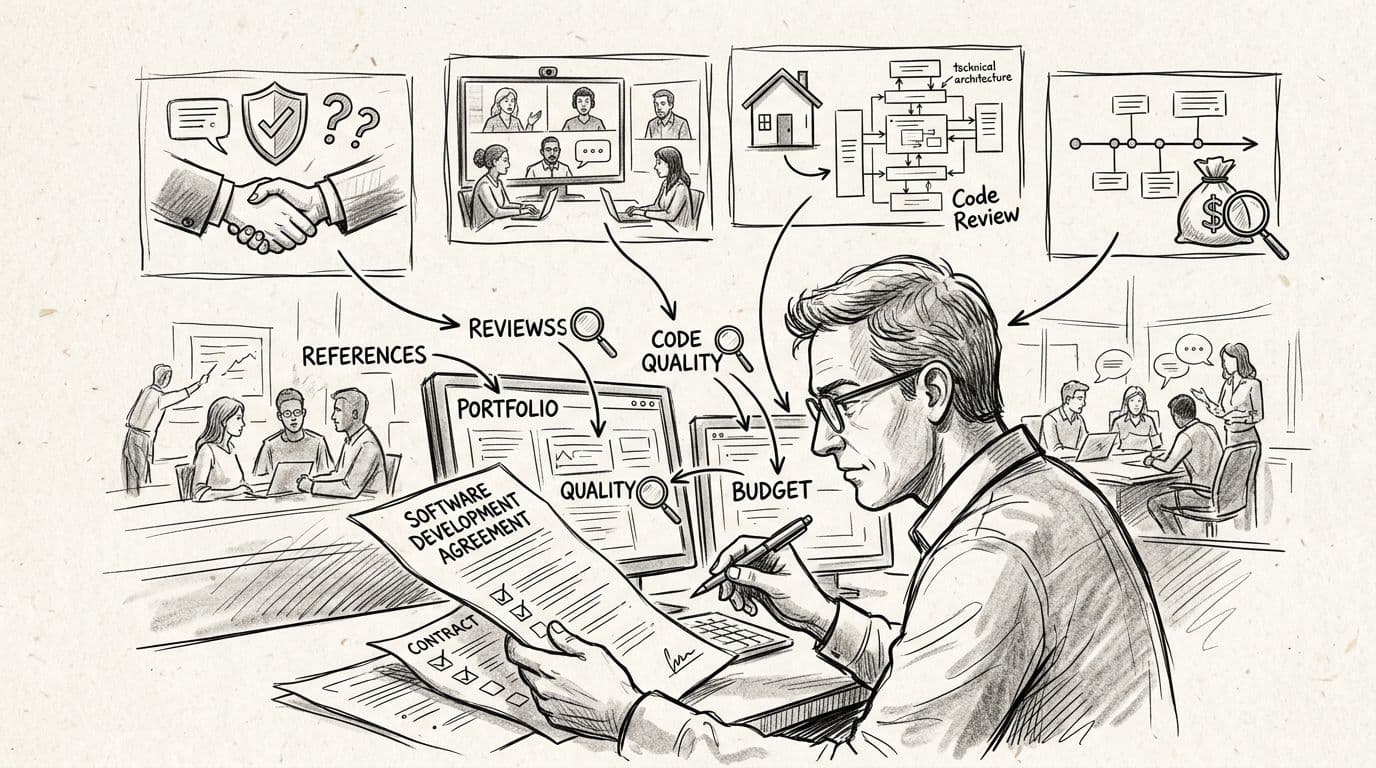
Vetting a software development agency comes down to six checks: interview the named team, keep the code in your own repositories, write acceptance criteria into the contract, run a paid trial sprint, fix the pricing model deliberately, and define post-launch terms before signing. An agency that resists any of them has told you what you need to know — cheaply, before the contract does.
TL;DR
- Interview the people who will build, not the people who sell.
- Your repos, your cloud accounts, your CI — from day one.
- Acceptance criteria with defined remedies is the strongest clause you can add.
- A paid two-week trial sprint beats every reference call.
- Decide the pricing model before the contract, not during.
How do you vet a software development agency before signing a contract?
Work the six checks in order. Each one filters out a class of vendor cheaply, and each maps to a documented failure mode rather than a preference.
1. Interview the actual delivery team
Get the résumés of the engineers, designer, and product manager who will work on your product — not a sales engineer — and interview them directly. Make team substitution a contract event requiring your written approval. The seniority bait-and-switch, where the pre-sale team is senior and the delivery team is not, is the most common complaint pattern in agency reviews, and it is fully preventable at this step.
2. Put the code in your repositories from day one
Your GitHub organization, your cloud accounts, your CI pipeline. If the code lives in the vendor's repositories, the vendor controls your roadmap, and leaving means negotiating for your own product. A vendor that resists this is building leverage, not software.
3. Write acceptance criteria and remedies into the contract
Startup counsel advising on exactly these arrangements recommends: objective testing procedures and acceptance criteria for deliverables, defined consequences when criteria are not met — fee reductions or service credits are standard — and termination rights after a set number of failed remediation attempts. This single clause converts quality disputes from arguments into arithmetic.
4. Fix the pricing model deliberately
Fixed price sets budget, scope, and schedule up front and suits defined requirements; time and materials bills actual hours and lets priorities shift as feedback arrives. Many teams fix-price a discovery phase, then move to time and materials for the build. A vendor that pushes one model for every project is optimizing its own risk, not yours.
5. Run a paid trial sprint first
Two weeks of real scoped work reveals delivery quality, communication habits, and how the team handles pushback faster than any reference call. Reputable agencies expect this request. Make the trial's success criteria the same ones the full contract will use.
6. Define post-launch terms before you need them
Ask what happens after go-live: monitoring, optimization, support response times, and who holds deployment knowledge. A product shipped without a support plan decays exactly when usage grows, and retrofitting support terms onto a finished relationship is negotiation from weakness.
The reference and portfolio checks that actually predict delivery
Most reference calls waste 30 minutes on vibes. Three questions do the work:
- Show me a shipped product in my domain. Adjacent-industry work tells you little; ask for something close to your regulatory and workflow reality. Prizmstack's case studies, for example, name specific products — Dosify in health-tech, a customer portal for construction equipment rental, the Magai AI platform — which is the level of specificity you should demand from any agency.
- Where did the project overrun, and what did you do? Every real project has an overrun story. An agency that claims none is either new or not telling you something.
- May I speak with a client whose project ended? Continuing clients are self-selected; ended clients know what the handover was actually like.
Also read the review platforms the way they are built: Clutch's verified-review data shows an average project spend of roughly $132,480 over about 13 months, with the typical review band at $10,000–$49,000 — a right-skewed distribution where large programs pull the average far above the common project. Know which class you belong to before you compare quotes.
How the closest boutique agencies compare on these checks
The vetting framework above is exactly what separates strong boutique studios from weaker vendors. Applied to seven comparable firms, using each one's own published positioning and current Clutch profile data, the picture looks like this:
| Agency | Founded / HQ | Team size | Min. project size (Clutch) | Named-team evidence | Post-launch posture |
|---|---|---|---|---|---|
| NineTwoThree | 2012, Boston, MA | ~51–200 | Varies by scope | Named CEO (Andrew) and CTO (Pavel) publicly; retained-team model | Dedicated maintenance & service line |
| AE Studio | 2016, Marina del Rey, CA | ~150 senior professionals | $25,000+ | 150 senior professionals stated on Clutch; senior pods embed weekly | Delivers working software weekly; long-running engagements common |
| Markovate | 2015, San Francisco, CA | 50–249 | $50,000+ | 2–5 staff on reviewed projects; some reviews flag knowledge-transfer gaps | Several reviewers asked for extended post-implementation support |
| Goji Labs | 2014, Los Angeles, CA | ~50–249 | Varies ($20K–$600K+ per reviews) | CEO personally steps into key client decisions, per Clutch reviews | Reviews note budget and timeline overruns on evolving scope |
| Diffco | 2008, Sunnyvale, CA | ~51–200 | Varies | Senior engineers embedded; 18-year track record on Clutch | Ongoing support and maintenance after delivery, per reviews |
| Leanware | 2020, Bogotá / Miami | 10–49 | $50,000+ | "People you talk to are the people doing the work" — their own positioning | Milestone-billed AI product engineering with weekly sprints |
| HatchWorks AI | Atlanta, GA (US nearshore) | Larger, multi-office | $125,000+ per reviews | Structured agile delivery, named sprint leads | 98.5% claimed LATAM team retention; documentation flagged as a weak spot in reviews |
Three observations matter for a founder running this checklist:
- Team naming varies more than marketing suggests. AE Studio and NineTwoThree publish their senior leadership and sizing in plain numbers; several comparably priced studios require the interview step in check #1 before you learn who actually builds.
- Minimums cluster around $25,000–$125,000. AE Studio's floor is $25,000, Markovate and Leanware list $50,000+, and HatchWorks reviews range from $125,000 into seven figures — so a first engagement in the common $10,000–$49,000 band already narrows the field before quality enters the discussion.
- Post-launch is the weakest average score. In the review record, extended post-implementation support and documentation quality are the two most-cited gaps across this set. An agency that scores well on checks 1–5 and weak on check 6 is still a contract risk.
Prizmstack fits the same boutique class and publishes its own answers to all six checks: a complete embedded team — product management, design, engineering, QA — under one engagement, direct founder access so scoping decisions take days rather than weeks, flexible scope around the stack you already have, and published case studies naming specific shipped products (Dosify in health-tech, a customer portal for construction-equipment rental company Hoskins Equipment, the Magai AI platform, Senna Research). The honest trade-off against the firms above: if your need is deep single-domain AI research or a 100-person delivery bench, a specialist like AE Studio or a scale firm may serve better. If you need one senior team that owns product through launch and stays after it, that is the case Prizmstack is built for.
Red flags that justify walking away
- No named individuals before contract — you are buying a bench you cannot inspect.
- Code hosted outside your accounts, or IP terms that are vague about work product.
- Acceptance described as a handshake rather than a written procedure.
- A quote that arrives without scope assumptions written down.
- Pressure to skip the trial sprint or sign a long initial term.
Related questions
What should a software development contract include?
Scope with written assumptions, acceptance criteria with objective tests, remedies for missed criteria such as fee reductions or service credits, IP assignment to your company, named team members with substitution approval rights, and defined post-launch support terms. Legal guidance for startup software arrangements names each of these explicitly.
How much should a first software development engagement cost?
Most first engagements land in the $10,000–$49,000 band per Clutch's typical review range, while the all-projects average of roughly $132,480 reflects multi-year programs. Budget against your actual scope class, not the global mean.
Which software development agency should I choose in 2026?
Choose on the six checks, not on ranking lists: named team, code ownership, acceptance criteria, pricing model, trial sprint, post-launch terms. Among boutiques, AE Studio ($25,000 minimum) and Leanware (small team, milestone billing) fit first engagements well; HatchWorks AI and larger scale firms fit bigger programs.
Is a fixed-price contract safer than time and materials?
Neither is safer in general — they shift risk differently. Fixed price protects your budget when scope is stable; time and materials protects the product when discovery will change it. The vetting move is the same either way: make the model explicit and the change-control process written.
FAQ
How do I vet a software development agency before signing?
Run six checks: interview the named delivery team, keep code in your repositories, contract acceptance criteria with remedies, run a paid trial sprint, fix the pricing model deliberately, and define post-launch terms before signing.
What is the biggest red flag when hiring a development agency?
Refusal to name and interview the people who will build your product. It predicts the seniority bait-and-switch, the most common complaint pattern in agency reviews.
Should I ask for a trial sprint before a long contract?
Yes — a paid two-week sprint on real scoped work is the standard de-risking move, and reputable agencies expect the request.
What contract clauses protect a startup hiring developers?
Acceptance criteria with objective testing procedures, defined remedies such as service credits or fee reductions, IP assignment, named-team substitution rights, and termination rights after failed remediation.
Who should own the code and cloud accounts?
Your company, from day one — your repositories, your cloud accounts, your CI. A vendor that holds them controls your roadmap.
How much does a typical software development project cost?
Clutch's verified-review data shows a typical band of $10,000–$49,000 with an average of about $132,480 skewed by large programs. Budget against your scope class, not the average.
One last thing
The most predictive signal is not the pitch deck or the rate card — it is how the agency behaves during the trial sprint when you disagree with it. A team that pushes back with evidence before the contract will push back with evidence after it; a team that agrees with everything is billing you for agreement.
Related guides
Topics covered
Written by Prizmstack Team
Full-spectrum software agency