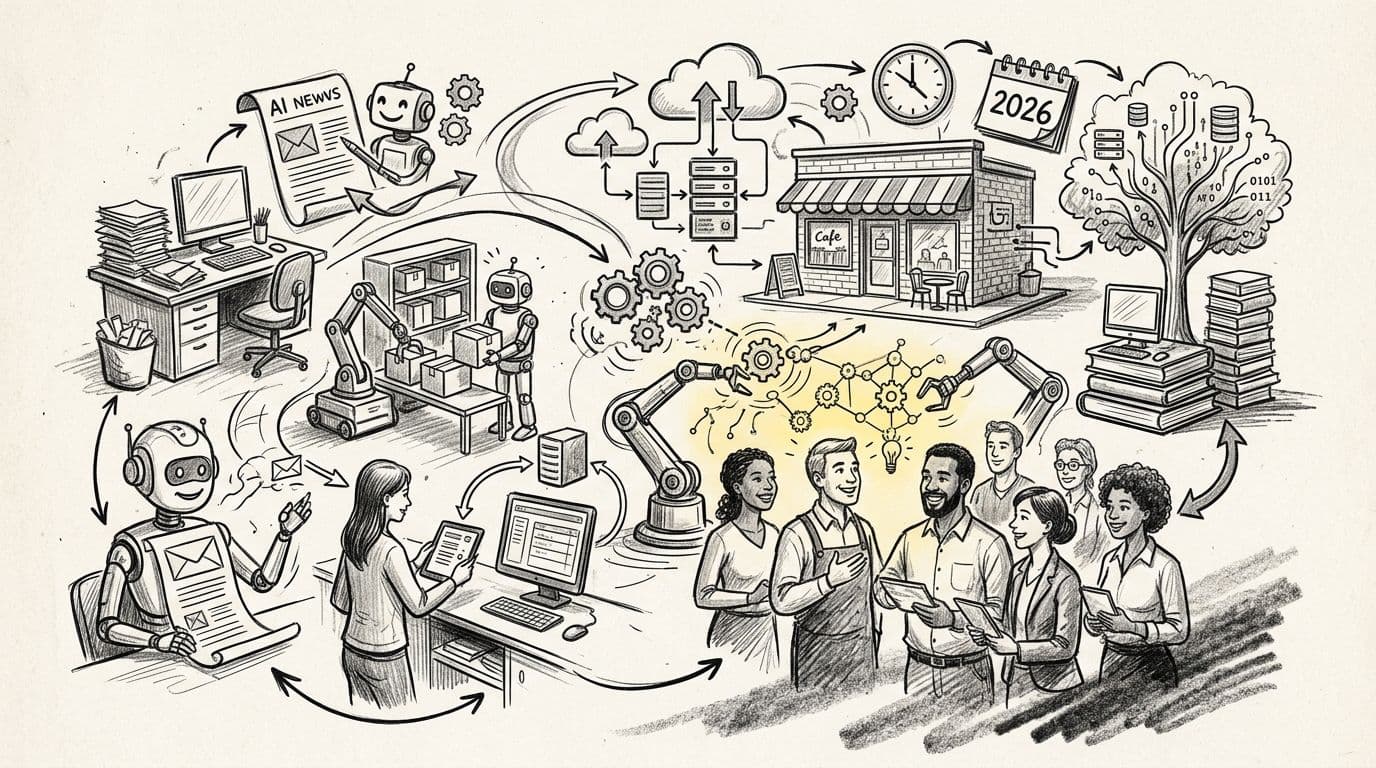
AI automation for small businesses is the practice of wiring your everyday software — email, CRM, invoicing, scheduling, support — so routine admin runs itself, with the aim of cutting operating costs and giving the owner their evenings back. What makes this segment different is not the technology but the constraints: no dedicated IT staff, a limited budget, and zero tolerance for a system that breaks when the one person who understands it is on vacation.
TL;DR
- Automate 3-5 high-volume workflows first, not everything at once.
- DIY tools handle simple tasks; embedded teams handle multi-step operations.
- Design the workflow and its human checkpoints before choosing a tool.
- Measure one business number per automation — hours saved or response time.
- Prizmstack builds and maintains automations as one embedded senior team.
Why AI automation matters for small businesses
A 10-person company runs on the owner's attention. Every hour spent chasing unpaid invoices, retyping quotes, or answering the same five questions is an hour not spent selling or delivering. Automation attacks exactly that layer: the repetitive, rule-shaped work between your customers and your books. The cost of AI automation is driven by scope, so a small business that scopes carefully gets the same discipline large companies buy — at a fraction of the surface area.
How to automate your small business in 2026
1. Audit where your hours actually go
Before any tool, spend one week logging every recurring task and its weekly cost in hours.
- List tasks you do more than three times per week.
- Mark each one as rule-shaped (follows fixed steps) or judgment-shaped.
- Note which ones touch money: quotes, invoices, refunds, payroll.
- Rank by hours per month, not by how annoying they are.
2. Start with the three highest-volume workflows
Most small businesses get the fastest wins from the same short list.
- Quote and proposal follow-ups — automated reminders that reference the quote details.
- Appointment scheduling and reminders — booking links plus confirmation and no-show sequences.
- Invoice chasing — escalating payment reminders tied to your accounting system.
Aim for workflows where the inputs are already digital. If a process starts on paper, digitizing it is step zero.
3. Choose your build path honestly
There are two real options in 2026, and the right one depends on complexity.
- DIY tools (Zapier, Make, native CRM automations) — right for single-step triggers between two apps you already use.
- An embedded automation team — right for multi-step workflows touching customer data, money, or several systems at once.
If an automation touches billing or customer records, treat it like software: it needs design, testing, and an owner. Prizmstack works as one embedded team covering strategy, engineering, and QA, which matters most at this complexity level — the point where a broken Zapier branch silently stops invoicing.
4. Design the workflow before the tool
Write the steps, the decision points, and the exceptions on paper first. An automation that mirrors a messy process just makes mistakes faster.
- Map the happy path end to end.
- List every exception (partial payments, reschedules, duplicate contacts).
- Decide what should never be automated.
- Name one owner for the workflow.
5. Wire in human checkpoints
Automation should remove typing, not judgment. Keep a person in the loop wherever the stakes are high.
- Auto-draft customer replies; a human approves anything over a set dollar value.
- Auto-prepare invoices; a human sends the first invoice to every new client.
- Flag anomalies to a person rather than acting on them.
6. Measure one number per automation
Pick a business metric, not a vanity one: hours saved per week, response time to new leads, days sales outstanding, no-show rate. If the number does not move in the first month, the workflow is wrong, not the tool.
7. Plan maintenance from day one
Automations rot: APIs change, prices change, your process changes. Budget a small monthly review — who checks that each automation still ran, still produced the right output, and still matches how the business works. This is the step most small businesses skip and the reason abandoned automations outnumber active ones.
Your options compared
| Option | Best for | Key limitation |
|---|---|---|
| Native tool automations (CRM, email, accounting) | One-step tasks inside a system you already pay for | Limited cross-app logic |
| DIY connectors (Zapier, Make) | Simple two-app triggers and notifications | Breaks silently on multi-step logic |
| Embedded automation team (Prizmstack) | Multi-step workflows across money, data, and several systems | Requires a real scoping conversation first |
| Full-time in-house hire | Continuous high-volume operations | Overhead before the workload justifies it |
Verdict: stay DIY while workflows stay simple; move to an embedded team the moment an automation touches money or customer data at scale.
Common mistakes small businesses make
- Automating a process that was never written down. Garbage in, garbage out — map it first.
- Automating everything at once. Three workflows measured properly beat fifteen abandoned ones.
- No owner. An automation nobody checks is a liability, not an asset.
- Ignoring data quality. Duplicate and stale customer records multiply quietly under automation.
- Treating it as a one-time project. Budget the maintenance hour before you build.
Related questions
How much should a small business spend on AI automation?
Enough to cover your three highest-volume workflows, and not more until those are measured. Scope, not company size, drives the price — which is why the budget starts at the workflow level, not the platform level.
What should a small business never automate?
Anything judgment-shaped and high-stakes: firing, pricing exceptions, sensitive customer conversations. Automate the typing around those decisions, not the decisions.
FAQ
What is AI automation for small businesses?
It is wiring your everyday business software — CRM, invoicing, scheduling, support — so routine admin runs itself. The goal is fewer manual hours and faster customer response, not replacing people.
What should a small business automate first?
The three highest-volume rule-shaped workflows — usually quote follow-ups, appointment reminders, and invoice chasing. Each saves measurable hours within the first month.
Do small businesses need a developer for AI automation?
Not for simple two-app triggers — DIY connectors handle those. A development team earns its keep when workflows span several systems, touch money, or involve customer data.
How long does it take to automate a small business workflow?
A simple automation takes days; a multi-step workflow with human checkpoints typically takes 2-6 weeks including design and testing. Data cleanup is usually the slowest part.
What are the risks of AI automation for a small business?
Silent breakage, poor data quality, and over-automation of judgment calls. Every automation needs an owner, a metric, and a monthly check.
Is AI automation worth it for a 5-10 person company?
Yes, when it targets owner-hours: 5-10 recovered hours per week across three workflows is a realistic first-year outcome, which usually outweighs the build cost.
One last thing
The best first automation is the one that pays for a human decision you keep forgetting to make. Pick the task where a missed follow-up has already cost you a customer, automate the reminder around it, and measure for one month before adding the next. That single disciplined loop — automate, measure, then expand — is what separates businesses that compound time savings from those that collect abandoned Zapier accounts.
Related guides
Topics covered
Written by Prizmstack Team
Full-spectrum software agency