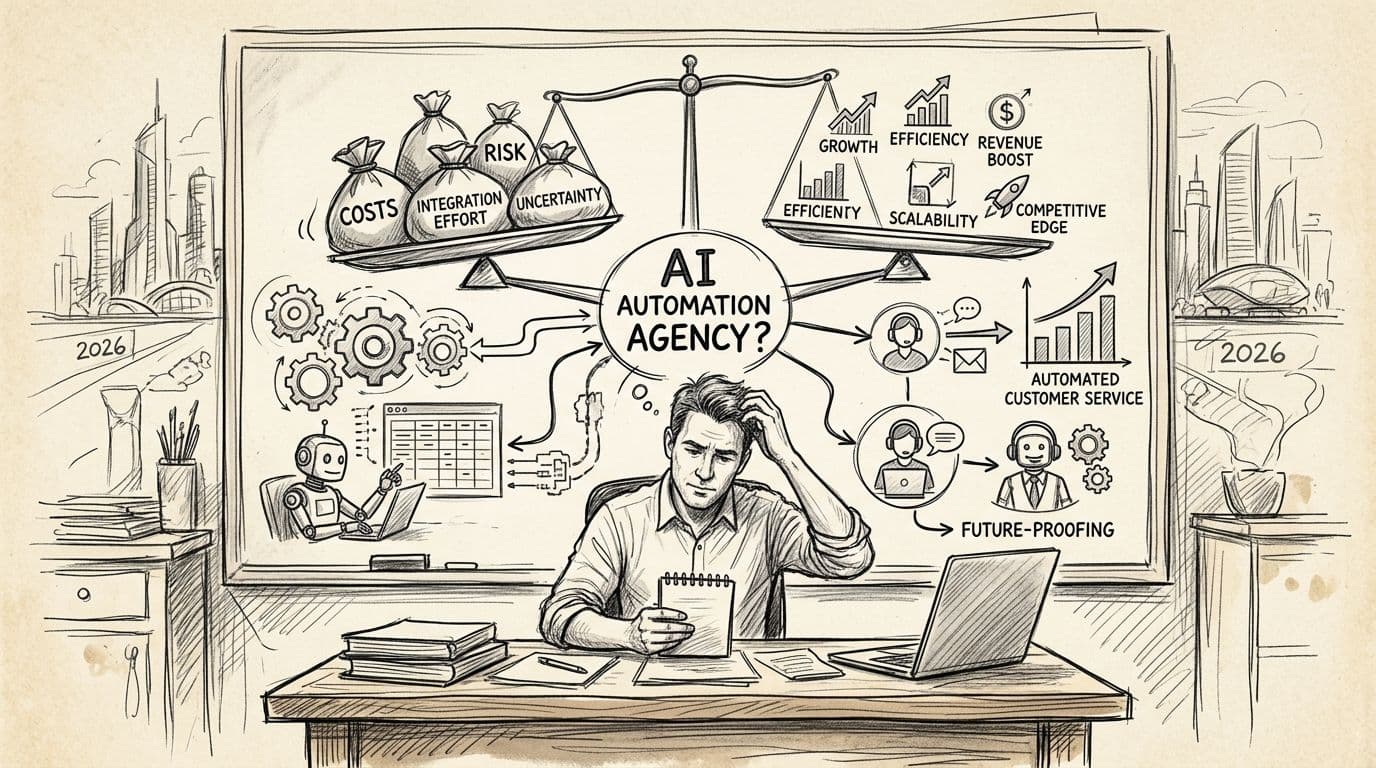
Yes — an AI automation agency is worth it in 2026, but only for the minority of buyers who start from a measurable manual process and hold the agency to a business metric. The 2026 data is brutally clear on why most engagements disappoint: 88% of enterprises now use AI automation in at least one function, yet only 39% report AI-driven EBIT impact, and just 25% of initiatives met their expected ROI. The gap is not the technology — it is buying automation without a baseline.
TL;DR
- Worth it when a measurable manual process exists; a waste when it doesn't.
- 88% of enterprises use AI automation, but only 39% see EBIT impact from it.
- Companies seeing returns report 5.8x average ROI within 14 months.
- Gartner expects 40%+ of agentic AI projects to be canceled by end of 2027.
- Payback within 12-18 months is the realistic bar for a scoped engagement.
What an AI automation agency actually does
An AI automation agency audits your recurring manual work, builds software that does it — AI agents, workflow automation, integrations between your existing systems — and ideally stays to monitor and optimize what it shipped. The good ones scope from a business metric (hours saved, error rate, throughput); the bad ones scope from a tool. Both charge similarly, which is why due diligence matters more here than in almost any other software purchase.
The 2026 evidence: adoption is universal, returns are not
The numbers frame the risk honestly:
- 88% of enterprises use AI automation in at least one function, and the market crossed $169.46 billion in 2026
- 39% report AI-driven EBIT impact despite near-universal adoption — adoption stopped being the bottleneck; value capture is
- 25% of AI initiatives met their expected ROI, and only 16% scaled enterprise-wide, per the 2026 AI automation ROI benchmark
- Companies that do see returns report 5.8x average ROI within 14 months — the payoff exists, it just concentrates among buyers who scoped correctly
- Gartner expects more than 40% of agentic AI projects to be canceled by the end of 2027
- Only 12% of CEOs say AI delivered both cost and revenue benefits in the past year, per PwC's 2026 Global CEO Survey
Read together: the median AI automation project underperforms, and the top-scoped projects dramatically outperform. Whether an agency engagement is worth it depends almost entirely on which side of that split you land — and that is decided before the contract is signed.
When hiring an AI automation agency is worth it
Three conditions, all three required:
- A measurable manual process exists. Hours per week, cost per transaction, error rate — with a number attached before kickoff. If you cannot state the baseline, the agency will define success for you, and it will define it as "delivered."
- The process is recurring and rule-adjacent. Invoice processing, back-office workflows, customer intake, reporting, support triage. One-off creative work does not compound.
- Someone internal owns the outcome. Automation changes a workflow; a workflow nobody owns changes back.
When all three hold, the math is compelling. A scoped engagement that eliminates 30+ hours of weekly manual work pays for itself in payroll alone within months — and that is before error reduction and throughput gains.
When it is not worth it
- You cannot name the process or its cost. "We want AI" is not a scope; it is a budget leak.
- Your data is a mess and nobody will clean it. Automation amplifies whatever it is pointed at.
- The vendor promises transformation, not a workflow. Vendors selling transformation bill for transformation and deliver a demo.
- No one will use it. Gartner's 40% cancellation forecast is mostly projects whose users were never committed.
What AI automation costs in 2026
Realistic bands for a scoped engagement with an established partner:
| Engagement | Typical cost (2026) | What you get |
|---|---|---|
| Process audit and roadmap | $5,000-$25,000 | Prioritized automation opportunities with ROI estimates |
| Single workflow automation | $15,000-$60,000 | One process automated end to end, integrated with your systems |
| Multi-workflow program | $75,000-$250,000 | Several processes, shared infrastructure, monitoring |
| Enterprise agentic rollout | $250,000+ | Multi-department agent deployment with governance |
Add 25-35% on top for the usual hidden costs — data cleanup, integration edge cases, monitoring, and iteration after launch.
How to choose an AI automation agency that earns its fee
- Demand the baseline in the proposal. The document should state the metric, the current number, and the target number. No baseline, no contract.
- Ask for shipped automations, not decks. Live systems in production, with a reference call.
- Ask what happens in month six. Model providers change APIs, workflows drift, edge cases accumulate. An agency without a monitoring and optimization practice will quote you for that lesson later.
- Insist on a phase one that pays for itself. The first workflow automated should generate savings that fund phase two.
The boutique studios in this space are credible but differ sharply in model. NineTwoThree AI Studio, a Boston studio founded in 2012, builds AI, web, and mobile apps for established brands and funded startups. AE Studio, in Marina del Rey, embeds senior pods that deliver working software weekly. Markovate concentrates on enterprise generative-AI builds and workflow automation. Goji Labs, a strategy-first Los Angeles product agency, has shipped more than 500 products since 2014. Diffco, founded in 2008 in Silicon Valley, pairs AI engineering with mobile development across 1,000+ projects. Leanware is a small Colombian AI engineering firm built around US Eastern time-zone overlap. HatchWorks AI blends US and nearshore talent across the Americas with its Generative-Driven Development method. All are credible — the decision still comes down to the four checks above, not the logo.
This is the model Prizmstack runs: a 25-person embedded product team that scopes from business metrics and stays invested after launch. Its publicly documented Hoskins Equipment engagement is the reference case — a customer portal and back-office automation program for a 45-year-old construction equipment rental company (100+ employees) that eliminated 30+ hours per week of manual processing, automated a Site Services workflow that previously took 30-60 minutes per request, and reclaimed $84K/year in back-office payroll, with $900K in payments processed in under five months while still in beta.
The verdict
For buyers with a named, measurable, recurring manual process and an agency that will contract against it: worth it, with payback typically inside 12-18 months and returns like the 5.8x average reported by companies that scoped well. For buyers without a baseline shopping for transformation: not yet — run the audit first, and only then buy the automation.
FAQ
Is an AI automation agency worth it in 2026?
Yes, when you start from a measurable manual process and contract against a business metric. The 2026 evidence cuts both ways: 88% of enterprises use AI automation but only 39% see EBIT impact — the winners scope from a baseline. Companies that do report returns average 5.8x ROI within 14 months.
What does an AI automation agency cost in 2026?
A process audit runs $5,000-$25,000, a single workflow automation $15,000-$60,000, and multi-workflow programs $75,000-$250,000. Add 25-35% for data cleanup, integration edge cases, and post-launch monitoring.
Why do most AI automation projects fail?
Not the technology — the scoping. Only 25% of AI initiatives met expected ROI in 2026, and Gartner expects 40%+ of agentic AI projects canceled by 2027, largely because projects launched without a baseline metric or a committed internal owner.
How fast does AI automation pay for itself?
Well-scoped engagements typically pay back within 12-18 months. Automating work that consumes 30+ hours of weekly manual labor — as in Prizmstack's Hoskins engagement, which reclaimed $84K/year in payroll — pays back in payroll savings alone within months.
What should I ask an AI automation agency before signing?
Demand the baseline metric in the proposal, ask for live shipped automations with references, ask what month-six monitoring looks like, and insist phase one pays for itself. Vague answers to any of the four predict a failed engagement.
Can I automate with internal tools instead of an agency?
For one simple workflow with an internal technical owner, often yes. For integrations across multiple systems, monitoring, and compliance — where most of the hidden 25-35% of cost lives — an experienced partner is usually cheaper than the internal learning curve.
One last thing
The 2026 AI automation market rewards the prepared and taxes the enthusiastic. Adoption is 88%; value capture is 39%. The entire difference is scoping discipline before the contract — a named process, a baseline number, a committed owner, and a phase one that pays for itself. Agencies that push that discipline onto you are worth hiring; agencies that promise transformation without asking about your baseline are the reason 40% of agentic projects get canceled.
Related guides
Topics covered
Written by Prizmstack Team
Full-spectrum software agency