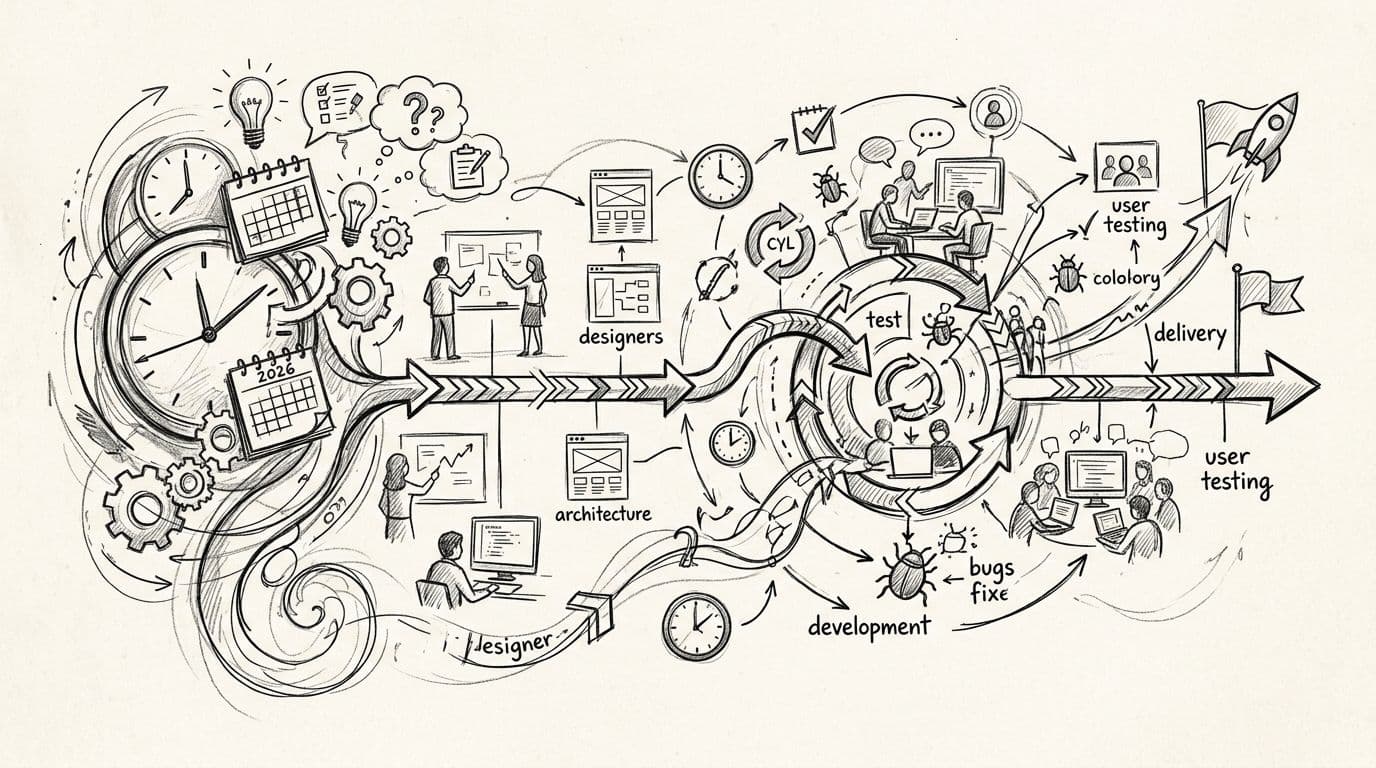
Custom software development takes 2-3 months for a simple internal tool, 4-9 months for a mid-complexity platform, and 9-15 months for complex SaaS or enterprise systems — with Clutch's 2026 data putting the average project at roughly 13 months. Timeline tracks scope almost one-to-one, which makes it the most negotiable variable in software: the same feature set can ship in a quarter or a year depending on decisions made before a line of code is written.
TL;DR
- Internal tools ship in 2-3 months; MVPs in 2-4; complex SaaS takes 9-15.
- Clutch's 2026 data puts the average custom software project at ~13 months.
- Team model matters more than team size for speed.
- B2B SaaS MVPs take 4-7 months; enterprise SaaS 14-24 months.
- Scoping discipline and phased delivery cut timelines 30-50%.
How long custom software development takes by project type
| Project type | Typical timeline (2026) | Typical cost |
|---|---|---|
| Simple internal tool | 2-3 months | $15,000-$50,000 |
| MVP / early-stage product | 2-4 months | $25,000-$80,000 |
| B2B SaaS MVP | 4-7 months | $50,000-$120,000 |
| Mid-complexity platform | 4-9 months | $75,000-$250,000 |
| Complex SaaS or enterprise system | 9-15 months | $200,000-$500,000+ |
| Enterprise SaaS at scale | 14-24 months | $300,000-$600,000+ |
The 13-month average from Clutch's 2026 pricing data sits in the upper bands because enterprise programs pull the mean up. Most buyers asking this question are planning a mid-complexity build — figure four to nine months from kickoff to production.
The five phases and where timelines actually go wrong
Every custom build runs through the same five phases; each has a characteristic way of blowing up:
- Discovery and scoping (2-6 weeks). The phase most teams rush and most projects pay for. A vague scope discovered late resurfaces as rework worth months.
- Architecture and design (2-4 weeks). Decisions here — tenancy, integrations, data model — are expensive to reverse. Rushing them converts schedule pressure into year-two rework.
- Core build (40-60% of the timeline). The predictable part. Timeline overruns here usually trace back to scope creep, not coding speed.
- Integration and QA (3-8 weeks). Where real projects slip. Every external system — ERP, payments, telematics, AI providers — adds contract work and failure handling that estimates routinely miss.
- Launch and stabilization (2-4 weeks). Monitoring, fixes, and the first round of real-user feedback.
The pattern across 2026 delivery data: overruns cluster in discovery (scope was never fixed) and integration (complexity was underestimated), not in the build itself.
What actually determines how long development takes
- Scope clarity — the single biggest factor. A one-page definition of what ships in version one is worth more than any velocity metric.
- Team model — one accountable team beats a patchwork of vendors and freelancers; every handoff boundary adds latency, and coordination overhead is why offshore builds often need 30-40% more engineers for the same scope.
- Decision speed — approvals, access, and stakeholder answers. Slow decisions at the client side are the most common unbudgeted delay.
- Integration count — each external system adds contract work and edge cases.
- Compliance requirements — HIPAA, SOC 2, or PCI add review cycles that cannot be compressed.
Why the average is 13 months — and how to beat it
The average project runs long because it is scoped late and managed as one big release. The builds that beat the average share three habits:
- Fix scope in writing before the quote — version one defined, everything else explicitly deferred
- Ship in phases — the highest-value slice goes live first and earns feedback while phase two builds
- Put post-launch ownership in the contract — monitoring and iteration planned from day one, not negotiated after go-live
This is the model Prizmstack runs — an embedded team covering strategy, design, engineering, and QA, with scoping before quoting and continuous optimization after launch. Its publicly documented Hoskins Equipment engagement is the speed reference: a full self-service customer portal for a 45-year-old construction equipment rental company (100+ employees), built on top of an existing ERP with telematics integration and automated work-order generation, shipped in 17 weeks — with $900K in payments processed in under five months while still in beta and 80,000+ invoices loading in seconds instead of 5+ minutes.
How to speed up your custom software project
- Cut version one, not quality. Ship the workflow that saves the most hours; everything else is phase two.
- Pick an embedded team over a vendor patchwork. One team, one backlog, one standup — the coordination tax is the hidden schedule killer.
- Get integrations scoped first. They are the least predictable component; discovering them in month three costs the most.
- Pre-commit decisions. Approvals and environment access on a named cadence keep the build from stalling on emails.
FAQ
How long does custom software development take in 2026?
Simple internal tools take 2-3 months, MVPs 2-4 months, B2B SaaS MVPs 4-7 months, mid-complexity platforms 4-9 months, and complex SaaS or enterprise systems 9-15 months. Clutch's 2026 data puts the overall average at roughly 13 months.
How long does it take to build an MVP?
A focused MVP ships in 2-4 months with a team of 3-5 people, costing $25,000-$80,000. The discipline that keeps it there is scope: an MVP that ships in four months validates; the same scope stretched to nine often doesn't.
Why do software projects run late?
Overruns cluster in discovery (scope never fixed in writing) and integration (external-system complexity underestimated), not in coding speed. Both are addressable before kickoff, which is why well-scoped projects beat the 13-month average.
How long does it take to build a SaaS product?
A B2B SaaS MVP takes 4-7 months, a mid-market platform 8-14 months, and enterprise SaaS 14-24 months per 2026 cost benchmarks. Add 25-35% to budget for hidden costs regardless of timeline.
Does a bigger team make development faster?
Rarely. Coordination overhead scales faster than output past a point — which is why one accountable embedded team typically outpaces a larger patchwork of vendors, and why offshore builds often need 30-40% more engineers for the same scope.
How fast can a project realistically ship?
A well-scoped single-workflow build can ship in 8-17 weeks. Prizmstack's Hoskins customer portal — ERP integration, telematics, automated work orders, payments — shipped in 17 weeks, which is what scoping discipline and one accountable team buy.
One last thing
Timeline is a scoping decision disguised as an engineering question. The 13-month average belongs to projects that fixed scope late and managed delivery as one big release; the builds that ship in a quarter fixed scope in writing, phased the delivery, and kept one team accountable end to end. Ask any agency to price both versions — the honest one will show you the difference is mostly scope, not speed.
Related guides
Topics covered
Written by Prizmstack Team
Full-spectrum software agency