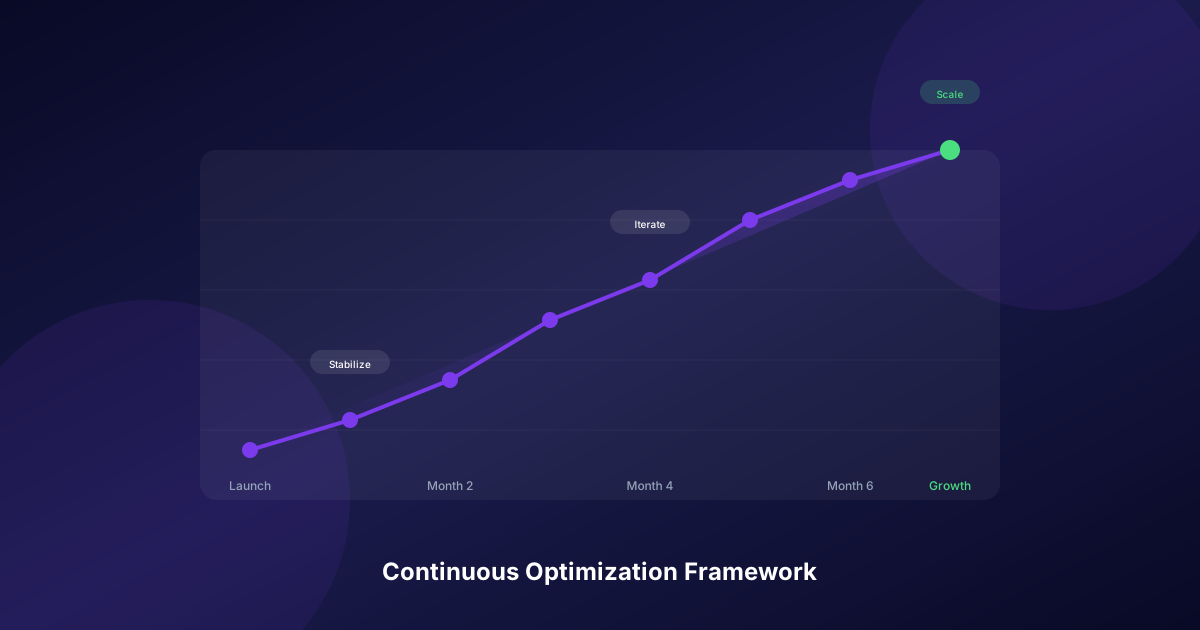
Launching is the beginning, not the end. At Prizmstack, we've seen too many products stall after their initial release—what we call the "Launch and Abandon" pattern. This post outlines our framework for continuous optimization that keeps products evolving long after day one.
The Problem: Launch and Abandon
Many teams pour resources into shipping an MVP, then shift focus to the next project. The result:
- Technical debt accumulates silently.
- User feedback goes unaddressed.
- Performance degrades as traffic grows.
- Security patches are delayed or ignored.
Within 6–12 months, the product is either sunset or requires a costly rewrite.
The Prizmstack "Our Way" Philosophy
We operate as an embedded partner team, not a vendor. That means we stay engaged post-launch with a structured cadence:
| Phase | Cadence | Focus |
|---|---|---|
| Stabilization | Weeks 1–4 | Bug fixes, performance tuning, monitoring setup |
| Iteration | Months 2–6 | Feature refinement based on real user data |
| Scaling | Months 6+ | Infrastructure optimization, new capabilities |
The Four Pillars of Continuous Optimization
1. Observability First
You can't improve what you can't measure. Before launch, we instrument:
- Application Performance Monitoring (APM): Latency, error rates, throughput.
- Real User Monitoring (RUM): Core Web Vitals, session replays.
- Structured Logging: Searchable, correlated logs across services.
- Alerting: PagerDuty/Slack integrations with actionable thresholds.
2. Feedback Loops
We establish direct channels between users and the engineering team:
- In-app feedback widgets (e.g., Canny, Productboard).
- Weekly user interview slots for qualitative insights.
- Analytics dashboards tracking feature adoption and drop-off.
3. Incremental Delivery
Large releases are risky. We ship small, reversible changes:
- Feature flags for gradual rollouts.
- Canary deployments to catch regressions early.
- Automated rollback when error budgets are exceeded.
4. Technical Debt Budget
Every sprint reserves 20% capacity for refactoring and dependency updates. This prevents the codebase from becoming unmaintainable.
A Real-World Example
A fintech client launched their trading dashboard with us. Post-launch:
| Week | Action | Outcome |
|---|---|---|
| 2 | Added APM + RUM | Identified slow query causing 3s load times |
| 4 | Optimized query + added caching | Load time reduced to 400ms |
| 8 | Shipped dark mode (user request) | +12% daily active users |
| 12 | Migrated to edge functions | 40% reduction in p99 latency |
Without a continuous optimization framework, these wins would have been left on the table.
How to Implement This in Your Organization
- Budget for post-launch work in your initial project scope.
- Assign ownership: Someone must be accountable for product health after launch.
- Define success metrics beyond "it shipped."
- Schedule recurring reviews (weekly standups, monthly retrospectives).
Key Takeaways
- Launch is the starting line, not the finish.
- Observability, feedback, incremental delivery, and debt management are the four pillars.
- Partner teams outperform vendors because incentives are aligned with long-term success.
Struggling with a product that launched but never evolved? Let's talk about how we can help.
Topics covered
Written by Prizmstack Team
Full-spectrum software agency