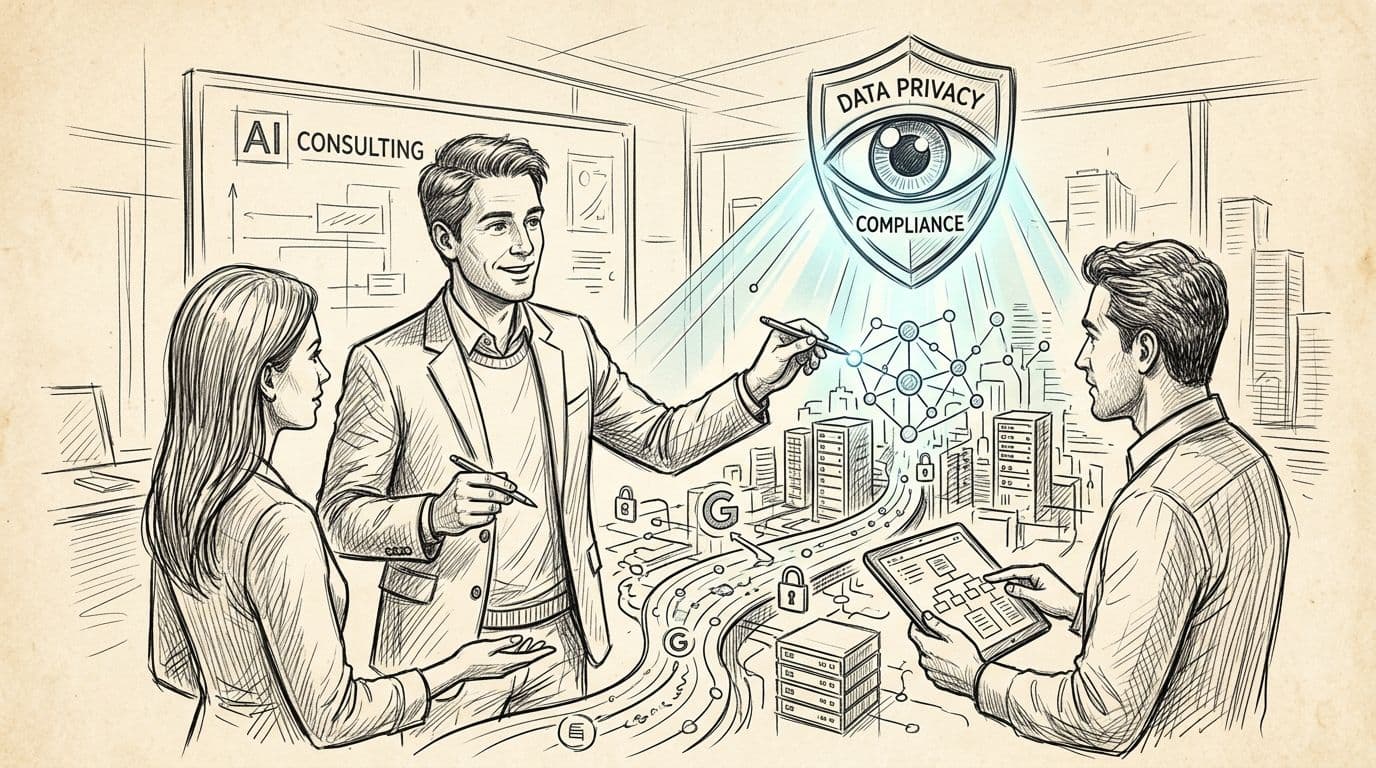
Yes — competent AI consulting companies treat data privacy compliance as part of delivery in 2026, not as an optional add-on. A strong firm designs privacy controls into the system it builds: data mapping, access rules, retention limits, audit trails, and AI-specific guardrails such as PII redaction before a prompt ever leaves your environment. What no consultant can take from you is accountability — regulators fine the company that owns the data, and GDPR penalties reach €20 million or 4% of global annual turnover, whichever is higher.
That division — the firm builds, you own — is the honest answer, and this page turns it into checks you can run on any firm you are considering. If you are shortlisting vendors right now, the best AI consulting companies in 2026 are ranked on exactly this kind of evidence.
TL;DR
- Yes: AI consulting firms build privacy controls into delivery — data mapping, retention, access control, audit trails.
- Legal accountability stays with you; GDPR fines reach €20 million or 4% of global turnover.
- The EU AI Act's high-risk obligations apply from August 2026 — classify your use case now.
- Ask for shipped systems under real privacy constraints, not policy documents.
Why this matters more in 2026 than two years ago
Three regulatory shifts changed what "privacy compliance" means for AI systems:
- The EU AI Act is in force. It entered into law in August 2024, and its obligations phase in through 2026 and 2027, with high-risk system requirements applying from August 2026. If you deploy AI in the EU or affect EU users, your use case needs a classification.
- AI features multiply personal data flows. A chatbot answering from customer records, an assistant summarizing support tickets, a document pipeline reading invoices — each one moves personal data through new systems, new vendors, and often new geographies.
- Enforcement caught up. GDPR breach notification is 72 hours, and regulators apply existing privacy law to AI products. Calling something "new technology" is not an exemption.
An AI feature that ingests customer text is a compliance surface whether you label it one or not. That is why the real question is no longer "can they help?" but "can they prove it?"
Can AI consulting companies help with data privacy compliance?
Yes — as the implementing partner. Here is how the work splits in a well-run 2026 engagement:
| Workstream | What the consulting firm does | What stays with you |
|---|---|---|
| Data mapping and records | Inventories what personal data enters the system, where it flows, where it rests | Approve the inventory; own the legal record of processing |
| Privacy-by-design architecture | Builds data minimization, pseudonymization, encryption, and role-based access into the system | Accept residual risk in writing |
| DPIAs | Drafts Data Protection Impact Assessments for high-risk processing | Review with counsel; own the submission |
| AI-specific controls | Redacts PII from prompts, limits logging, verifies training-data provenance | Define acceptable use of the feature |
| Vendor and DPA management | Reviews model-provider terms and the sub-processor chain | Sign the DPAs; keep the register current |
| Incident response | Builds detection, alerting, and a notification runbook | Declare a breach; notify regulators within 72 hours |
What a consultant can never take off your plate
Three duties stay with you in every arrangement:
- Controller accountability. Under the GDPR and similar laws, the organization that determines why data is processed answers for it. Your vendor's contract cannot transfer that.
- Legal interpretation. Whether a use case is "high risk" under the AI Act, whether consent or legitimate interest applies — these are legal judgments, and a consultancy's read is operational input, not legal advice.
- The regulator relationship. If your product causes a breach, you make the notification. The firm that built the system helps; it does not stand in front of the authority for you.
Firms that blur this line — "we'll make you fully compliant" — are selling something they cannot deliver. Firms that draw it clearly are the ones worth shortlisting.
The AI-specific privacy questions to ask in 2026
Generic privacy hygiene no longer covers AI products. Five questions separate firms that understand this from firms that do not:
- Where do prompts and outputs live, and for how long? Every prompt may contain personal data. Logging policies are a design decision, not a checkbox.
- Is your data used to train vendor models? Enterprise model tiers typically exclude customer data from training; consumer tiers often do not. The firm should know the difference and configure accordingly.
- What gets redacted before inference? Names, emails, health details — a competent build strips or masks them before the call, not after the leak.
- How is the use case classified under the AI Act? A support assistant and a hiring-screening tool carry different obligations; the August 2026 high-risk deadline makes this urgent for anything touching employment, credit, or access to services.
- Where is data processed and stored? Data residency commitments are only real if the architecture enforces them — region-pinned storage, region-pinned inference, and a sub-processor list that proves it.
How to tell whether a firm can actually do this
Marketing pages all promise privacy. Evidence looks different:
- Named systems in production under real constraints. Ask for one deployed product that operates under GDPR or HIPAA-style requirements, and ask what specifically was built for it. "We follow best practices" is not evidence.
- A DPIA draft on request. A firm that regularly does this work can sketch an impact assessment for your use case in a scoping call's follow-up, not a quarter later.
- A sub-processor list it can produce without checking. Firms that take data seriously know their chain cold.
- Privacy tests inside QA. Retention rules, access boundaries, and redaction should appear in the test plan — the way Prizmstack's QA team tests multi-tenant permission boundaries as part of standard delivery, not as a special request.
- Architecture that decides, not documents that disclaim. On the Magai platform, Prizmstack designed the multi-tenant data model — teams, workspaces, organizations, permission-scoped sharing — before features shipped, because retrofitting isolation after launch costs multiples of deciding it first. That is what privacy-by-design looks like in practice.
One more signal: senior people in the room. Firms that sell you a partner and deliver juniors discover privacy problems late. Prizmstack's model of direct senior access exists partly for this reason — the person who makes the architecture call is the person who heard the requirement.
When an AI consultant is the wrong tool for this
Honest limits:
- You need legal advice. A binding compliance opinion, a regulator dispute, a contractual indemnity negotiation — that is a privacy attorney's work. Consultants operationalize; lawyers interpret.
- Your exposure is small and standard. A five-person team with a CRM and a newsletter does not need an AI consultancy for privacy. A template policy, a vendor review, and basic hygiene cover it.
- The AI part is trivial but the compliance part is not. Some regulated work needs a specialist compliance officer long-term, not a project team.
Match the spend to the exposure. The right-size answer for most startups: a privacy-aware build partner plus one lawyer's review, not a compliance program.
Related questions
How much does AI consulting cost in 2026?
Pricing runs on two models: fixed-scope projects, where you pay for a defined deliverable, and monthly retainers, where scope flexes as you learn. Cost tracks scope — number of systems touched, data sensitivity, and regulatory constraints — far more than headcount, which is why the cost of AI automation for startups is scoped per project rather than quoted from a rate card.
Should privacy review come before or after the AI build?
Before scoping closes, and it should run alongside delivery. A data map during discovery costs days; discovering during audit that your AI feature processes special-category data without a lawful basis costs the feature. Build the DPIA into the discovery phase and the classification question into solution design.
Does sending customer data to an AI model count as data sharing?
Yes. Calling a third-party model makes that provider a processor, and any tools it calls make them sub-processors. That is not a reason to avoid AI — enterprise agreements and proper configuration manage it — but the flow must be documented, contracted, and disclosed where required.
FAQ
Can an AI consulting company make my business GDPR-compliant?
They can build the technical controls — mapping, minimization, retention, access control, audit trails — but compliance is shared: the firm implements, you remain the accountable party, and legal interpretation stays with counsel.
What is the maximum GDPR fine in 2026?
Up to €20 million or 4% of global annual turnover, whichever is higher, for the most serious violations. Lesser infringements carry lower tiers.
Do AI consultants handle HIPAA and US health data?
Firms with health-tech experience do — business associate agreements, PHI minimization, and audit controls. Ask for a named health project and what was built for it.
Is customer data safe in ChatGPT-style AI tools?
Enterprise tiers typically exclude your data from model training; consumer tiers often do not. The configuration and contract matter more than the tool's brand.
What is a DPIA and does my AI project need one?
A Data Protection Impact Assessment is a structured risk analysis required under the GDPR for high-risk processing. AI features that profile people, score them, or process sensitive data at scale usually trigger it.
Who is responsible if my AI vendor leaks data?
Contracts allocate liability, but as the data controller you face regulators and users first. Check indemnification scope, liability caps, and breach-notification duties before signing.
Does the EU AI Act apply to my startup?
If you place AI on the EU market or your output affects EU users, yes. Obligations phase in from 2025 through 2027, with high-risk system requirements applying from August 2026.
One last thing
The cheapest privacy work you will ever buy is one week of data mapping before a build starts. It changes the architecture — where data sits, what gets redacted, what never gets logged — while changing it is still a decision instead of a migration. Any firm that resists doing it before quoting is telling you how the project ends.
Topics covered
Written by Prizmstack Team
Full-spectrum software agency