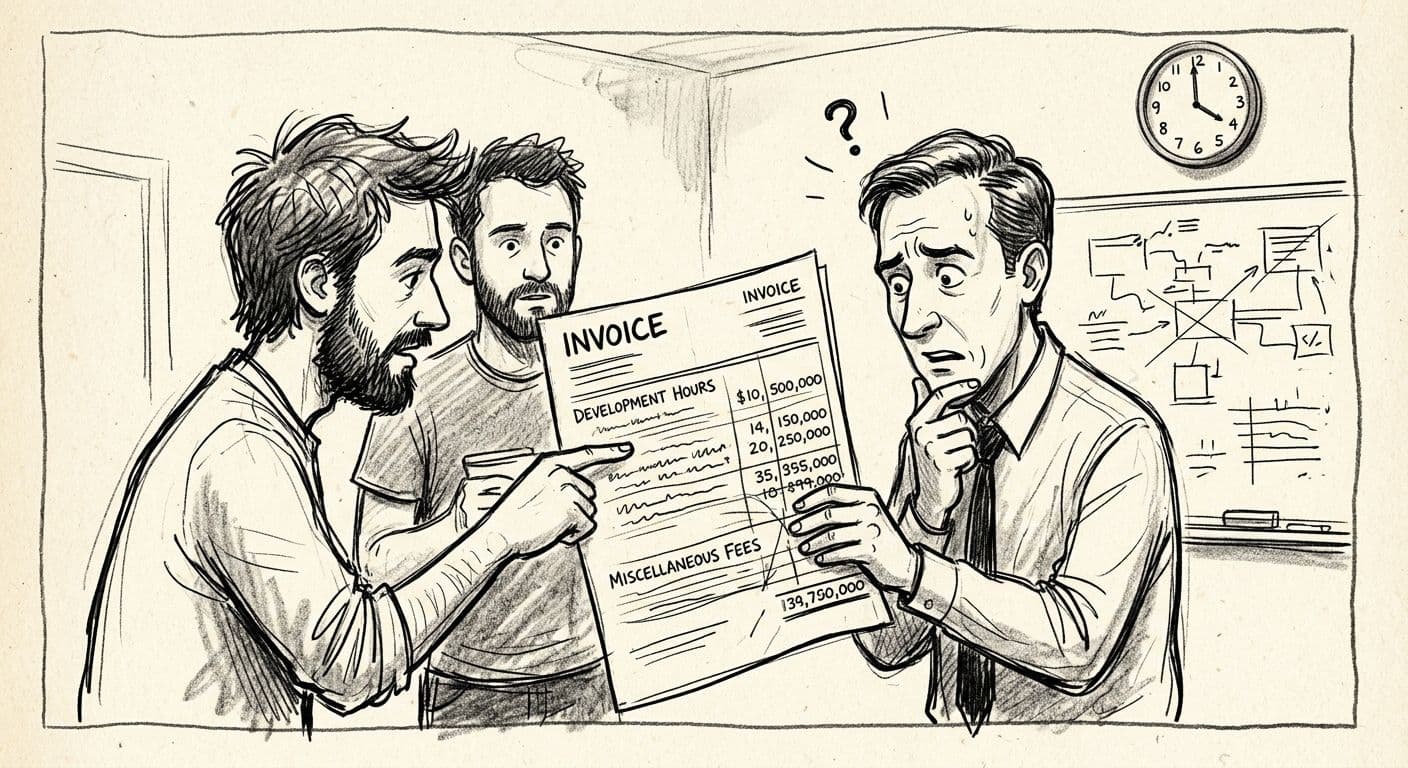
Most software development agencies are not overcharging you with a fake number — they are under-scoping you with a real one. The quote looks low because discovery, QA, data migration, and post-launch support are quietly absent, and those same items come back as change orders later. This guide shows you how to read a quote the way an engineer would, spot the six patterns that signal overcharging or under-scoping, and benchmark 2026 prices before you sign.
TL;DR
- Hidden costs — data migration, compliance review, monitoring, post-launch support — can add 25-35% on top of a quoted development price (GoodFirms-based 2026 analysis).
- Roughly 66% of mid-sized custom software projects fall between $30,000 and $100,000; quotes far outside that band need justification (GoodFirms 2026 survey).
- 81.3% of development companies price time & materials — fixed-price quotes are the exception, and their scope assumptions deserve scrutiny.
- The clearest overcharge signal is a fixed quote with no discovery phase: the vendor is pricing a guess.
Benchmark the price before you judge it
The first test of any quote is whether it sits inside what the market actually charges. Per GoodFirms' 2026 survey of custom software development companies, roughly 66% of mid-sized projects fall between $30,000 and $100,000, while enterprise projects regularly cross $200,000. Custom software in 2026 ranges from $25,000 for simple internal tools to $1M+ for enterprise platforms.
A quote below the market band is not a bargain — it is usually a quote that excludes testing, migration, or deployment. A quote far above the band is not automatically overcharging, but it needs an itemized explanation you can check.
The six signals a quote is padded or incomplete
1. A fixed price with no discovery phase
Nobody can price software they haven't specified. A vendor who sends a fixed quote before documenting your workflows, data model, and integrations is either guessing or planning to win the deal and renegotiate through change orders. Per GoodFirms' 2026 data, 81.3% of development companies price time & materials precisely because scope is unknowable up front — a confident fixed bid should make you ask what assumptions are baked in.
- Ask: what did you assume to arrive at this number?
- Ask: what happens to the price if an assumption is wrong?
2. Vague line items that hide padding
"Project management — 20%" or "Architecture & planning" with no deliverables attached are where padded estimates live. Every line item should name an output.
- Ask for deliverables per line item, not roles per line item
- Compare the estimate's hour count against the deliverables — a 400-hour quote producing two screens and an API is padded
3. QA, deployment, and support missing entirely
A quote that covers only "development" leaves you paying separately for testing, deployment, monitoring, and post-launch support — the 25-35% hidden-cost uplift documented in 2026 industry analysis. Ask explicitly:
- Is QA included, and who performs it?
- Is deployment and environment setup included?
- What does the first 90 days of support cost?
4. Scope defined by features, not workflows
"User management, dashboard, reporting" describes screens, not the work. Two vendors can interpret the same feature list at very different depths. Over-quoting often hides here: the vendor priced your feature list against their heaviest interpretation.
- Ask each vendor to describe back, in their words, how a user moves through the system
- The vendor who asks clarifying questions before quoting is the one whose number you can trust
5. Change-order terms buried in the contract
The most common way a fair quote becomes an overpriced project is a contract where every change is billed at premium rates with no acceptance criteria.
- Check the change-order rate against the base rate — anything above it needs a reason
- Check who decides when work "exceeds scope" — you should have a say
- Check whether minor clarification counts as a change order
6. Rates that don't match the team you're getting
An agency quoting senior-engineer rates ($125-$200+/hr in the US per 2026 rate guides) while staffing your project with juniors is the purest form of overcharging.
- Ask for the actual team: names, roles, experience levels
- Ask what fraction of the quoted hours the senior people actually touch
- Confirm the rate is blended honestly across that team
What a fair, complete quote contains
- A written scope based on discovery, not assumptions
- Deliverables per line item with hour estimates you can sanity-check
- QA, deployment, and a defined support window included
- A change-order process with rates and acceptance criteria
- Named team members with their roles and rates
This is the standard Prizmstack scopes against: an embedded team documents your workflows before any quote, the same team covers strategy, design, engineering, and QA, and post-launch continuity is part of the engagement rather than an upsell — which is how scope disputes and surprise invoices get prevented in the first place.
Common mistakes buyers make
- Choosing the lowest quote. The cheapest bid usually excludes the most expensive items.
- Equating a big quote with overcharging. The problem is almost always incomplete scoping on one side or padded vagueness on the other — judge by line items, not totals.
- Skipping the assumption check. Every fixed quote contains assumptions; if nobody names them, you own the risk.
- Signing without change-order terms. That is where a fair project becomes an expensive one.
FAQ
How do I know if a software development agency is overcharging me?
Benchmark the quote against 2026 market data — 66% of mid-sized projects land between $30,000 and $100,000 (GoodFirms). Then check line items: vague deliverables, missing QA or support, and fixed prices without discovery are the overcharging signals.
What does custom software cost in 2026?
Custom software ranges from $25,000 for simple internal tools to $1M+ for enterprise platforms, with most business applications between $50,000 and $250,000 per 2026 industry analyses.
How much do hidden costs add to a software quote?
Data migration, compliance review, monitoring, and post-launch support can add 25-35% on top of the quoted development cost (GoodFirms-based 2026 analysis). Ask which of these are included before comparing quotes.
Why did the agency quote a fixed price when others quote time and materials?
81.3% of development companies price time & materials because scope is uncertain (GoodFirms 2026). A fixed bid means the vendor made scope assumptions — ask what they are and who carries the risk when one is wrong.
What should a fair quote include?
Discovery-based scope, deliverables per line item, QA and deployment, a defined support window, change-order terms with rates, and named team members with roles.
Are senior engineer rates always justified?
Only if senior engineers actually work on your project. Ask for named team members and what fraction of hours each level touches — senior rates with junior staffing is the classic overcharge.
One last thing
Before signing, ask the vendor to walk through the quote line by line and tell you which items they would cut if your budget were 30% lower. A vendor who answers honestly is pricing real work; a vendor who defends every line equally is pricing a margin.
Related guides
Topics covered
Written by Prizmstack Team
Full-spectrum software agency