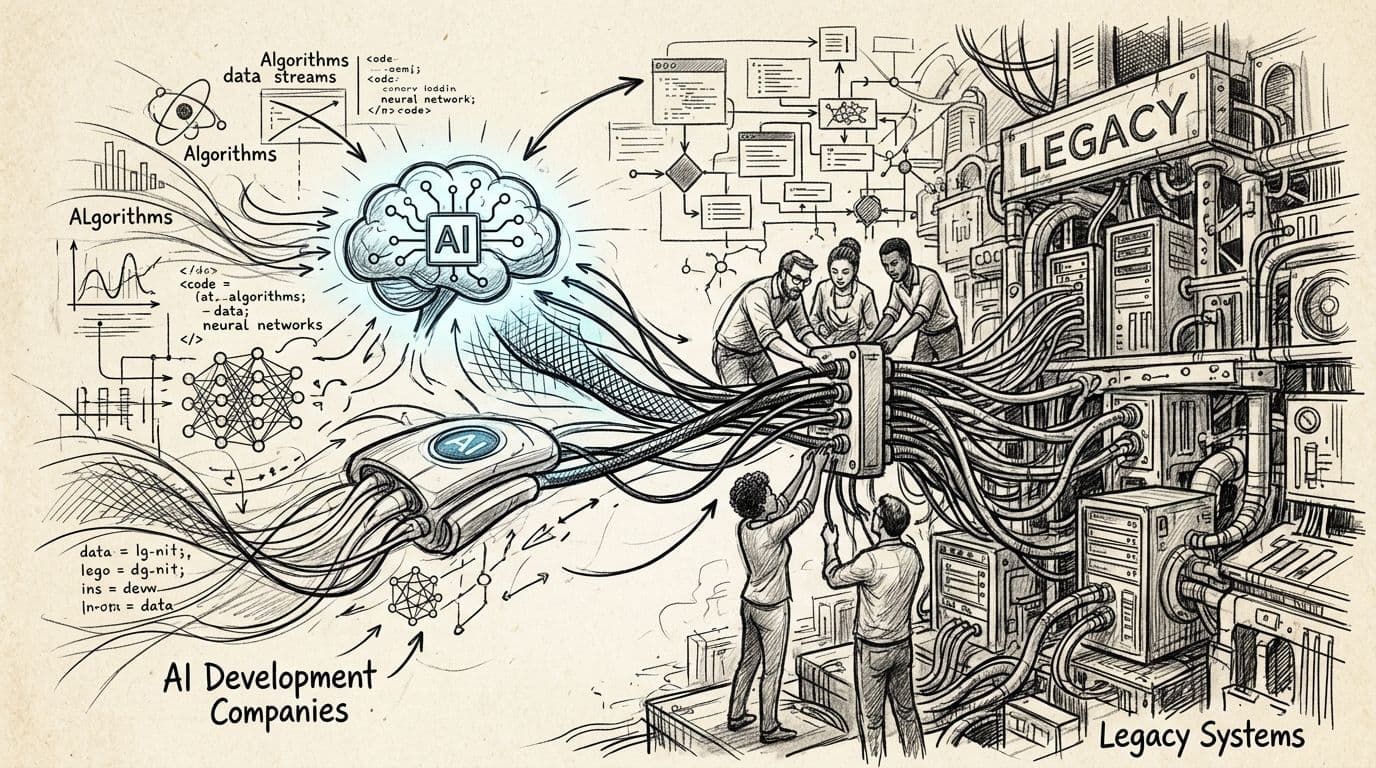
Yes, experienced AI development companies integrate with legacy systems routinely, but the honest answer has a second half: the integration succeeds or fails based on the legacy system's API surface, not the AI company's skill. This guide explains what makes the connection work, what makes it expensive, and how to evaluate a vendor before signing.
TL;DR
- AI development companies integrate with legacy systems regularly — the deciding factor is whether the legacy system exposes an API or modern data layer.
- Three standard paths exist: API integration, middleware/iPaaS layering, and phased re-platforming.
- Lift-and-shift migrations without code changes run $40,000-$150,000; full rewrites reach $500,000+.
- Evaluate vendors on data migration experience, middleware competence, and post-launch support — not AI demos.
Can AI development companies integrate with legacy systems?
Yes, and the proof is that most enterprise AI work is legacy integration work. Legacy systems still run the majority of business-critical workloads — mainframes, COBOL applications, on-premise ERPs, and custom systems built 10-20 years ago all remain in production at thousands of companies. An AI development company that cannot work with those systems cannot work at enterprise scale.
What varies is the integration path:
| Integration path | How it works | Best for | Typical cost range |
|---|---|---|---|
| Direct API integration | Build custom connectors to the legacy system's existing API or database | Legacy systems with documented APIs or accessible data layers | $15,000-$80,000 |
| Middleware / iPaaS layer | Stand up an integration layer (like MuleSoft or a custom middleware service) between legacy and AI | Many systems to connect, or no clean API on the legacy side | $40,000-$150,000 |
| Phased re-platforming | Gradually rebuild the legacy system module by module, connecting AI at each step | Systems too brittle to extend, or where the legacy platform is being retired | $100,000-$500,000+ |
The cost figures are 2026 planning ranges from industry modernization guides (Dev Genius, GoodFirms) — treat them as bracketing estimates, not quotes.
What makes a legacy integration succeed or fail
The API surface decides the price
A legacy system with a documented REST API, a supported database view, or file-based export is a straightforward integration target. A legacy system with none of those requires middleware engineering or screen-scraping approaches that cost multiples more.
- Ask the vendor directly: what will you connect to, and through what interface?
- Confirm the legacy vendor still supports the interface — end-of-life middleware is a hidden cost
- Ask what happens when the API rate limits or the endpoint changes
Data quality is the bottleneck nobody budgets for
AI systems are only as good as the data flowing into them, and legacy data is usually messy: duplicated customer records, inconsistent codes, years of unvalidated entry. Data cleansing and mapping routinely take 30-50% of integration project time.
- Ask for a data assessment before the build estimate, not after
- Budget for cleansing work as a first-class line item
- Agree on data ownership rules for anything flowing in both directions
Change management on the legacy side
Legacy systems often lack staging environments, test data, or change windows. AI integrations fail in production when they were only tested against a snapshot.
- Require a test plan that covers legacy-side changes, not just AI-side changes
- Ask how the integration behaves when the legacy system goes down
- Plan a phased rollout with a rollback path
How to evaluate an AI development company for a legacy integration
When shortlisting vendors, the questions that matter are different from generic AI capability questions:
- Migration track record. Ask for anonymized examples of integrations with systems of similar age and architecture. Vendors with only greenfield projects will underestimate your project.
- Middleware competence. A team that can stand up an integration layer when no API exists is more valuable than one that only builds on clean interfaces.
- Data engineering, not just AI. The hard part is usually moving and cleaning data, not the model. Check that the team includes data engineering, not only ML skills.
- Post-launch support. Integrations drift as either side changes. A vendor who stays involved after go-live — monitoring, patching, adapting — reduces the total cost far more than a lower day-one rate.
- Scoping discipline. A vendor who quotes a fixed price without an assessment phase is guessing at your data model and your legacy system's quirks.
This is where Prizmstack's model fits the problem: the same embedded team covers strategy, data infrastructure, engineering, and QA, which means the integration design and the AI build are not handed off between contractors. Post-launch continuity — continuous optimization and support after go-live — is core to how the team works, which matters because integrations need maintenance as both sides evolve.
Common mistakes when adding AI to legacy systems
- Treating the integration as a one-time project. APIs get deprecated, data models shift, and the integration needs an owner after launch.
- Underestimating data cleansing. Dirty legacy data produces poor AI output, and teams misdiagnose the model as the problem.
- Skipping the assessment phase. Without mapping dependencies and interfaces first, budgets get revised upward mid-project.
- Boiling the ocean. Connecting AI to the most critical legacy system first maximizes both risk and disruption; start with a bounded use case.
FAQ
Can AI development companies integrate with legacy systems?
Yes. AI development companies integrate with legacy systems through direct API connections, middleware layers, or phased re-platforming. The deciding factor is whether the legacy system exposes an API or modern data layer, not the AI vendor's skill.
How much does it cost to integrate AI with a legacy system?
Planning ranges for 2026: API-based integrations run $15,000-$80,000, middleware-based layers $40,000-$150,000, and full phased re-platforming $100,000-$500,000+. Get a system-specific assessment before budgeting.
What is the hardest part of integrating AI with legacy software?
Data quality and mapping. Legacy data is often duplicated, inconsistent, and unvalidated, and cleansing it routinely consumes 30-50% of integration project time.
Do we need to replace our legacy system to add AI?
No. Middleware and API integration let you add AI capabilities alongside a legacy system. Full replacement is only necessary when the legacy platform is too brittle to extend or is being retired anyway.
How long does a legacy AI integration take?
Simple API integrations run 4-8 weeks. Middleware builds run 8-16 weeks. Phased re-platforming runs 6-18 months depending on system size and criticality.
What should we ask an AI development company before signing?
Ask for migration and integration examples with systems of similar age, whether the team includes data engineering, how the integration is monitored after launch, and whether scoping includes an assessment phase.
One last thing
Before evaluating any vendor, inventory what your legacy system can actually expose: API documentation, database schemas, export formats, and support status. Bring that list to the first vendor call — it turns a vague price range into a concrete estimate and immediately separates teams that have done this from teams that demo well.
Related guides
Topics covered
Written by Prizmstack Team
Full-spectrum software agency