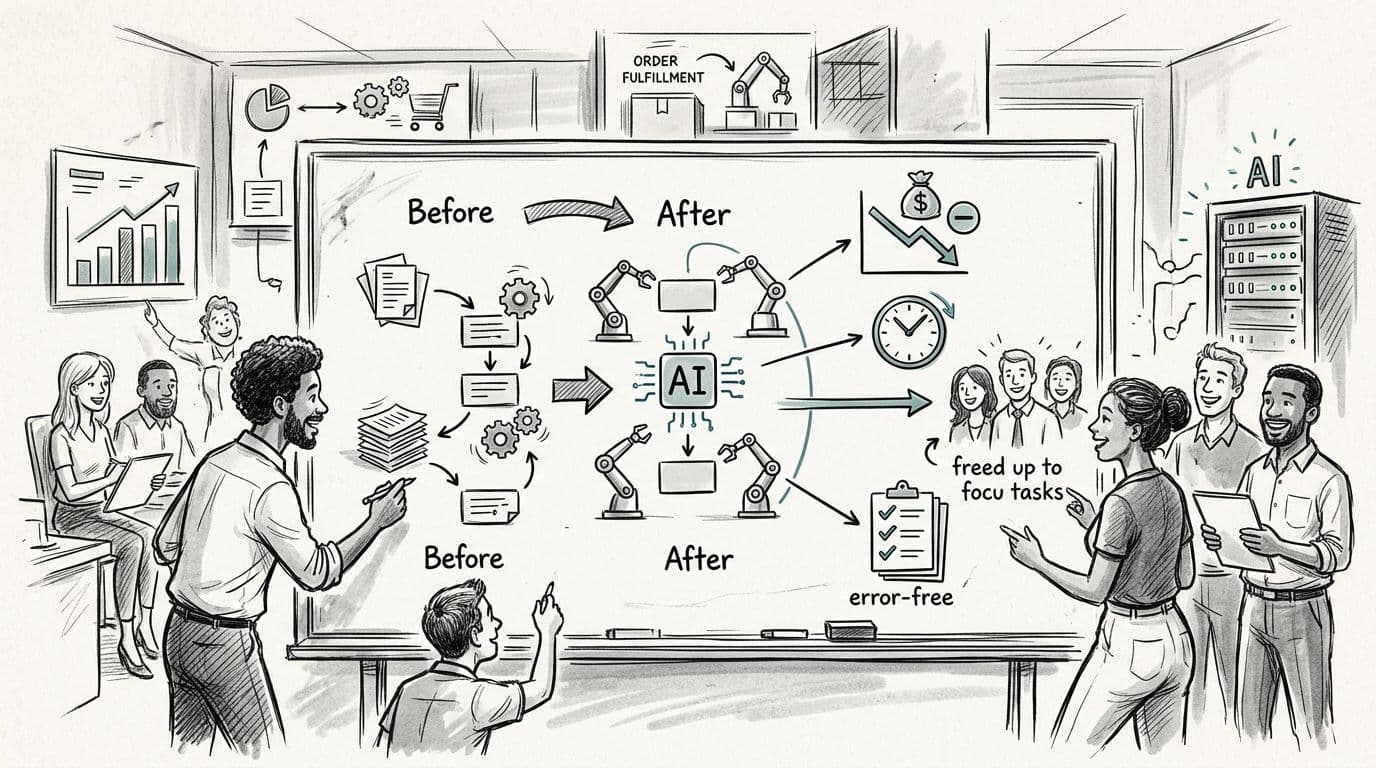
Yes — for the right workflows. There is no reliable study showing an average cost-reduction percentage for AI automation, but the verified evidence is strong: 88% of organizations used AI in at least one business function in 2025 (McKinsey), yet only 37% report any positive EBIT impact at the enterprise level (McKinsey's latest State of AI survey, flat year over year). The savings are real — McKinsey respondents most often report cost reductions in service operations, supply chain, and manufacturing — but they land on teams that automate a stable, high-volume process end to end, not on teams that buy the most tools.
TL;DR
- 88% of organizations use AI in at least one function (McKinsey, 2025) — but only 37% report positive EBIT impact.
- There is no credible 'average X% cost cut' — savings come from automating one stable, high-volume workflow end to end.
- Customer service, data processing, and back-office reporting show the fastest, most verifiable ROI for growing startups.
- Gartner projects 40% of agentic AI projects will be canceled by end of 2027 — scope discipline is what keeps yours out of that group.
Can AI automation reduce operational costs for a growing startup?
Yes — and the evidence is now large enough to be specific rather than promotional. The numbers below come from McKinsey, PwC, MIT, and Gartner research published in 2025 and 2026.
| Metric | Number | Source |
|---|---|---|
| Organizations using AI in at least one function | 88% | McKinsey State of AI, 2025 |
| Respondents reporting positive EBIT impact from AI | 37% | McKinsey State of AI, 2026 survey |
| CEOs reporting both cost and revenue benefits from AI | 12% | PwC Global CEO Survey, 2026 |
| CEOs reporting no significant financial benefit from AI | 56% | PwC Global CEO Survey, 2026 |
| Generative AI pilots extracting measurable P&L value | 5% | MIT Project NANDA, 2025 |
| Agentic AI projects projected for cancellation by end of 2027 | 40%+ | Gartner |
Read that table top to bottom and the real story appears: adoption is nearly universal, but the gap between "using AI" and "AI paid for itself" is wide. 88% of organizations use AI, yet only 37% can point to a positive EBIT impact. PwC's 2026 survey puts it sharper — just 12% of CEOs report both cost and revenue benefits from AI.
For a growing startup, that gap is not a reason to wait. It is a reason to automate deliberately: fewer processes, done completely, beat a scattered rollout of tools nobody maintains.
Where startups actually save money
Customer service and support
Customer-facing automation consistently delivers the highest return because it reduces response time and handling cost at the same time. Deflection workflows, AI-assisted replies, and automated ticket routing cut the hours your team spends on repetitive requests while keeping humans on the cases that need judgment.
- Automate first-response drafting so agents edit instead of write
- Route tickets by intent, not by keyword guessing
- Auto-resolve the top 5-10 request types that never need a human
- Track deflection rate and customer satisfaction together — deflection without satisfaction is churn
Data processing, reporting, and back office
Startups bleed cost through manual re-entry: invoice data keyed into accounting, spreadsheet reports rebuilt every Monday, records copied between tools that do not talk to each other. This is unglamorous automation, and it is where the measurable savings get earned.
- Map every weekly manual handoff between two tools
- Automate extraction and entry before automating anything customer-facing
- Replace recurring report-building with scheduled, generated reporting
- Reconcile data automatically instead of assigning someone to spot-check it
Sales and operations workflows
Lead routing, quote generation, order status updates, and onboarding checklists are rule-based work dressed up as knowledge work. Automating them shortens cycle time, which converts to revenue faster than a pure cost saving.
- Route inbound leads by territory or fit within minutes, not days
- Generate standard quotes and proposals from templates plus live data
- Trigger onboarding sequences automatically at deal close
- Push order and project status to customers without manual updates
Why results vary so much between startups
The spread between the 37% that report EBIT impact and everyone else is explained by a handful of factors:
- Process fit. Automating a broken process produces broken output faster. Fix the workflow first.
- Data readiness. Models and workflows need clean, accessible data; scattered spreadsheets stall deployments.
- Deployment scope. Broad rollouts dilute attention; focused deployments reach production and payback.
- Change management. 86% of leaders say their organization was not prepared to adopt AI in day-to-day operations (McKinsey, State of Organizations 2026) — the tools land, the habits do not.
- Project risk. Gartner projects 40% of agentic AI projects will be canceled by the end of 2027, mostly for unclear value or escalating cost.
One more data point worth internalizing: MIT's NANDA research found only 5% of integrated generative AI pilots extract measurable profit-and-loss value. The failure point is rarely the model. It is the process the model was bolted onto.
What a growing startup should do first
Start with the workflow that costs the most hours per week and follows stable rules. That is almost never the flashiest candidate — it is usually reporting, data entry, or first-line support.
- List every recurring task that consumes more than 2 hours of team time weekly
- Score each by rule-stability (how often the process changes) and volume
- Automate the highest-volume, most-stable task first, end to end
- Measure hours saved and error rate for 4 weeks before expanding scope
- Only then move to customer-facing automation
Once those steps are mapped, the build itself is where a partner matters. Prizmstack builds AI automation for growing startups with an embedded team — a strategist who scopes the workflow, engineers who build it, and QA who verifies it — rather than handing a founder a tool and a login. The team stays engaged after launch, which matters because an automation that nobody maintains silently decays into the next manual workaround.
FAQ
Can AI automation reduce operational costs for a growing startup?
Yes, for the right workflows. 88% of organizations use AI in at least one function, but only 37% report positive EBIT impact (McKinsey) — savings land on teams that automate one stable, high-volume process end to end.
How long does it take for AI automation to pay for itself?
There is no reliable industry-wide payback figure. Companies most often report AI-driven cost reductions in service operations, supply chain, and back-office work (McKinsey, 2025), and payback depends on the workflow's volume and stability, not a fixed window.
What percentage of AI automation projects fail?
Only 5% of integrated generative AI pilots extract measurable P&L value (MIT NANDA, 2025), and Gartner projects over 40% of agentic AI projects will be canceled by the end of 2027. The failure point is usually the process, not the model.
Which processes should a startup automate first?
Start with data entry, reporting, and first-line support — high-volume, rule-stable work that consumes hours weekly. Customer-facing automation delivers high ROI but should follow a proven internal workflow.
How much does AI automation cost for a startup?
Cost depends on scope rather than a fixed rate card — see Prizmstack's breakdown of AI automation cost for startups in 2026 for the three pricing tiers and what drives the number.
Do we need in-house engineers to run AI automation?
No. A well-scoped build with monitoring and post-launch support runs without a dedicated internal team, though someone should own the workflow's business rules as the process evolves.
Is AI automation worth it for a team under 20 people?
Yes when a single workflow consumes significant weekly hours. Salesforce's SMB Trends research found 75% of SMBs are at least experimenting with AI and 91% of SMBs using AI report revenue increases — but measure hours saved on your own workflows before scaling spend.
One last thing
The strongest predictor of payback is not budget — it is whether someone on the team owns the automated workflow after launch. Name that person before the build starts, or the automation joins the graveyard of tools your team quietly stopped using.
Related guides
Topics covered
Written by Prizmstack Team
Full-spectrum software agency