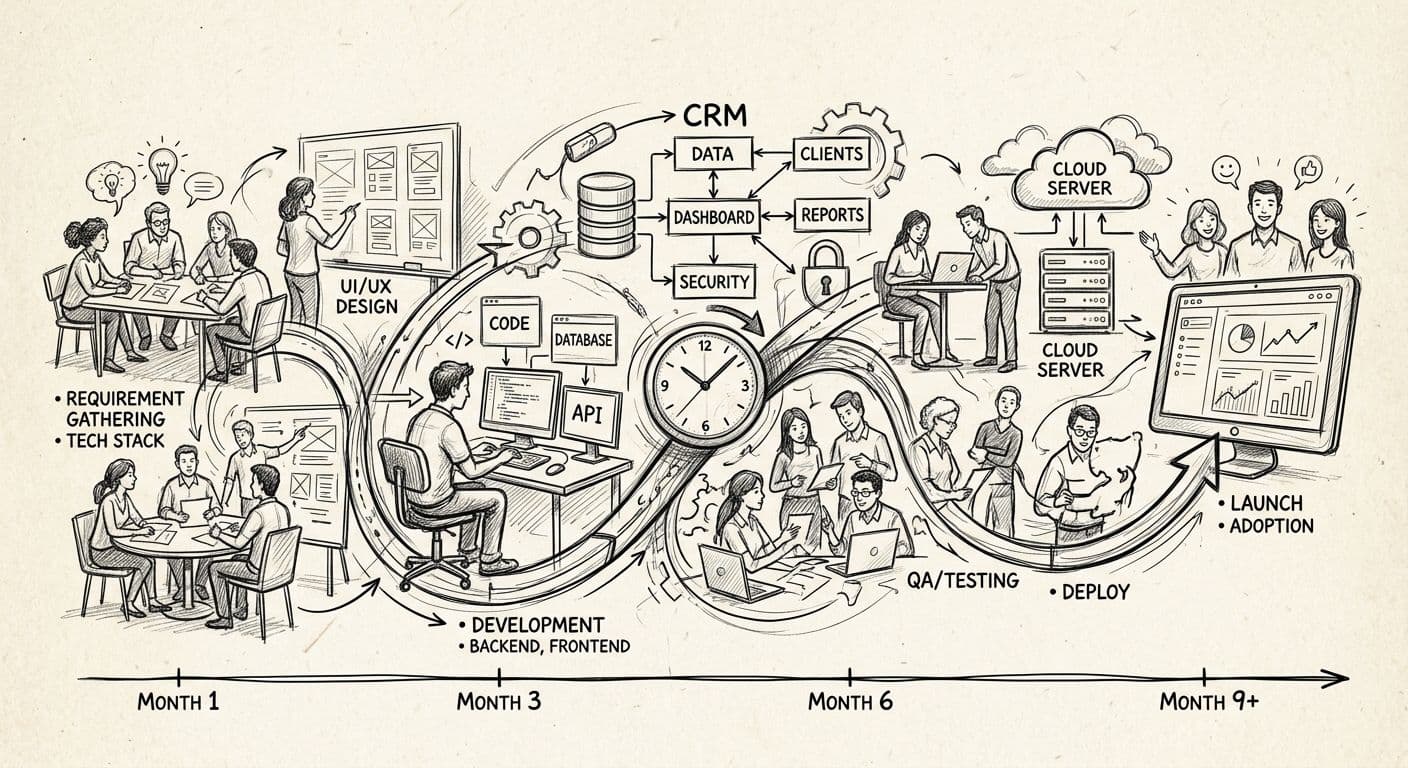
A custom CRM takes 3 to 5 months to build at simple scope, 5 to 9 months at mid complexity, and 9 to 12 months or longer for an enterprise-grade system with real-time integrations and compliance reporting. The timeline is driven by what the system must do — not by how many screens it has — and data migration from an existing system is the line item most plans leave out.
TL;DR
- Simple custom CRM: 3–5 months. Mid-complexity: 5–9 months.
- Enterprise-grade CRM with compliance reporting: 9–12+ months.
- Real-time ERP sync and multi-stakeholder deals stretch timelines most.
- Data migration is the phase teams forget to schedule.
- Add a 25% buffer to any CRM estimate before you commit it.
How long does it take to build a custom CRM?
The timeline bands by complexity:
| CRM scope | Typical timeline | What's included |
|---|---|---|
| Simple | 3–5 months | Contacts, pipeline, basic reporting, 1–2 integrations |
| Mid-complexity | 5–9 months | Multiple modules, several integrations, custom workflows, data migration |
| Enterprise-grade | 9–12+ months | Multi-stakeholder deals, custom quoting, real-time ERP sync, compliance reports |
Source: PieSoft's 2026 CRM development timeline guide; HubSpot community estimates for lean MVPs land in the same 3–6 month band.
Two things decide which band you land in. First, what the system must do: a CRM that manages contacts, tracks a pipeline, and logs communications is a fundamentally different project from one that manages multi-stakeholder deal structures, generates custom quotes, syncs with an ERP in real time, and produces regulatory compliance reports. Second, how clean your existing data is — migration from a legacy system is its own phase with its own testing burden, and it is the most commonly omitted line in CRM plans.
What drives a CRM timeline up or down
- Scope of functionality. Standard reporting — pipeline by stage, deals closed by period, activity by rep — builds fast. Custom analytics that aggregate across modules, calculate derived metrics, or produce regulatory or financial reports require careful design and are time-intensive to build correctly.
- Integrations. Email, calendar, and marketing tools connect in days; real-time ERP or billing sync adds weeks of design and testing per system.
- User roles and permissions. Multi-role hierarchies with field-level permissions add design and QA time disproportionate to their apparent size.
- Data migration. Years of contacts, notes, and deal history in inconsistent formats is often the single largest unknown in the estimate.
- Team model. A dedicated embedded team with direct decision access compresses timelines; a committee-review process stretches every phase.
- Preparation quality. Implementation guides consistently find that mapped processes, clean data, and named decision-makers shorten go-live — and that projects without them slip.
How to keep a custom CRM build on schedule
- Write the scope down before requesting estimates. A CRM estimate without written scope is a guess; the same build priced twice can differ by months purely on assumptions.
- Deliver a first working version fast. Implementation guidance recommends a working iteration within 2–3 months, then improving step by step — this surfaces the real requirements while the schedule can still absorb them.
- Price and schedule migration explicitly. Get data migration as its own line item with its own testing plan, not as a bullet inside "setup."
- Add a 25% buffer. CRM implementation guides advise building at least 25% into both time and budget estimates — the teams that skip it are the teams that miss quarters.
- Choose the delivery model that matches your pace. A fixed-price build suits stable, well-specified requirements; time and materials suits products where sales feedback will reshape the pipeline logic mid-build. An embedded team covering product management, design, engineering, and QA under one roof — the model Prizmstack operates — removes handoff latency between phases, which is where CRM builds most often lose weeks.
- Plan the post-launch phase in the original plan. Adoption, workflow tuning, and reporting refinement after go-live are where a CRM earns its value; teams that treat launch as the end underuse what they paid for.
Build custom or configure an existing CRM?
Before committing to a custom build, price the alternative honestly:
| Option | Best for | Key limitation |
|---|---|---|
| Configure an existing platform | Teams whose workflows fit standard sales processes | Customization ceiling; per-seat costs compound |
| Extend a platform with custom modules | Standard core with a few unique workflows | Integration debt accumulates over time |
| Build custom | Differentiated sales processes, unique data models, compliance-driven requirements | Highest timeline and ownership burden |
A custom CRM earns its 5–9 months when the sales process itself is the differentiator — multi-stakeholder deals, custom quoting, industry-specific data models. When the process is standard, configuring an existing platform in weeks beats building what already exists.
Related questions
How long does a custom CRM MVP take?
A lean MVP with basic contact management, a deal pipeline, and task reminders takes roughly 3–6 months with a small, well-coordinated team. Adding email integration, custom analytics dashboards, automation workflows, and role-based access stretches the timeline significantly beyond that band.
How long does CRM implementation take for a mid-sized company?
Mid-sized organizations typically run several months, with complex implementations running 6 to 12 months or longer when extensive customization, complex integrations, or insufficient preparation are involved. Preparation quality is the variable most within your control.
What is the fastest way to get a custom CRM live?
Ship a minimal pipeline first and iterate: a working version within 2–3 months, then scheduled improvement cycles. Teams that try to launch the full feature set in one release trade a fast start for a long, risky build.
FAQ
How long does it take to build a custom CRM?
A simple custom CRM takes 3–5 months, mid-complexity builds 5–9 months, and enterprise-grade systems with real-time ERP sync and compliance reporting 9–12 months or longer.
What makes a custom CRM build take longer?
Custom analytics, real-time ERP integrations, multi-role permissions, and data migration from legacy systems. Migration is the most commonly underestimated phase.
How long is a custom CRM MVP?
Roughly 3–6 months for basic contact management, pipeline tracking, and task reminders with a small coordinated team.
Should I add buffer time to a CRM estimate?
Yes — implementation guides recommend at least 25% buffer on both time and budget. Estimates without it are planning to be wrong.
Is it faster to configure an existing CRM than build one?
Usually yes — configuration runs weeks to a few months against 3–12 months for a custom build. Custom earns its timeline only when the sales process itself is the differentiator.
What should be built first in a custom CRM?
One working pipeline: contacts, deal stages, and standard reporting. Everything else — analytics, integrations, permissions depth — should wait for real usage feedback.
One last thing
The fastest custom CRM projects share one habit: they launch a minimal pipeline in under three months and let real sales activity rewrite the requirements. Teams that specify eighteen months of features before the first user logs in are not building a CRM — they are building a guess, and the second build after launch is where the real schedule lives.
Related guides
Topics covered
Written by Prizmstack Team
Full-spectrum software agency