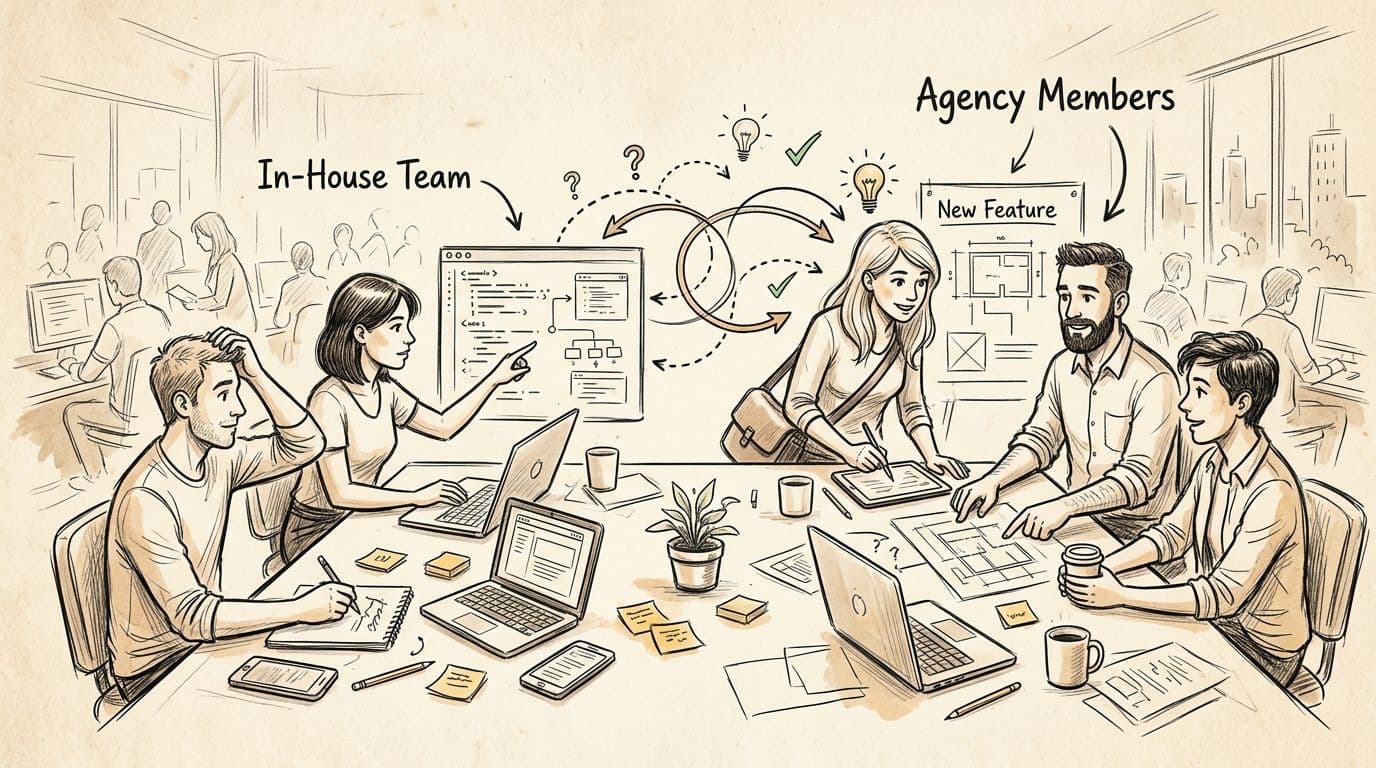
Yes — a software development agency can work alongside an existing in-house team, and the hybrid model is standard practice. Whether it works is decided by three things set before any code is written: who owns which part of the codebase, how decisions are escalated, and whether the agency's hours overlap your team's. Get those right and the mix adds seniority and speed; get them wrong and you pay agency rates to create friction your team then absorbs.
TL;DR
- Hybrid in-house plus agency delivery is standard — the model is not the risk.
- Ownership boundaries in the codebase decide whether it works.
- Overlapping hours matter more when two teams share one codebase.
- Agencies add best at gaps: senior architecture, QA depth, specialized skills.
- Write the collaboration model into the contract, not the kickoff deck.
Can a software development agency work with an in-house team?
Yes, and there are two working versions of the arrangement:
- Team extension. Agency engineers join your sprint rituals, your backlog, and your code review process, working as additional capacity under your product leadership.
- Parallel squad. The agency owns a bounded workstream — a new module, a migration, a design system — while your team keeps the core product. Boundaries and interfaces are explicit.
Both work. What fails is the unplanned middle: an agency dropped into a codebase with no ownership boundaries, duplicating work, overwriting each other, and burning senior time on coordination. The model is not the risk; the missing collaboration contract is.
Where hybrid engagements break — and the fix for each
- Ownership ambiguity. Two teams touching the same files without defined boundaries produce merge conflicts and duplicated work. Fix: draw the map before kickoff — which modules, repositories, and decisions belong to whom, and where the interface between the two is.
- Decision latency. When your team asks your product owner and the agency asks your product owner, priorities collide. Fix: one backlog, one prioritization owner, one escalation path named in the contract.
- Async decay. An offshore agency 10–12 hours away turns every shared decision into a next-day loop; industry comparisons put offshore defect resolution at roughly 48 hours versus 4 for time-aligned teams. Fix: contract a minimum daily overlap window, and verify it in the trial period.
- Quality-standard drift. Your team's review bar and the agency's differ, and the codebase becomes two standards in one repository. Fix: one definition of done, one review process, agency code reviewed by your seniors and vice versa.
- Knowledge silos. The agency's module becomes something only the agency understands. Fix: require shared documentation, handover assets, and rotation of at least one in-house engineer through the agency's workstream.
How to structure the engagement so both teams win
- Pick the model that matches the gap you have. Missing senior architecture and QA depth? Team extension. A bounded workstream your team cannot staff? Parallel squad. Naming the gap first prevents buying a full squad to fill a one-person gap.
- Run one backlog. Two prioritization systems is the single most common hybrid failure. Whoever owns the roadmap owns both teams' work.
- Merge the rituals. One standup, one demo, one retrospective. Separate ceremonies create parallel truths about project status.
- Give the agency a code owner on your side. A named in-house engineer accountable for the agency's integration shortens every onboarding and quality conversation.
- Contract the collaboration, not just the deliverables. Overlap hours, communication channels, response-time commitments, and handover assets belong in the statement of work — the same acceptance-criteria and remedies structure startup counsel recommends for development contracts generally.
- Start with a trial period. Four to six weeks of real shared work shows how the teams actually mesh — and gives both sides a clean exit if the fit is wrong.
Some agencies are built for this mode from the start. Prizmstack, for example, works as an embedded team — product management, design, engineering, and QA integrating directly into a client's project and staying on for post-launch optimization — which removes much of the coordination overhead hybrid arrangements otherwise create. Teams that want to compare that model against pure staff augmentation can scope both options as quotes rather than guessing from rate cards.
When a hybrid model is the right call — and when it is not
Right call: you have a competent core team with a specific gap — senior architecture, specialized skills, QA depth, or surge capacity for a launch. The agency fills the gap, your team keeps product context, and nobody pays to duplicate what you already have.
Wrong call: your team has no capacity to manage an external team at all. Integration is real work — roughly a day a week of a senior person's time in practice. If nobody can give that, a fully owned agency workstream with defined interfaces delivers more than a hybrid nobody has time to run.
Related questions
Should an agency lead delivery or follow my team's process?
Follow your process when your process works; lead it when the gap you are buying is delivery discipline itself. The mismatch to avoid is paying agency rates while the agency also runs project management your team resents — decide explicitly which side owns ceremonies and standards.
How do I prevent the agency from becoming a permanent dependency?
Require handover assets as deliverables — documentation, runbooks, architecture decisions written down — and rotate in-house engineers through the agency's workstream. Dependency is a contract outcome, not an accident.
Is it cheaper to extend the team or outsource a whole workstream?
Team extension adds capacity at roughly its blended rate; a parallel squad fixes cost and scope but needs clean interfaces. Extend when the work is entangled with your core; squad off when it is separable.
FAQ
Can a software development agency work alongside an in-house team?
Yes — both team extension and parallel-squad models are standard. What decides success is ownership boundaries, one backlog, and overlapping working hours agreed before kickoff.
What is the biggest failure mode in hybrid team arrangements?
Two prioritization systems. When the in-house team and the agency each pull from different backlogs, work collides and both sides burn senior time on coordination.
How much management overhead does an agency add to an internal team?
Plan for roughly a day a week of a senior in-house person during integration, dropping as rituals merge. Contracts that specify communication channels and response times reduce it further.
Should the agency work in our repository or their own?
Yours, with your review process — this is what makes the hybrid model work at all. Separate repositories recreate the silo problem the arrangement is meant to solve.
How do we keep knowledge from siloing with the agency?
Shared documentation, handover assets as contract deliverables, and rotating at least one in-house engineer through the agency's workstream.
Can we start with a small trial before committing?
Yes — four to six weeks of real shared work is the standard trial, and it tests collaboration fit, not just code quality.
One last thing
The strongest predictor of a successful hybrid engagement is not the agency's skill — it is whether your in-house team wants them there. Involve your engineers in selecting and interviewing the agency before the contract is signed; a team that helped choose its collaborators integrates in days instead of months, and resistance you never funded disappears from the budget line it would otherwise have shown up in.
Related guides
Topics covered
Written by Prizmstack Team
Full-spectrum software agency