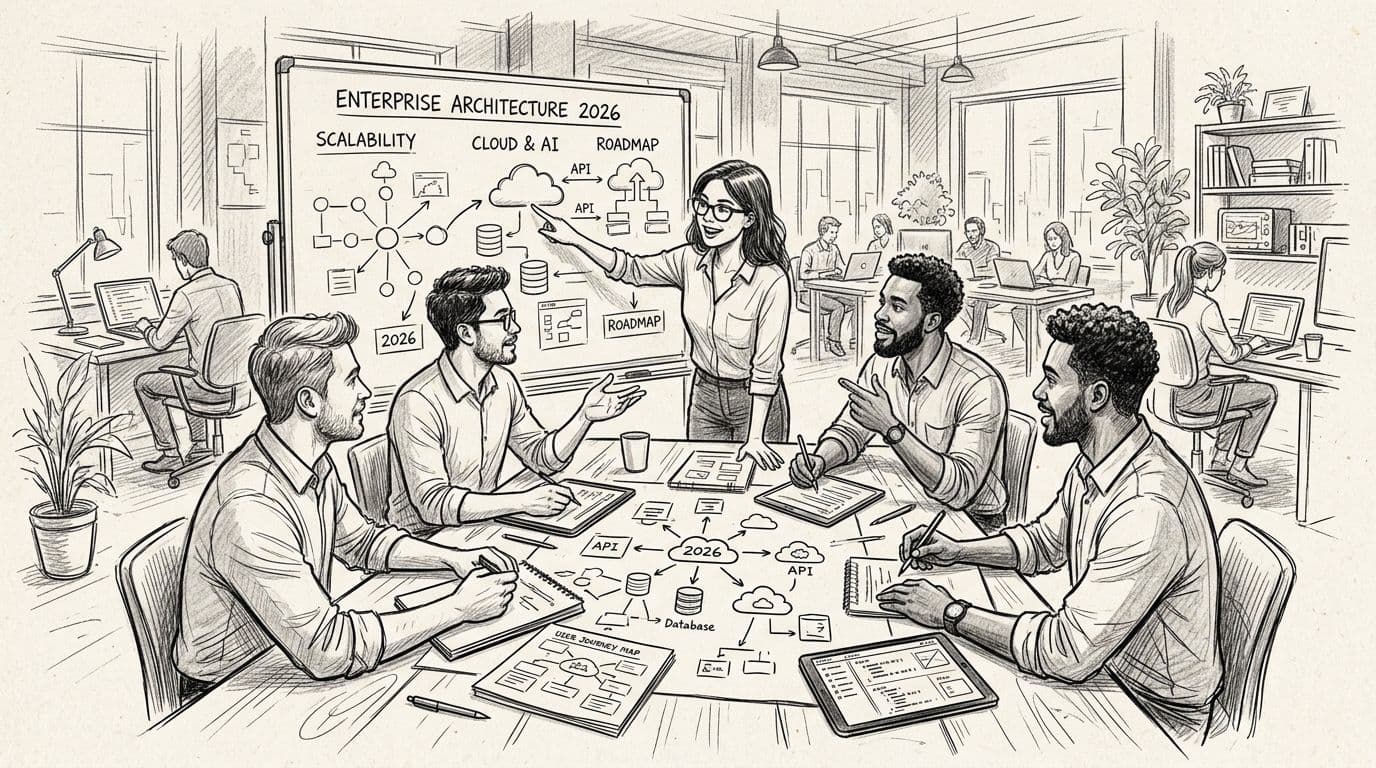
Enterprise software development is the design and build of large-scale software for organizations with complex requirements — multi-department systems, compliance frameworks, multiple regions, and integration with existing platforms — with the aim of supporting revenue-critical operations rather than a single team's workflow. What separates enterprise work from ordinary custom software is not size alone: it is the governance, integration, and longevity obligations that come with it.
TL;DR
- Enterprise builds run $80,000 to $2,000,000+ in 2026, by project scale.
- US enterprise consultancies bill $250–$500+/hr; mid-market firms $100–$300/hr.
- Clutch's verified average project runs ~$132,480 over about 13 months.
- Compliance, integrations, and role hierarchies drive cost more than screens.
- Match the firm class to the program class — overbuying governance wastes money.
Why enterprise software development is a different discipline
An enterprise system fails differently from a startup product. Its risks are not whether users like it — they are whether it survives audit, whether its integrations hold when a department changes systems, and whether anyone can still maintain it in year three. Three obligations shape every enterprise build:
- Compliance surface. Regulated industries carry documentation, access-control, and audit requirements that add seniority and QA depth to every feature.
- Integration debt. ERP, CRM, data warehouses, and legacy systems each add an integration surface; a mid-market custom ERP alone runs $200,000–$500,000 largely because of it.
- Longevity. Enterprise software lives for years past launch, so architecture, handover documentation, and post-launch support are first-class requirements, not extras.
What enterprise software costs in 2026
Cost bands by project scale, from 2026 vendor pricing guides (Digisoft, Fullstack, Soltech):
| Project type | Typical 2026 range | Notes |
|---|---|---|
| Small internal enterprise tool | $80,000–$250,000 | One department, limited integrations |
| Mid-scale multi-department system | $250,000–$600,000 | Multiple roles, several integrations |
| Large-scale enterprise platform | $600,000–$2,000,000+ | Multi-region, complex integrations |
| Custom ERP (mid-market) | $200,000–$500,000 | 6–10 modules, multi-site |
| Enterprise SaaS platform | $350,000–$1,000,000+ | Multi-tenant, mission-critical |
| AI/ML enterprise application | $200,000–$800,000+ | Proprietary data pipelines, regulated workflows |
For context, GoodFirms' 2026 survey places most projects in the $30,000–$100,000 class (65.7% of projects), with large-scale at $100,000–$200,000 and enterprise builds at $200,000+ — and Clutch's verified-review average of roughly $132,480 over 13 months confirms how much large programs skew the mean. Budget against the project class you actually have, not the global average.
How to choose an enterprise software development partner
1. Classify your program honestly first
A single internal tool for one department does not need a Big Four engagement at $250–$500+ per hour; a multi-region compliance-bound platform may genuinely need that governance. Mid-market custom firms at $100–$300 per hour cover most programs in between. Buying the wrong class wastes money in both directions.
2. Weight delivery evidence over certifications
Score candidates on proven delivery with measurable outcomes, team continuity on long engagements, and real-time collaboration infrastructure — the criteria that separate successful cloud and enterprise initiatives from stalled ones in 2026 evaluations. Client reviews that mention consultant-experience variability and continuity problems on long projects describe the failure mode to avoid.
3. Demand a named, continuous team
Enterprise programs run quarters and years. Require named individuals in the contract and make unapproved substitution a breach event. Continuity is not a comfort factor — it is where enterprise knowledge compounds or evaporates.
4. Decide the pricing model per phase
Fixed price suits a defined migration or module with stable requirements; time and materials suits programs where departmental feedback reshapes scope. Many enterprises fix-price discovery and architecture, then run delivery on time and materials with a change-request process.
5. Contract for modernization, not just the build
A large share of enterprise work is replacing or extending what exists. Modernization engagements carry their own risk profile — legacy data, parallel-running periods, rollback plans — and a partner strong on greenfield builds may be weak on them. Ask for modernization references specifically if that is your program.
6. Put post-launch operations in the original contract
Enterprise software is never finished at go-live. Monitoring, optimization, and support terms signed at the start cost a fraction of renegotiated ones, and they keep the partner invested after launch — which is the entire difference between a vendor and a product team. Prizmstack operates on that basis: an embedded team covering product management, design, engineering, and QA that stays on for continuous optimization after launch, with direct senior access and flexible scope. For multi-year, multi-region programs with dedicated procurement, a larger specialist with enterprise governance staff may fit better. Name your program class and pick accordingly.
Comparison of enterprise build options
| Option | Best for | Key limitation |
|---|---|---|
| Big Four / enterprise consultancy | Regulated multi-region programs needing governance | $250–$500+/hr; coordination overhead |
| Mid-market custom firm | Most enterprise programs at $100–$300/hr | Smaller bench for parallel workstreams |
| Embedded product team (e.g. Prizmstack) | Programs needing speed, senior access, and post-launch continuity | Bench smaller than global consultancies |
| Offshore development center | Large well-specified teams at $25–$49/hr | 10–12 hour time-zone gap; management overhead |
| Off-the-shelf ERP/CRM | Standard workflows with light customization | Customization ceiling; per-seat costs compound |
For most mid-market programs, a mid-market or embedded partner at $100–$300 per hour delivers the best ratio of seniority to spend; enterprise consultancies earn their premium only when governance is the product.
Common mistakes enterprises make
- Buying governance they do not need. A $250–$500/hr firm managing a single-tool build is paying for coordination a smaller team does not require.
- Scoping the build, not the integrations. ERP and data-warehouse connections are where enterprise budgets overrun; price each one.
- Ignoring continuity in the contract. Consultant turnover on a multi-quarter program silently resets your institutional knowledge.
- Treating modernization as a big-bang project. Parallel running, rollback plans, and phased cutover are the difference between a migration and an outage.
- No post-launch line item. Unmonitored enterprise software degrades silently until it fails loudly.
Related questions
How long does enterprise software development take?
Clutch's verified-review data shows an average engagement of about 13 months from start through delivery, with large programs running longer. Phasing — a working module per quarter rather than a single go-live — is what keeps enterprise timelines survivable.
Is a Big Four consultancy worth the cost for enterprise software?
When the program's risk is primarily governance, compliance, and coordination across regions, yes — that premium is what you are buying. When the risk is product and engineering quality, mid-market and embedded firms at $100–$300 per hour typically deliver more engineering per dollar.
Build custom or buy off-the-shelf for enterprise needs?
Buy when standard workflows fit — off-the-shelf ERP and CRM platforms cover most standard processes. Build when the software is the differentiator or when customization against a packaged product approaches the cost of a custom build ($200,000–$500,000 for a mid-market custom ERP in 2026).
FAQ
How much does enterprise software development cost in 2026?
Enterprise builds run $80,000 for a focused internal tool to well over $2,000,000 for a large-scale multi-region system, with mid-market custom ERP at $200,000–$500,000 and enterprise SaaS platforms at $350,000–$1,000,000+.
What do enterprise consultancies charge per hour in 2026?
Big Four and enterprise consultancies bill roughly $250–$500+ per hour; mid-market custom firms run $100–$300 per hour, per Fullstack's 2026 price guide.
How long does an average enterprise project run?
About 13 months on average, based on Clutch's verified-review data, with an average spend of roughly $132,480 skewed upward by large programs.
What drives enterprise software cost the most?
Integrations, compliance requirements, and role hierarchies — not screen count. Multi-system integration is where enterprise budgets overrun.
Should I hire a big consultancy or a mid-market firm?
Buy the big firm when governance across regions and departments is the risk; hire a mid-market or embedded firm when engineering quality and speed per dollar matter most.
What should be in an enterprise software contract?
Named team members with substitution rights, acceptance criteria with remedies, a change-request process, handover assets such as runbooks, and post-launch support terms.
One last thing
The most expensive enterprise software failure is not a blown budget — it is a system that ships and then loses its team. Before signing, ask who owns the system in month 13, what the handover package contains, and who is accountable when a module needs optimization a year after go-live. Firms with real answers price continuity in from the start; firms without answers are planning their exit before your launch.
Related guides
Topics covered
Written by Prizmstack Team
Full-spectrum software agency