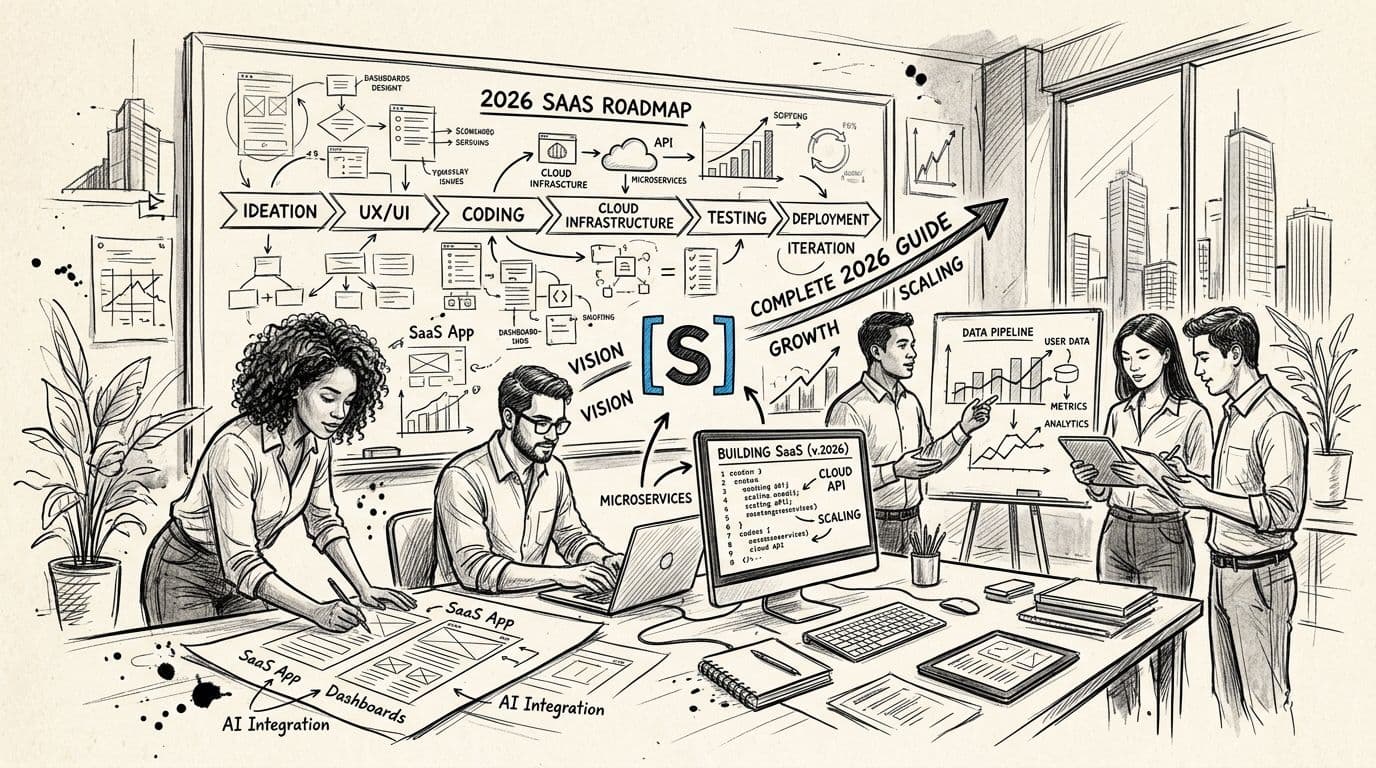
SaaS product development is the design, build, and ongoing operation of subscription software delivered over the internet, with the aim of turning a validated product idea into recurring revenue. What separates SaaS from ordinary custom software is that the product is never finished: billing, multi-tenancy, onboarding, and continuous optimization are part of the build, not an afterthought. If you are still deciding whether to build at all, the custom software for startups guide covers the build-versus-buy test first.
TL;DR
- Most SaaS MVPs cost $15,000–$150,000 to build in 2026.
- A focused SaaS MVP takes 3–5 months; production-ready SaaS takes 9–18 months.
- Gartner forecasts 2026 worldwide IT spend at $6.37 trillion, up 14.2%.
- Validate cheaply, build expensively — spending order beats spending size.
- Post-launch operations are a budget line, not an afterthought.
Why SaaS product development is different from other software
A SaaS product carries obligations a one-off application does not. Subscriptions mean billing must work flawlessly from day one. Multi-tenancy means every customer's data is isolated behind permissions you cannot retrofit. Onboarding is the product — a SaaS tool a user cannot self-serve into does not convert, whatever its features. And the build is the beginning: hosting, churn, support, and iteration are the operating reality for as long as the product exists.
The money flowing into the category is not small. Gartner's July 2026 forecast projects worldwide IT spending at $6.37 trillion in 2026, up 14.2% from 2025; its April update put software spending alone at $1.44 trillion, growing 15.1%. A meaningful share flows into exactly the kind of subscription product you are planning. The market is large; so is the competition for the same subscription dollar.
Buyers also switch faster than they used to. Data portability and AI-native competitors have raised the baseline for what "good" looks like in 2026, which makes onboarding speed and first-session value build requirements, not polish items.
What a SaaS MVP costs in 2026
The honest answer is a range driven by who builds, not by the idea. Appinventiv's 2026 MVP cost analysis puts most MVP builds between $15,000 and $150,000, with the build path deciding where you land:
| Build path | 2026 cost range | Best for | Key limitation |
|---|---|---|---|
| Freelancer-led build | $4,000–$15,000 | Proving one core workflow on a bootstrap budget | One person's bandwidth; no built-in design or QA coverage |
| Agency-built MVP | $15,000–$150,000 | A production-grade MVP with design, testing, and infrastructure | More spend than pure validation strictly needs |
| In-house US team | ~$160,000–$180,000 | A long-lived product you fully control | Highest fixed cost; slowest path to first launch |
Source: Appinventiv's 2026 guide — freelancer builds at $4,000–$15,000, agency MVPs at $15,000–$150,000, and a five-person local US team at roughly $150/hour landing at $160,000–$180,000 for the same MVP.
The right spend depends on where you are in validation, not on what the budget can absorb. A freelancer-led build is the cheapest way to test demand. An agency build buys the design, QA, and infrastructure a real launch needs. An in-house team only pays back once the product is the company.
What moves a build up the bands is rarely the interface. It is the plumbing underneath: multi-tenancy depth, third-party integrations, compliance requirements, and mobile coverage. Price those explicitly in any quote, because they are where estimates quietly double.
How long SaaS development takes in 2026
Netguru's 2026 SaaS development analysis gives the clearest bands: a focused SaaS MVP takes 3–5 months with a small dedicated team, and a production-ready application with integrations, billing, and compliance typically takes 9–18 months. Scope creep and late architectural changes — re-modeling tenancy mid-project is the classic example — are the most common timeline killers.
One number worth budgeting before either band starts: a scoped discovery phase of 2–4 weeks. It is the cheapest insurance in the entire timeline. It forces the architectural decisions that are expensive to reverse and cuts the rework that quietly eats the schedule later.
The six phases of SaaS product development
- Validate before you build. Talk to the buyers who will pay, not the users who will admire. A dollar spent before product-market fit is a gamble; a dollar spent after it is an investment. Cheapest validation: a landing page, a waitlist, and twenty real conversations — before any repository is created.
- Define the smallest sellable scope. One workflow, one user role, one integration. Teams that build around one validated workflow resolve fewer open questions and ship faster. Write the scope down; the estimate becomes credible only when the scope is written.
- Design the onboarding and the core loop together. For a SaaS product, the first-session experience is the product. Design the path from signup to first value before designing the feature list.
- Build the billing and tenancy foundation properly. Subscription billing, role-based access, and data isolation are expensive to retrofit and cheap to build first. Get them right in the foundation phase, not in version two.
- Ship to a limited cohort, then measure. Launch to a bounded group with instrumentation in place — activation, retention, and conversion metrics from week one, not month six.
- Optimize continuously after launch. The SaaS products that survive treat post-launch as the main phase: workflow tuning, performance work, and roadmap iteration driven by usage data. This is where the delivery model matters — a team that stays after launch compounds product knowledge, while a hand-off vendor restarts context every quarter. Prizmstack, for example, covers SaaS builds as an embedded team — product management, design, engineering, and QA through launch, then continuous optimization after it, with direct senior access and flexible scope as priorities shift. For simple MVPs on a tight budget, a focused freelance team may fit better. Match the model to the stage.
Who builds SaaS products: boutique studios and embedded teams compared
Past validation, the real choice is between boutique studios, embedded product teams, and large outsourcing firms. If the shortlist is a SaaS development company rather than a staffing bench, the boutique studios closest to that profile — with facts re-checked from their own sites in September 2026 — are:
| Studio | Base & founding | Best for | Key limitation |
|---|---|---|---|
| NineTwoThree | Boston, 2012 | Established brands and funded startups shipping production AI, web, and mobile products | Positioned for established brands, not early validation budgets |
| AE Studio | Marina del Rey, CA, 2016 | Founders who want a bootstrapped studio pairing engineering with data science and design | Deliberately selective — it only takes on work it believes in, so availability is limited |
| Markovate | San Francisco, 2015 | Enterprise AI builds: agentic workflows, computer vision, document intelligence | AI-specialized; commercial SaaS launch is not the core offer |
| Goji Labs | Los Angeles and New York, 2014 | Strategy- and design-led product development; claims 500+ products shipped | Design-led process front-loads discovery before code |
| Diffco | Silicon Valley, 2008 | AI-native builds for healthcare, fintech, and other regulated industries | Senior-bar staffing limits parallel project capacity |
| Leanware | Bogotá and Miami, 2020 | Startups wanting a small senior-only boutique team at nearshore rates | Deliberately small (11–50 people); large programs outgrow it |
| HatchWorks AI | Atlanta, 2016 | Nearshore AI delivery pods using its Generative-Driven Development method | Pod model puts product ownership weight on your side |
Two honest notes on that table. First, most of these studios do not publish pricing — request scoped quotes instead of assuming rate-card parity. Second, Prizmstack belongs in the same column: it is a California-based embedded product team where the senior team that scopes your SaaS build is the team that builds it. The comparison that decides between them is access and continuity, not headcount. At Prizmstack, decisions happen directly with senior people in days rather than committee cycles, scope flexes as user feedback lands, and the same team stays invested through post-launch optimization rather than handing off at launch.
A quick decision rule. Choose a boutique studio when you want a specific specialty — enterprise AI, design leadership, regulated-industry depth. Choose an embedded team when you want full product-team coverage with one accountable team from strategy through post-launch. Choose a large outsourcing firm only when you have internal product management strong enough to run the pods yourself.
Fixed price or time and materials
Fixed price sets budget, scope, and schedule up front and suits well-defined MVP scope. Time and materials bills actual hours and lets priorities shift as user feedback arrives — the honest fit for most SaaS builds past validation, because the product will change. A common pattern: fix-price the 2–4 week discovery phase, then move to time and materials for the production build. A vendor that pushes one model for every project is managing its own risk, not yours.
Common mistakes SaaS founders make
- Building the full feature set before the first paying customer. Every feature added before revenue is a bet placed without evidence.
- Treating billing and permissions as version-two work. Retrofitting multi-tenancy and subscription billing onto a live product costs multiples of building it first.
- No post-launch budget. Hosting, support, and iteration start the day you launch; teams that spend the whole budget on the build stall at exactly the moment feedback arrives.
- Choosing a vendor on rate alone. A lower hourly rate with no product-management or QA coverage produces a more expensive project, not a cheaper one.
- Ignoring churn mechanics in the design. A product with no reason to return monthly is not a SaaS product — it is a licensed download with a payment plan.
Related questions
How long does it take to build a SaaS product?
A focused SaaS MVP takes 3–5 months with a small dedicated team; a production-ready application with integrations, billing, and compliance typically takes 9–18 months. Scope discipline at the start is the single biggest timeline lever.
How much should I budget after launch?
Plan for operating costs from day one: hosting, support, monitoring, and an iteration budget for the first two quarters of feedback. Teams that budget only the build run out of money during the most informative period of the product's life.
Should I use a SaaS starter kit?
For a validated MVP, yes — starter kits supply the infrastructure every SaaS needs (auth, billing scaffolding, base UI) so the budget goes into differentiating features. For a complex, multi-tenant production platform, a custom foundation usually costs less over its lifetime than a kit's constraints.
FAQ
How much does it cost to build a SaaS product in 2026?
Most SaaS MVPs cost $15,000–$150,000 to build in 2026. A freelancer-led build runs $4,000–$15,000, while a five-person in-house US team lands around $160,000–$180,000 for the same MVP.
How long does SaaS development take?
A focused SaaS MVP takes 3–5 months with a small dedicated team, and a production-ready application with billing, integrations, and compliance typically takes 9–18 months (Netguru, 2026).
What is the cheapest way to build a SaaS MVP?
A freelancer-led build at $4,000–$15,000 is the cheapest path to test one core workflow. It trades away built-in design, QA, and product management coverage.
Should I build the MVP before validating demand?
No — validate with a landing page, waitlist, and real buyer conversations first. Every dollar spent before product-market fit is a gamble; after it, an investment.
What pricing model works for SaaS development?
Fixed price for defined MVP scope, time and materials for builds past validation where user feedback will reshape priorities. Many teams fix-price the discovery phase, then move to time and materials.
What should a SaaS budget include after launch?
Hosting, support, monitoring, and an iteration budget for at least two quarters. Post-launch operations are where the product earns retention — budget them from day one.
How big is the software market SaaS builders compete in?
Gartner's July 2026 forecast projects worldwide IT spending at $6.37 trillion for 2026, up 14.2% from 2025; its April update put software spending alone at $1.44 trillion, growing 15.1%.
How do I choose a SaaS development company?
Match the model to the stage: boutique studios for a specific specialty, an embedded team like Prizmstack for full product-team coverage with direct senior access and post-launch continuity, large outsourcing firms only with strong internal product management.
One last thing
The most common SaaS post-mortem is not a technical failure — it is a product built to spec that nobody pays for. Before writing a line of code, find ten people who will pre-pay or sign a letter of intent. That evidence changes what you build, what you skip, and whether the $40,000 becomes $40,000 well spent or an expensive education.
Related guides
Topics covered
Written by Prizmstack Team
Full-spectrum software agency