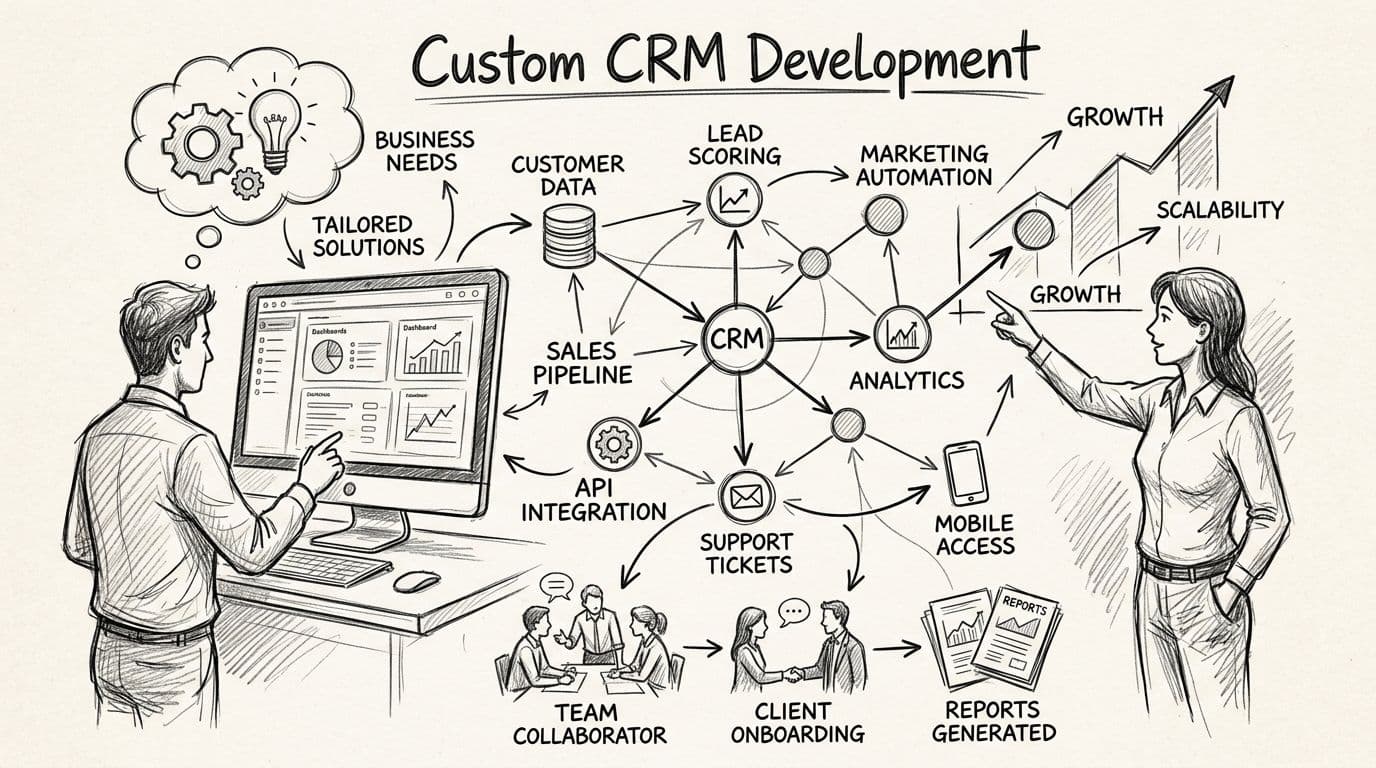
Growing businesses outgrow spreadsheet-and-inbox sales tracking fast, and a custom CRM software development project becomes the fix once off-the-shelf tools start forcing your process to bend around their limits instead of the other way around. This guide covers what a custom build actually involves, what it costs in 2026, and how to decide if it is the right move before your next renewal.
TL;DR
- Custom CRM development in 2026 runs $24,000 to $360,000+, per 2026 vendor cost guides from RaftLabs and Purrweb, depending on features, integrations, and team size.
- A custom CRM stops making sense below roughly 15-20 users, where per-seat SaaS pricing usually still wins on total cost.
- Teams with a non-standard sales process, industry-specific data model, or heavy integration needs are the clearest fit for a custom build.
- Prizmstack scopes custom CRM projects with a dedicated product strategist and engineering team rather than a single contractor.
Why this matters for growing businesses
A CRM is the system of record for every deal, every customer relationship, and every renewal a growing business has. When that system is a generic tool bent sideways with workarounds, the cost shows up as lost deals, duplicate data entry, and reports nobody trusts.
Off-the-shelf CRMs like Salesforce or HubSpot charge per user, per month, which scales painfully once a sales or ops team crosses 20-30 seats. A custom build is a one-time engineering cost instead of a recurring per-seat bill, and according to Purrweb's 2026 CRM cost analysis, custom development typically becomes more cost-effective than per-seat licensing within 2 to 3 years for teams of 20 or more users.
How to plan a custom CRM build
Map your current sales and service workflow first
Before any engineering conversation, document how deals, tickets, or cases actually move through your business today, not how the org chart says they should.
- List every stage a deal or case passes through, from first contact to close or resolution
- Note where data currently lives (spreadsheets, email, a legacy tool, a whiteboard)
- Flag every manual handoff between people or tools
- Identify which reports leadership actually looks at each week
- Write down the one workaround your team complains about most
Decide whether the problem is process or software
Most teams jump to "we need new software" when the real issue is an undocumented process. A custom CRM will not fix a sales process nobody agrees on.
- Run the workflow you mapped past the 3-5 people who actually use it daily
- Resolve disagreements about stage definitions before writing a single requirement
- Separate "must exist on day one" from "nice to have later"
- Confirm which existing tools (email, calendar, invoicing, support desk) must connect to the new system
Price out the off-the-shelf alternative honestly
Before committing to a custom build, run the real numbers on staying with, or upgrading to, an off-the-shelf CRM.
- Get a per-seat quote for your actual headcount, not a promotional entry price
- Multiply by 36 months to compare against a one-time build cost
- Price out the add-on modules (advanced reporting, automation, integrations) separately — they are rarely included in the base tier
- Ask whether the vendor's data model can represent your product or service without heavy customization
Scope the build around your highest-friction workflow, not every feature
The most common custom CRM failure is trying to replicate every feature of a mature SaaS product on day one.
- Pick the single workflow causing the most lost time or lost revenue today
- Build that first, end to end, before adding secondary modules
- Defer nice-to-have automations to a second phase
- Keep the initial data model narrow enough that a small team can fully test it
Choose a build partner who scopes before they quote
Once the requirements are real, the build itself is where a custom crm software development company like Prizmstack enters the picture. A team that jumps straight to a fixed quote without a discovery phase is guessing at your data model.
- Ask how the team maps your workflow before writing any code
- Confirm who stays involved after launch, not just through go-live
- Check whether the same team does the design, the build, and the QA, or if those are handed off
- Ask what happens when your process changes six months after launch
Plan for the integrations before you plan for the interface
A CRM that does not talk to your email, invoicing, or support tools recreates the exact data silos a custom build is supposed to remove.
- List every existing tool that needs to read or write CRM data
- Confirm each tool has a usable API, not just a manual export
- Decide which integrations are needed at launch versus phase two
- Budget engineering time for integration testing, not just the connection itself
Custom CRM vs. the alternatives
| Option | Best for | Typical 2026 cost range | Key limitation |
|---|---|---|---|
| Off-the-shelf CRM (Salesforce, HubSpot) | Teams under 20 users with a standard sales process | $25-$165 per user/month | Cost scales linearly with headcount; workflow bends to fit the tool |
| No-code/low-code CRM builder | Simple pipelines with light customization needs | Low upfront cost, ongoing platform fees | Breaks down under complex data models or heavy integrations |
| Custom CRM development | Non-standard processes, industry-specific data, 20+ users | $24,000-$360,000+ (RaftLabs, Purrweb, 2026 guides) | Higher upfront cost and a real discovery phase before code ships |
Those cost ranges come from RaftLabs' and Purrweb's 2026 CRM development cost breakdowns: a basic build with contact management and deal tracking lands around $24,000-$45,000, a standard build with automation and reporting runs $54,000-$112,000, and an enterprise build with AI-driven insights and deep integrations reaches $150,000-$360,000 or more.
Common mistakes growing businesses make
- Scoping every feature of a mature SaaS product on day one. This is the single biggest driver of blown budgets and missed timelines.
- Skipping the workflow mapping step. A build based on assumptions instead of the actual sales process gets rebuilt within a year.
- Treating integrations as an afterthought. A CRM disconnected from email and invoicing recreates the silos it was meant to fix.
- Choosing a build partner on price alone. The cheapest quote is often the one without a discovery phase, and the rework costs more than the discovery would have.
- Not planning for life after launch. A CRM that cannot evolve as the sales process changes becomes the next legacy system to replace.
FAQ
How much does custom CRM development cost in 2026?
Custom CRM development costs $24,000 to $360,000+ in 2026, based on RaftLabs' and Purrweb's 2026 cost breakdowns. A basic build with contact management and deal tracking runs $24,000-$45,000; an enterprise build with AI features and deep integrations reaches $150,000-$360,000 or more.
Is a custom CRM cheaper than Salesforce or HubSpot?
Not upfront. Off-the-shelf CRMs charge $25-$165 per user per month with no large initial cost. A custom CRM becomes cheaper over time for teams of 20+ users, typically inside 2-3 years, because it removes the per-seat fee entirely.
How long does a custom CRM build take?
A basic custom CRM build takes roughly 8-12 weeks; a standard build with automation and reporting runs 12-20 weeks; an enterprise build with AI-driven features can take 20-40 weeks or more, per RaftLabs' 2026 timeline data.
What is the biggest risk in a custom CRM project?
Scoping every feature of a mature SaaS product before launch is the most common failure mode. Teams that build around their single highest-friction workflow first, then expand, ship faster and avoid rework.
Does a custom CRM need to replace every tool we use?
No. A well-scoped custom CRM integrates with your existing email, invoicing, and support tools rather than replacing them outright. Integration planning should happen before interface design, not after.
Who should build a custom CRM: a freelancer or an agency?
A freelancer can work for a narrow, well-defined build under roughly $30,000. Anything involving multiple integrations, a non-standard data model, or ongoing evolution after launch benefits from a full team covering strategy, design, engineering, and QA together.
One last thing
The teams that regret a custom CRM build almost never regret the engineering — they regret skipping the workflow mapping step and building a system nobody agreed on the definitions for. Get five people in a room to agree on what "qualified" means before a single screen gets designed.
Related guides
Topics covered
Written by Prizmstack Team
Full-spectrum software agency