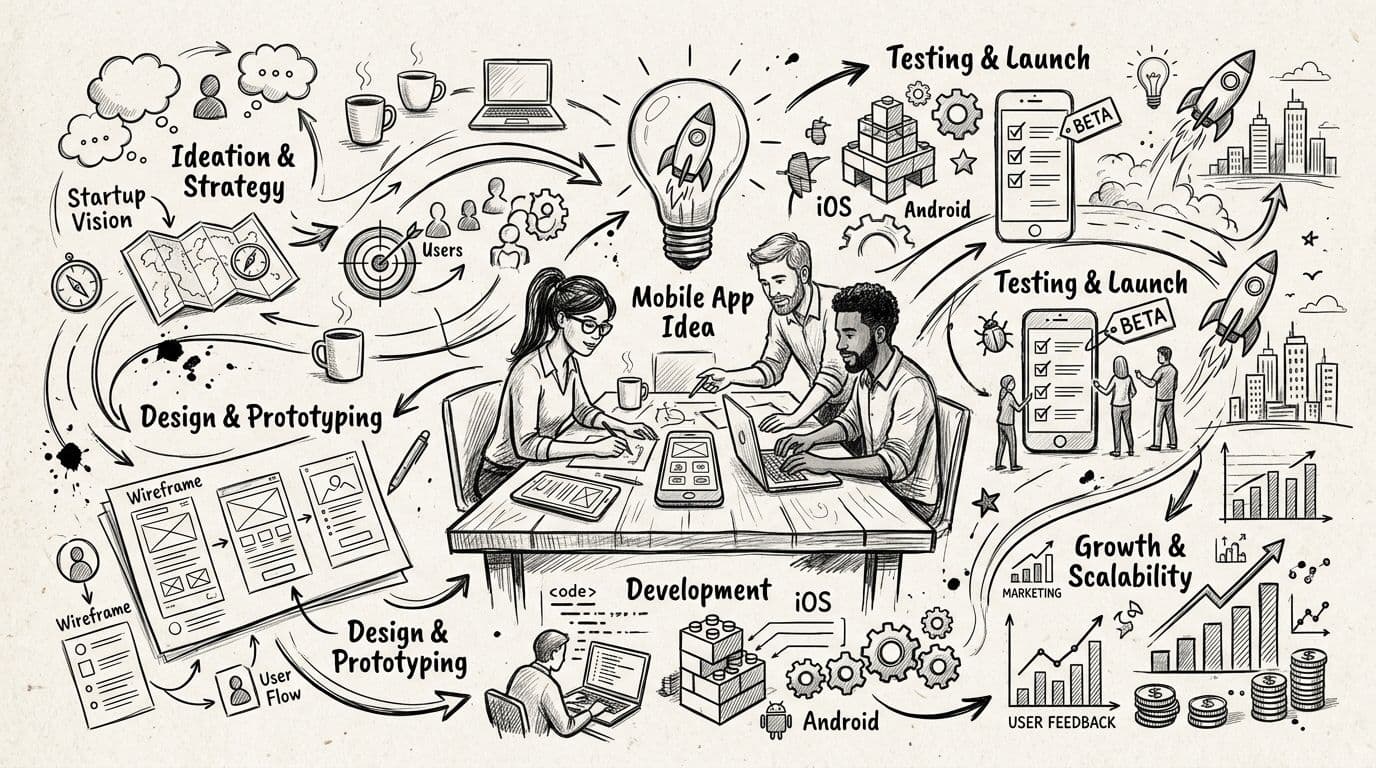
Most startup mobile apps cost $15,000 to $150,000 in 2026, with a lean MVP at $15,000-$50,000, a growth-stage app with payments and integrations at $50,000-$150,000, and complex enterprise products above $300,000 (Unico Connect, Cynoteck 2026 guides). The range is wide because scope, platform choice, and who builds it move the number more than any feature list does. This guide covers what a startup actually needs at each stage, what each stage costs, and how to avoid the budget traps that sink first-time founders.
TL;DR
- A startup mobile app MVP runs $15,000-$50,000 in 2026; growth-stage apps with payments and integrations run $50,000-$150,000 (Unico Connect, 2026).
- Cross-platform builds in Flutter or React Native save 30-45% versus two native apps.
- Budget 15-25% of the build cost per year for maintenance after launch.
- The average agency-built app costs $90,780, and the most common project bracket is $10,000-$49,999 (Clutch survey).
Why this matters for startup founders
An app is usually a startup's core product, not a side project — which means the build decision carries the company. The most expensive mistakes are not engineering mistakes; they are sequencing mistakes: building too much before validation, choosing native twice when cross-platform would do, and hiring for a sprint when the product needs a team for a year.
The market data backs the discipline: the average agency-built app costs $90,780, but the most common project bracket is $10,000-$49,999 (Clutch pricing survey) — most successful startups ship smaller first and expand after users confirm the direction.
What a startup app costs in 2026
| Stage | Typical cost | Timeline | What it includes |
|---|---|---|---|
| Lean MVP | $15,000-$50,000 | 2-4 months | One core flow, basic accounts, single platform (Unico Connect, urlaunched) |
| Mobile app MVP | $25,000-$80,000 | 2-5 months | Core features plus light integrations (urlaunched) |
| Growth-stage app | $50,000-$150,000 | 4-8 months | Payments, integrations, analytics, both platforms |
| Complex/enterprise app | $150,000-$300,000+ | 6-12 months | Multi-role systems, compliance, deep integrations |
Cynoteck's 2026 guide puts most business apps — user accounts, payments, push notifications, API integrations — between $50,000 and $120,000, with post-launch costs (maintenance, hosting, QA, fixes) typically adding 30-50% on top of the original build.
How to plan a startup mobile app build
Validate before you scope
Every dollar spent before users confirm the direction is a dollar spent twice.
- Write down the single job your app does better than the existing alternative
- Test the demand with a landing page, waitlist, or concierge version before engineering starts
- Cut the feature list to the one flow a user cannot live without
- Set a launch date that forces scope decisions, then hold it
Choose the platform strategy deliberately
Platform choice is the single biggest cost lever in 2026.
- Cross-platform builds in Flutter or React Native save 30-45% versus building twice natively (Unico Connect)
- Go native only when performance, device hardware, or platform-specific UX genuinely demands it
- Remember the backend is usually the most expensive part of the build, not the screens
Scope an MVP that can launch, not a product that can scale
- Build one complete user journey end to end rather than ten half-finished ones
- Ship analytics and error tracking on day one — you will need the data to decide phase two
- Defer social login variety, admin panels, and edge-case handling until usage justifies them
Pick a build model that matches your stage
- Freelancers suit bounded, well-specified work under roughly $30,000
- Agencies and embedded product teams fit production builds of $50,000+ spanning design, engineering, and QA
- Ask any vendor what happens after launch — support, updates, and who owns the code. An app nobody maintains loses users faster than one that launched late.
Budget for life after launch
- Plan 15-25% of the build cost per year for maintenance (Cynoteck, Unico Connect)
- Add app store fees, cloud hosting, and third-party API costs to the run rate
- Reserve budget for the post-launch fixes and small features real usage always surfaces
How boutique studios compare for startup budgets
Most startup advice stops at "hire an agency." The studios closest to Prizmstack's model — verified against their current Clutch profiles in 2026 — differ sharply on where their budgets start:
| Studio | Best for | Minimum project size | Watch out for |
|---|---|---|---|
| Prizmstack | One embedded product team for startups | Scoped per product | No public pricing |
| Goji Labs | Design-led validation in Los Angeles | $25,000+ | $100-$149/hr rate band |
| AE Studio | AI-heavy builds | $25,000+ | Most projects $50,000-$199,999 |
| HatchWorks AI | Enterprise AI delivery | $25,000+ | 250-999 employees; most projects $200,000+ |
| Markovate | AI product builds | $50,000+ | Mid-market and enterprise client base |
| Leanware | Mid-market product builds | $50,000+ | Mid-market client base |
| Diffco | Mobile and computer-vision MVPs | Not published | AI/computer-vision specialization |
| NineTwoThree AI Studio | Funded brands and startups | Most projects $200,000-$999,999 | Well above lean-MVP budgets |
Two things stand out. First, the lean MVP budgets of $15,000-$50,000 fall below the published minimum at half of these studios — the cheapest firm to hire is often not the cheapest way to build. Second, studios with similar minimums still differ on what happens after launch, and that is the question worth asking in every first call.
Prizmstack's model fits here: an embedded team covers product strategy, design, engineering, and QA as one unit, with direct founder access instead of account-manager layers, scope that flexes when the product pivots, and continuous optimization after launch — the phase most builds leave unowned. Its own case studies (Dosify in health-tech, Magai as a multi-model AI platform, and a construction-equipment customer portal) show products delivered as cohesive builds rather than handoffs.
Common mistakes startup founders make
- Building the full vision before the first user. Validation comes from a small working product, not a complete one.
- Choosing native twice for a validation-stage app. Cross-platform saves 30-45% and ships both stores at once.
- Treating launch as the finish line. Maintenance, fixes, and iteration are 15-25% per year, forever.
- Hiring for the sprint instead of the product. A solo contractor who leaves after launch leaves you with code nobody owns.
- Ignoring the backend until it hurts. The backend is usually the most expensive part of the build — scope it first, not last.
FAQ
How much does it cost to develop a mobile app for a startup in 2026?
A startup mobile app MVP costs $15,000-$50,000 in 2026, a growth-stage app with payments and integrations runs $50,000-$150,000, and complex enterprise products start at $150,000-$300,000+ (Unico Connect, Cynoteck, urlaunched 2026 guides).
How long does it take to build a startup app MVP?
Most MVPs take 2-5 months (urlaunched, 2026). A lean single-flow MVP can ship in 2-4 months; growth-stage builds with payments and integrations run 4-8 months.
Should a startup build native or cross-platform?
Cross-platform development in Flutter or React Native saves 30-45% versus building two native apps, and ships to both stores simultaneously (Unico Connect, 2026). Go native only when performance or hardware access genuinely requires it.
What is the average cost of an agency-built app?
The average agency-built app costs $90,780, and the most common project bracket is $10,000-$49,999 (Clutch pricing survey). Most startups ship smaller first and expand after validation.
What does it cost to maintain an app after launch?
Plan for 15-25% of the build cost per year in maintenance, plus hosting, app store fees, and third-party API costs. Post-launch costs typically add 30-50% on top of the original build over time (Cynoteck, 2026).
What should a startup build first: the app or the backend?
Scope the backend first — it is usually the most expensive part of the build, not the screens. A thin but correct backend plus one polished user journey beats a feature-rich front end on an unstable foundation.
One last thing
Decide before engineering starts who owns the product after launch — updates, fixes, and the second phase. The cheapest build quote usually comes with the least answer to that question, and the answer is what determines whether your app is a business or an artifact.
Related guides
Topics covered
Written by Prizmstack Team
Full-spectrum software agency