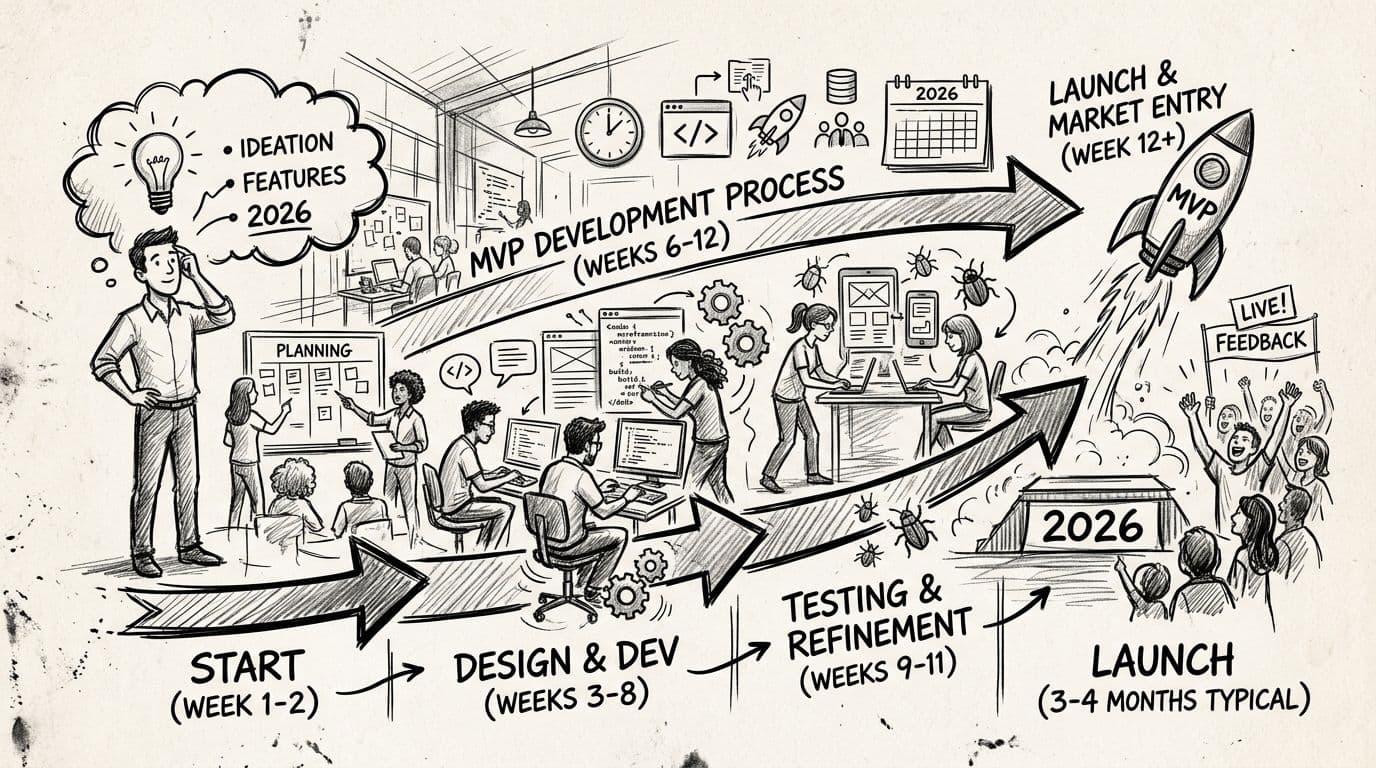
A typical MVP takes 2–4 months (8–16 weeks) from kickoff to launch in 2026 — lean single-feature builds ship in 4–8 weeks, while fintech or healthtech MVPs stretch to 3–6 months. The headline number excludes the two phases most teams forget: discovery and post-launch iteration, both of which the launch date has to absorb.
TL;DR
- Most MVPs launch in 8–16 weeks in 2026; the honest median is about 12 weeks.
- Lean single-feature builds ship in 4–8 weeks; regulated fintech takes 3–6 months.
- Altar.io's founder survey found MVPs average about 4 months, most commonly 3.
- No-code prototypes reach real users in 2–4 weeks, then usually get rewritten.
- Decision latency — not code — is the biggest schedule killer in MVP builds.
How long does it take to launch an MVP?
| MVP type | Timeline in 2026 | Source |
|---|---|---|
| Lean, single-feature MVP | 4–8 weeks | Forcoda (2026) |
| Standard SaaS or mobile MVP | 8–16 weeks | Forcoda (2026) |
| Average across founder-reported projects | About 4 months, most commonly 3 | Altar.io survey |
| No-code or low-code prototype | 2–4 weeks | Helpware (2026) |
| Fintech MVP | 8–16 weeks to MVP; 32–56 weeks to production-grade | SpaceO Technologies |
| Complex or regulated MVP | 16–24+ weeks | Forcoda (2026) |
The honest median for a dedicated team is around 12 weeks. Eight weeks happens when scope is disciplined and the founder is decisive; sixteen happens when the product has two distinct user types who both need to log in — that is not one MVP, it is two, and the timeline reflects it.
Anyone who quotes a timeline before a discovery conversation is guessing. The launch date is set by how many things must be true on launch day, not by how ambitious the vision is — and holding that line is what separates a team that owns the whole product from one that just codes tickets. The Magai platform Prizmstack built is what that ownership looks like across architecture, design, and delivery.
MVP timelines by product type in 2026
A lean single-feature MVP: 4–8 weeks
One user, one job, one path through the product. A scheduling tool for one type of clinic, a quoting calculator for one trade, a dashboard that replaces someone's spreadsheet.
It ships in 4–8 weeks because you deliberately refuse to build: no admin console, no role hierarchy, no self-serve onboarding. You do those things manually until enough people care. The catch — this only works if you actually know who your first user is. If you are still guessing, you are ready for customer research, not code.
A standard SaaS or mobile MVP: 8–16 weeks
This is where most funded startups land: real authentication, a billing flow (usually Stripe), a primary dashboard, a notification layer, and two or three integrations that matter to the buyer.
Mobile adds app-store submission. Apple reports that 90% of App Store submissions are reviewed in under 24 hours, but a rejection restarts the clock, so submit early and expect at least one round. If two user types each need their own login and views, budget 16 weeks — a two-sided product is two builds. That is not a hypothetical: the Customer Portal case study is exactly what shipping customer-facing and internal admin portals side by side looks like.
A fintech or healthtech MVP: 3–6 months
SpaceO Technologies' 2026 pricing analysis puts a fintech MVP at 8–16 weeks, a production-ready fintech app at 20–32 weeks, and enterprise-grade platforms with complex compliance at 32–56 weeks. The engineering is not necessarily harder — the dependencies are: sponsor-bank compliance reviews, processor underwriting, EHR sandbox credentials, none of which care about your board meeting.
If the product handles PHI, the HIPAA Security Rule applies to your MVP the same way it applies to a mature product — plan on adding 4–8 weeks versus a comparable non-regulated build. Build compliance-relevant architecture (encryption, audit logs, access controls) from day one, then pursue attestations in parallel with early pilots.
A no-code MVP: 2–4 weeks — then a rewrite
Helpware's 2026 breakdown puts a no-code or low-code prototype at 2–4 weeks and basic MVPs at 1–3 months. No-code moves fast for standard workflows but hits a ceiling on custom logic and integrations. Go in knowing it is a validation instrument, not a foundation — you will rewrite it, and that is fine, because the point is real users, not architecture.
Where the weeks actually go
On a typical 12-week build, the phases break down like this:
- Discovery and product definition (1–3 weeks). User interviews, feature prioritization, technical architecture, and a written scope everyone signs. This is the cheapest week to change your mind and the most expensive week to skip.
- UX/UI design and prototyping (2–4 weeks). Wireframes, a clickable prototype, and a lightweight component library — put it in front of five real users before a line of production code.
- Core engineering and integrations (6–12 weeks). The bulk of the calendar: backend, frontend, data model, and the unglamorous infrastructure nobody demos. Two-week sprints with a working demo at the end of each.
- QA and user testing (1–3 weeks). Overlaps development rather than following it. Automated tests on critical paths, then a closed beta with 10–20 real users.
- Deployment and launch (about 1 week). Production environment, monitoring, analytics instrumentation, and store submission if mobile.
The phases overlap — percentages deliberately run past 100%. Any agency showing you a clean waterfall Gantt chart is showing you a sales artifact, not a plan.
What makes an MVP launch in 4 weeks versus 9 months
- Scope discipline. A lean single-feature MVP ships in 4–8 weeks. Every "while we're in there, can we also..." costs about a week; four of them cost a month.
- Number of integrations. Each external system (payments, messaging, legacy data) adds design, error handling, and test time.
- Compliance and partner queues. Regulatory review, bank underwriting, and sandbox credentials run on their own clocks. In regulated industries, plan a 30–50% buffer.
- Decision latency. The single biggest schedule killer. A design question waiting four days for a founder who is out raising, multiplied across twenty decisions, quietly costs three weeks. Name one decision-maker and commit to a 24-hour turnaround.
- Team structure. A dedicated full team parallelizes design and build; a solo or part-time build serializes them. Two to four engineers plus a designer is the efficient range — past six, coordination overhead eats the gains.
- AI coding tools, honestly. METR's randomized trial famously found experienced developers were 19% slower with early-2025 AI tools while believing they were 20% faster; its 2026 update suggests agentic tooling has flipped much of that into a real speedup. The honest read: AI compresses the mechanical work, and does nothing for the decisions.
How fast do boutique studios move in 2026?
When you hire instead of build, published speeds differ mostly because of process, not talent. These are the closest boutique studios to Prizmstack, with what each currently publishes (checked October 2026):
| Studio | Published pace | Source |
|---|---|---|
| Diffco | Working AI proof of concept in 1–2 weeks | Diffco |
| AE Studio | Shipped a manufacturing ERP document-ingestion build in about 5 weeks, two weeks ahead of schedule | AE Studio case study |
| Markovate | Focused AI pilot in 4–6 weeks | Markovate |
| Leanware | Sprint 0 scoping in 2–4 weeks; one fitness app went concept-to-launch in about 4 months | Leanware case studies |
| NineTwoThree | Discovery call, then validation sprint, then build — no published week count | NineTwoThree |
| Goji Labs | Rapid strategy sprints before any build; 500+ products launched | Goji Labs |
| HatchWorks AI | Agentic AI pods that replace a team of 8–12, nearshore talent across the Americas | HatchWorks AI |
Notice what the fastest numbers have in common: they are scoping or pilot figures, not full-product launches. A 1–2 week proof of concept is real, and it is not an MVP — the launch-date math above still applies to the full build.
What actually tightens a studio's timeline is decision speed. The boutiques that publish tight estimates are the ones with direct access to the people doing the work — no account-manager layer between you and the code. That is how Prizmstack's product team operates: the founder is your client partner, strategists, designers, engineers, and QA scope the work together, scope stays flexible until it is signed, and the same team stays invested after launch instead of shipping and disappearing.
How to shorten your MVP timeline without cutting corners
- Cut to one workflow. Pick the single user journey that proves the product works, and build only what serves it — the 90/10 solution.
- Buy integrations, don't build them. Stripe, Twilio, and managed auth exist so you don't spend three weeks building payments. Assembling proven pieces saves 2–3 weeks versus building from scratch.
- Run design ahead of development, never in series. Flows and edge cases mapped before a single component is built eliminates the rework cycles that kill velocity.
- Test weekly, not at the end. QA that starts in week 10 finds the bugs that were cheap to avoid in week 3.
- Run strict two-week sprints with a hard demo. Working software every two weeks, or the timeline is fiction.
- Name one decision-maker. A 24-hour turnaround on questions moves schedules more than any tooling change.
What happens in the weeks after launch
Launch day is a start line. The MVP existed to generate evidence, and now you have to read it: activation rate, week-four retention, time-to-first-value. Most products need two or three meaningful iterations post-launch — roughly 8–12 weeks of active development before you are pitching traction instead of vision.
The stakes of getting scope right outlive launch week. CB Insights' analysis of failed startups puts poor product-market fit among the top causes of failure, cited in about 43% of cases. Building less and learning faster is the whole point of an MVP.
That post-launch loop — measure, fix, optimize — is also where most vendors vanish. Prizmstack treats the weeks after launch as the start of continuous optimization, with a structured stabilization and iteration cadence; the full framework is here.
FAQ
How long does it take to launch an MVP in 2026?
Most MVPs launch in 8–16 weeks in 2026. Lean single-feature builds ship in 4–8 weeks; complex fintech or healthtech MVPs take 3–6 months.
What is the average time to develop an MVP?
About 4 months, according to Altar.io's survey of founders, with 3 months the most common. Dedicated teams with tight scope routinely beat that.
How long does a no-code MVP take?
A no-code or low-code prototype takes 2–4 weeks, per Helpware's 2026 breakdown. Treat it as a validation instrument — custom logic and integrations usually force a rewrite.
Why do fintech and healthtech MVPs take longer?
Compliance work happens before the first feature ships: security architecture, KYC/AML, HIPAA. A HIPAA build adds about 4–8 weeks over a comparable non-regulated one.
Can an MVP really be built in 4 weeks?
Yes, but only for a genuinely single-feature product with one user type and no meaningful integrations. Four weeks for a two-sided marketplace is either a scope misunderstanding or a product you will rebuild.
Does a bigger team make an MVP faster?
Up to a point. Two to four engineers plus a designer is the efficient range; past six, coordination overhead eats the gains.
How long after launch should the next release come?
Plan the first 1–2 weeks for stabilization, then run real-user data into a 2–4 week release cadence. Most products need two or three meaningful iterations.
One last thing
Run the two-user-type test before you commit to a launch date: if two different kinds of user both need to log in and see different things, you are building two MVPs, and your timeline should say 16 weeks, not 8. Then ask every vendor you quote to name what is out of scope — a serious estimate names its assumptions: what is in, what is deferred, and who makes decisions and how fast. If a vendor cannot answer that, the date on their proposal is marketing.
Related guides
Topics covered
Written by Prizmstack Team
Full-spectrum software agency