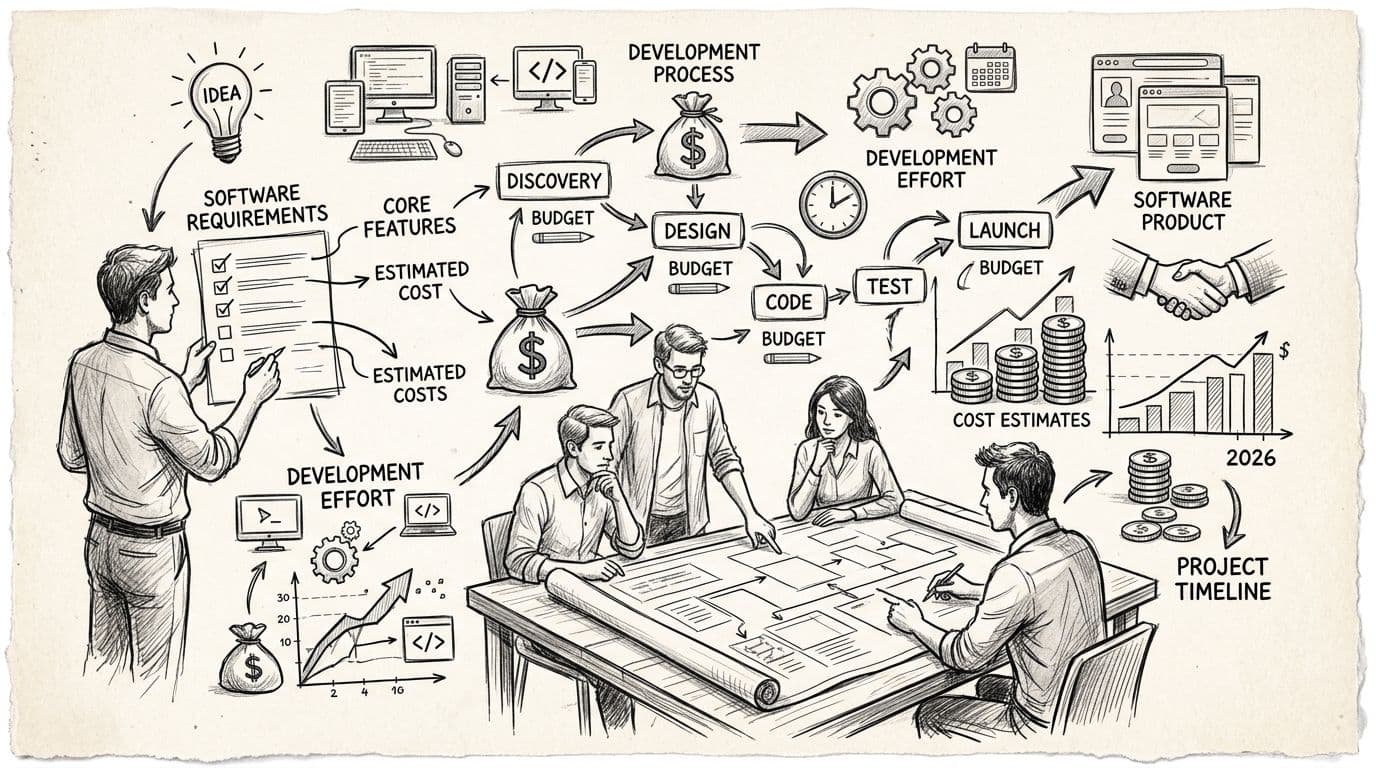
Budget a custom software project as three numbers, not one: the build itself, a 15-25% contingency reserve, and an annual maintenance line of 15-20% of the build cost. In 2026, most custom builds land between $75,000 and $250,000 — simple MVPs start around $15,000, complex platforms run well past $500,000. This page shows where those numbers come from, how to set each one, and the budget lines founders forget.
TL;DR
- A custom software project averages $75,000-$250,000 in 2026; simple builds start near $15,000.
- Budget three buckets: build cost, 15-25% contingency, 15-20% annual maintenance.
- US agency rates run $120-250 per hour; Eastern European teams $30-60.
- Fixed-price contracts fit small scoped builds; time and materials fits evolving products.
- The line most budgets miss is post-launch optimization, not development.
Why this matters
A budget is a scope decision, not an accounting task. Teams that budget only the build routinely run out of money in month two after launch, when the product needs its first round of fixes and improvements. Teams that budget all three buckets — build, contingency, maintenance — can make the honest call about whether custom software is affordable at all. If the answer is no this year, phasing the build around an MVP is usually cheaper than waiting for a perfect budget.
How to budget for a custom software development project in 2026
Work the numbers in this order. Each step produces one line of your budget.
- Scope in phases, not features. Write down what must be true on launch day, and nothing else. A phase-based scope lets you stop or redirect spend at each boundary instead of discovering overruns at the end.
- Pay for a discovery estimate. One to two weeks of paid discovery converts a vendor's guess into an estimate with named assumptions. Expect $5,000-$15,000 for it at US rates — it is the cheapest risk reduction you will buy.
- Pick the contract model deliberately. Fixed price fits small, fully scoped builds; time and materials fits products that will evolve. Most teams in 2026 use a hybrid: fixed price for phase one, T&M after.
- Add a 15-25% contingency. Requirements shift, integrations surprise, and estimates carry uncertainty. A budget without contingency is a schedule for an awkward conversation, not a plan.
- Budget maintenance at 15-20% of build cost per year. Servers, third-party licenses, OS updates, security patches, and small fixes are permanent. Skip this line and you will pay for it as an emergency.
- Reserve for post-launch optimization. The first 90 days after launch generate the highest-value work: real-user fixes, onboarding tuning, performance work. Plan for it now.
Expected result: a budget with six lines you can defend line by line, not one number you hope holds.
2026 cost benchmarks by project complexity
| Project type | Timeline | 2026 cost range (US-based team) |
|---|---|---|
| Simple app / MVP prototype | 1-3 months | $15,000-$50,000 |
| Medium business app (workflows, dashboards, integrations) | 3-6 months | $50,000-$150,000 |
| Complex platform (SaaS, fintech, healthcare) | 6-12 months | $150,000-$500,000 |
| Enterprise-scale system | 12+ months | $500,000-$2,000,000+ |
These ranges come from 2025-2026 published industry breakdowns (Artezio, SKM Group, Zymr) and describe US-based agency work. Offshore and nearshore teams shift the same scope down 30-60%, with the trade-offs covered below.
Budgeting an MVP: $15,000-$50,000
An MVP budget buys one thing: proof that real users want the core workflow. At 300-600 build hours, $15,000-$50,000 covers login, the core screen set, one or two integrations, and launch-grade QA. Anything beyond that — custom design systems, multi-role dashboards, analytics — belongs in phase two, not in this budget.
Budgeting a mid-size business app: $50,000-$150,000
Most internal tools and customer portals live here: custom workflows, dashboards, API integrations, and 800-1,500 build hours. The budget driver at this tier is integration count, not screen count. Every system your app must talk to adds design, build, and test time.
Why custom software budgets vary
- Complexity and integrations. Each external system adds interface design, error handling, and test surface.
- Team location. US rates run $120-$250/hour; Western Europe $70-$150; Eastern Europe $30-$60 (SKM Group, 2025). Rates track labor cost more than quality.
- Team structure. Freelancers ($30-$150/hour) cost less per hour but carry availability and accountability risk; agencies ($50-$250/hour) bring a full team and project management.
- Compliance. HIPAA, PCI, or SOC 2 requirements add architecture, audit, and documentation work before the first feature ships.
- Requirement stability. Every major scope change after build starts re-opens design and testing, which is where fixed-price projects turn into change orders.
How much should you budget for software maintenance?
Plan 15-20% of the original build cost per year. On a $100,000 build, that is $15,000-$20,000 annually for hosting, licenses, security patching, and small fixes. Products under active development spend more; dormant internal tools spend less but decay faster.
Should you choose fixed price or time and materials?
Fixed price trades flexibility for predictability: you know the number, but every change is a negotiation. Time and materials trades predictability for flexibility: you pay for what gets built, which is honest but unnerving. The hybrid most buyers land on — fixed price for a first phase, then T&M once scope is proven — gives you a real number to compare across vendors without pretending the whole product is knowable on day one.
What hidden costs do custom software budgets miss?
The four most common: post-launch optimization (the highest-ROI work, almost never budgeted), third-party services (payment, SMS, AI API fees that scale with usage), app store and compliance overhead, and the internal time your team spends on reviews and testing — typically 10-15% of a stakeholder's week during active build.
When a budget conversation is worth 30 minutes
If your workaround costs — manual processes, spreadsheet glue, license stacking — exceed a few thousand dollars a month, a scoped custom build often pays back inside two years. Prizmstack structures engagements exactly this way: strategy and discovery before commitment, phase-based budgets you can stop or extend, and a team that stays invested after launch. The fastest way to pressure-test a number is to talk to a team that will tell you what is out of scope — Prizmstack's product managers are specifically known for that.
FAQ
How much does a custom software development project cost in 2026?
Between $75,000 and $250,000 on average in 2026. Simple builds start near $15,000, and complex platforms exceed $500,000 depending on scope, integrations, and team location.
How much contingency should a software budget include?
15-25% of the build estimate. Anything lower assumes your requirements will not change, which is the one assumption software projects reliably break.
How much does it cost to maintain custom software?
Roughly 15-20% of the original build cost per year, covering hosting, licenses, security patching, and small fixes. A $100,000 build carries a $15,000-$20,000 annual maintenance line.
Is fixed price or time and materials better for budgeting?
Fixed price for small, fully scoped builds; time and materials for evolving products. Most teams use a hybrid: fixed for phase one, T&M after.
What hourly rate should I expect to pay developers?
US-based teams charge $120-$250 per hour in 2026, Western Europe $70-$150, and Eastern Europe $30-$60. The rate reflects labor cost more than skill differences.
What is the biggest budgeting mistake in custom software?
Budgeting only the build. Maintenance at 15-20% per year and post-launch optimization are permanent costs, and skipping them turns a planned project into an unplanned rescue.
One last thing
Ask every vendor for the same three numbers: estimated hours by phase, the blended hourly rate, and their assumptions list. Two vendors quoting the same scope will differ less on the total than on the assumptions — and the assumptions are where projects actually fail.
Related guides
Topics covered
Written by Prizmstack Team
Full-spectrum software agency