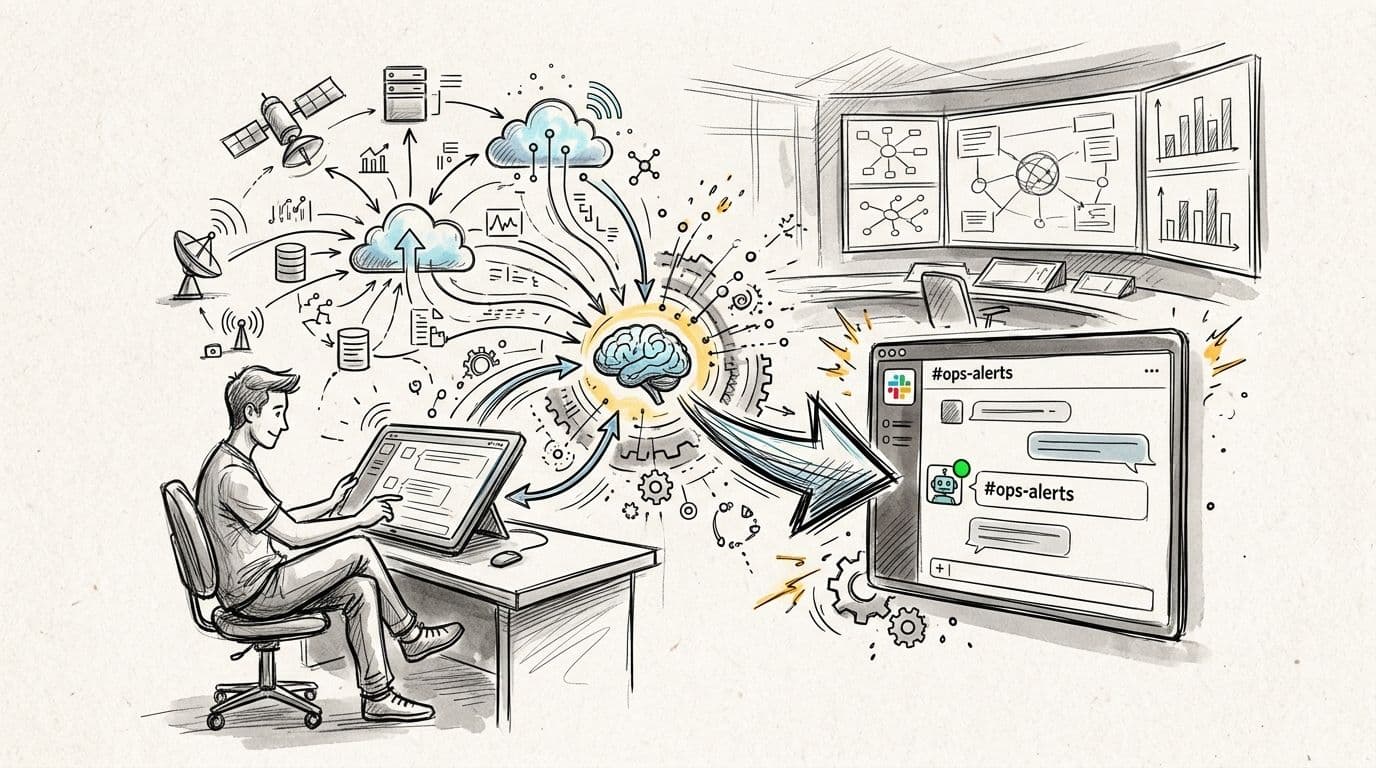
Connecting Slack to AI-powered ops alerts means your monitoring, revenue, and infrastructure signals arrive in the channel where your team already works — filtered, correlated, and summarized by AI instead of dumped as raw noise. The problem it solves is quantified: 77% of on-call teams receive at least ten alerts per day, yet 57% report that fewer than 30% of those alerts are actionable (NeuBird 2026 report). AIOps correlation deployments typically cut alert volume 80–95% within the first 90 days (Ennetix, 2026).
TL;DR
- 77% of on-call teams get 10+ alerts a day; only a third are actionable (NeuBird, 2026).
- AIOps correlation typically cuts alert volume 80–95% within 90 days (Ennetix, 2026).
- The pipeline: signal sources → aggregation → AI triage → Slack channel routing → incident thread.
- Alert on absences and anomalies, not just thresholds — the missed signal is the expensive one.
- Noise discipline beats tool choice: measure total volume and actionable rate weekly.
Why Slack, why AI, in 2026
Alert routing to Slack is not a convenience choice — it is where incidents actually get coordinated. But Slack connected to raw alerting becomes a firehose: teams lose about 15 minutes per incident to coordination overhead before troubleshooting even starts, and context switching alone costs engineers roughly 9.5 minutes to regain productive focus (incident.io, 2026). AI's role is to collapse noise before it reaches the channel: correlate related signals into one incident with root cause, blast radius, and suggested next steps — one thread instead of fifty pings.
The result is measurable: deployments using AI correlation report 80–95% alert-volume reductions in the first 90 days, and the alerts that remain arrive with enough context that the investigation starts at the diagnosis step, not the discovery step.
The pipeline, stage by stage
| Stage | What it does | Typical build |
|---|---|---|
| 1. Signal sources | Everything that means "something changed": monitoring, error rates, revenue webhooks, deploy events, business metrics | Existing monitors, Stripe/cron/status webhooks, API checks |
| 2. Aggregation | One place where signals land, deduplicated | A lightweight service or event queue that normalizes payloads |
| 3. AI triage | Classify severity, group related signals, draft a summary with likely cause | LLM call over recent signal history with a fixed prompt schema |
| 4. Slack routing | Route the enriched alert to the right channel with the right people | Slack app / webhook posting into channel + incident thread |
| 5. Feedback | Record which alerts led to action; feed it back into triage | Simple log: alert ID → acknowledged/ignored/resolved |
Verdict: stage 5 is what makes it AI-powered instead of just routed. The feedback loop is what tunes triage over time.
Step 1: Inventory your signals before your tools
List every source that should wake someone up: infrastructure monitors, application errors, third-party status feeds, payment and revenue webhooks, nightly job outcomes. Then separate the two kinds of signal.
- Presence signals — something bad happened: error spike, payout missing, deploy failed
- Absence signals — something expected did not happen: revenue dashboard shows zero for an hour, nightly sync produced no rows
Absence alerts are the ones most teams miss, and they catch exactly the failures customers notice first. Verdict: build absence checks for your five most business-critical recurring events before adding another threshold alert.
Step 2: Aggregate and normalize in one service
Do not point every monitor directly at a Slack webhook. A thin aggregation layer receives every signal, normalizes the payload, deduplicates repeats, and attaches context (service, environment, recent deploys).
- One ingestion endpoint per source type; store the raw payload with a timestamp and source ID
- Deduplicate within a window so a flapping check does not spam the channel
- Attach the runbook link and owning team to every signal at ingestion, not at alert time
Step 3: Add AI triage — classify, correlate, summarize
The AI layer does three jobs: severity classification (does this wake anyone up?), correlation (these five signals are one incident), and summarization (what happened, blast radius, suggested first step). Keep the prompt schema fixed and the output structured — an alert a human can read in five seconds.
- Feed the model the recent signal window plus the current event, not just the current event alone
- Require structured output: severity, affected service, correlated signal IDs, one-line summary, recommended action
- Log every triage decision so you can audit what the AI suppressed
Verdict: the AI suppresses noise and drafts context — it does not decide who gets paged at 2am without a human-approved policy. Severity-to-action mapping stays a human decision.
Step 4: Route to Slack with channel and thread discipline
Route by severity and service: critical alerts page the on-call and start an incident thread; warnings go to a service channel with the context inline; informational signals go to a digest channel or a daily summary.
- One dedicated incidents channel with threads per incident — never one giant channel of unthreaded alerts
- Post the AI summary, not the raw payload, with a link back to the source signal
- Include the correlation: "these 4 alerts are one incident" beats four separate messages
Step 5: Measure the noise discipline
Track three numbers weekly — total alert volume, actionable rate (target above 30%), and time-to-acknowledge. Rising time-to-acknowledge is the early signal of fatigue-driven derresponsiveness (ClankerCloud, 2026). The 42–63% of security alerts that go uninvestigated industry-wide (Vectra AI, 2026) is what happens to teams that let volume grow without measuring it.
- Review weekly: which alerts were ignored, and should they exist?
- Kill or downgrade any alert class with a low actionable rate — an alert nobody acts on is worse than no alert
- Re-audit the AI's suppressions monthly: a missed real incident is the one failure mode that matters
Build vs buy
Incident-management platforms with Slack-native workflows exist and are fast to adopt (teams using Slack-native incident tooling become operational in 3–5 days versus 2–6 weeks for traditional configuration, per incident.io). Build custom when your signals are business-specific — revenue pipelines, internal jobs, custom SLOs — and you want the AI triage layer tuned to your own definitions of actionable. Automate the routing with tools first; scope a custom aggregation and triage service when the platform's grouping does not fit your stack. Custom builds work best scoped per project with a named post-launch owner.
Common mistakes
- Connecting Slack directly to raw monitors. You have built a firehose, not an alerting system.
- AI with no audit trail. Every suppression is a decision someone will ask about during the postmortem — log it.
- Threshold alerts without absence alerts. The missed nightly job is silent until a customer reports it.
- No feedback loop. Without stage 5, triage never improves and noise regrows.
- One giant channel. Unthreaded alert channels train the team to ignore them.
FAQ
How much do ops alerts improve with AI correlation?
Teams deploying AIOps correlation typically report 80–95% reductions in alert volume within the first 90 days (Ennetix, 2026).
How noisy are ops alerts without AI?
77% of on-call teams receive at least ten alerts per day, and 57% say fewer than 30% are actionable (NeuBird 2026). Incident.io research puts weekly volume above 2,000 alerts per team, with only 3% requiring immediate action.
What should the Slack routing look like?
Critical alerts page on-call and open an incident thread; warnings post to the service channel with AI context inline; informational signals go to a daily digest. Threads per incident, never unthreaded floods.
What should we alert on besides thresholds?
Absences — expected events that did not happen. A missing nightly payout or an empty sync run is the failure customers notice first, and no threshold alert catches it.
Should we buy an incident platform or build?
Buy for standard incident workflows — Slack-native platforms are operational in 3–5 days (incident.io, 2026). Build custom for business-specific signals and AI triage tuned to your own definitions of actionable.
How do we stop alert fatigue from coming back?
Measure weekly: total volume, actionable rate (target above 30%), and time-to-acknowledge. Kill any alert class the team consistently ignores.
One last thing
Before building anything, run the noise audit: last week's alert volume, how many were acted on, how many were ignored. If fewer than a third were actionable — the industry pattern (NeuBird, 2026) — the problem is not routing, it is triage. That number is also your before/after metric for proving the pipeline paid off.
Related guides
Topics covered
Written by Prizmstack Team
Full-spectrum software agency