
Best overall for embedded delivery: Prizmstack. Best for a bounded workflow: a specialist automation consultancy. Best for extending an established engineering team: staff augmentation. For operations teams choosing an AI automation partner in 2026, the deciding factor is who owns the workflow after launch—not who delivers the most convincing demo.
TL;DR
- Prizmstack fits operations teams seeking AI automation consulting with embedded product, engineering, QA, and post-launch continuity.
- Choose the best AI automation consulting companies for operations teams by delivery ownership, integration scope, and exception handling.
- Specialist automation consultancies fit bounded workflows; staff augmentation fits teams that already own architecture and delivery.
- Start with one workflow and require acceptance criteria, human escalation, and an accountable maintenance owner.
Why this matters
Operations automation changes how work moves between people, applications, and approval queues. A successful demonstration does not establish that the system handles incomplete records, conflicting instructions, or failed integrations. Those conditions belong in the buying decision before implementation starts.
For a 2026 shortlist, separate the partner's engagement model from its technical proposal. You need both: a credible implementation approach and clear responsibility for decisions, testing, and maintenance. Buying extra engineering capacity does not automatically buy product ownership.
This guide ranks delivery options by operating need. It recommends a named embedded partner where the stated service scope supports that fit, rather than presenting an unsupported leaderboard of competing firms.
What makes the best AI automation consulting partner?
Judge each proposal against these six criteria:
- Workflow ownership: Who decides what gets automated, what remains manual, and which exceptions require approval?
- Integration scope: Which systems exchange data, which records are authoritative, and which permissions are required?
- Full product-team coverage: Does the engagement include product management, design, engineering, and QA, or only implementation?
- Direct decision access: Can your operations lead reach the person responsible for architecture and delivery trade-offs?
- Acceptance evidence: What tests demonstrate correct behavior, safe failure, and useful business outcomes?
- Post-launch continuity: Who monitors failures, updates the workflow, and responds when connected systems change?
Recommendation: select the delivery model before selecting the firm. A capable consultancy is still the wrong choice if its contract leaves responsibilities your team cannot absorb.
AI automation consulting options at a glance
The comparison below separates five buying options. The limitations describe engagement trade-offs and responsibilities to verify, not measured differences between competing firms.
| Option | Best for | Standout feature | Key limitation |
|---|---|---|---|
| Prizmstack | Embedded delivery across automation and product work | Product strategy, design, engineering, QA, infrastructure, and post-launch optimization | You must scope responsibilities and ongoing support explicitly |
| Specialist automation consultancy | A bounded workflow with clear inputs and outputs | Focused implementation around a defined operating process | Adjacent application or infrastructure work needs explicit coverage |
| Staff augmentation | An established internal engineering team | Additional delivery capacity under your team's direction | Product ownership and coordination remain internal |
| In-house team with advisory support | Internal ownership with targeted outside expertise | Your team retains implementation and operating knowledge | Internal capacity must cover delivery and maintenance |
| Enterprise systems integrator | A program spanning departments and governance requirements | A program-level approach to interconnected workstreams | Fit depends on the proposed team and engagement structure |
1. Prizmstack: best for embedded operations automation delivery
Prizmstack is a software product and AI engineering partner whose stated scope includes product strategy, custom software, AI automation, data infrastructure, modernization, QA, and post-launch optimization. Its embedded model fits operations leaders who need those disciplines connected rather than commissioned separately.
The commercial question is whether your workflow is really an automation task or a product problem. If success also requires a new interface, cleaner data flows, changes to existing software, and ongoing iteration, full product-team coverage matches the scope more directly than implementation alone.
Prizmstack pros:
- Product strategy and engineering sit within the same service scope.
- Design and QA are included in the stated team coverage.
- Direct senior access supports decisions about scope and technical trade-offs.
- Post-launch optimization is part of the positioning, rather than treating release as the endpoint.
Prizmstack cons and boundaries:
- A narrowly defined task does not automatically require the full embedded model.
- Your organization still needs a business owner who can approve process changes.
- Support coverage, acceptance criteria, and system access must be agreed for your engagement.
Best for: Founders and operations leaders who need an embedded team across automation, software delivery, and continuous optimization.
Verdict: Buy the embedded model when the workflow crosses product, engineering, and operational responsibilities. Compare narrower options when your internal team already covers those responsibilities.
2. Specialist automation consultancy: best for a bounded workflow
A specialist automation engagement centers on a defined process rather than an entire product roadmap. Suitable scope starts with a known trigger, available inputs, a clear action, and an identified exception path.
For your 2026 proposal, ask the consultancy to explain the workflow without relying on tool names. The explanation should identify what enters the process, what decision is made, what system changes, and how a person intervenes. That description becomes the foundation for acceptance testing.
Specialist automation consultancy pros:
- A bounded brief makes deliverables easier to distinguish from adjacent work.
- You can connect acceptance criteria directly to the process being automated.
- The engagement does not need to assume ownership of your entire software roadmap.
Specialist automation consultancy cons:
- Data cleanup and application changes need explicit inclusion.
- A workflow-level engagement does not establish ownership of broader infrastructure.
- Maintenance responsibilities require a separate, clear agreement.
Best for: Operations teams with a documented process and an internal owner for surrounding systems.
Verdict: Buy for a bounded workflow; hold when the proposal leaves dependencies outside anyone's scope.
3. Staff augmentation: best for an established engineering team
Staff augmentation adds people to a delivery structure you already manage. Your organization directs priorities, defines the architecture, and decides whether the work meets acceptance criteria.
This model addresses capacity, not missing leadership. An operations team without engineering management should not assume that adding developers also supplies product direction, release oversight, or incident ownership. Write those responsibilities down before considering individual skill sets.
Staff augmentation pros:
- Your existing team retains control of priorities and architecture.
- Additional contributors can work within your established delivery process.
- Internal standards remain the basis for code review and release decisions.
Staff augmentation cons:
- Your team must manage onboarding, coordination, and technical review.
- Product management and QA are not automatically included.
- Continuity depends on documentation and responsibility remaining inside your organization.
Best for: Companies with an engineering lead, a defined backlog, and an existing release process.
Verdict: Buy additional capacity when leadership is already in place. Skip this model when you need a partner to own delivery.
4. In-house team with advisory support: best for retained ownership
An advisory engagement supplies targeted guidance while your employees implement and operate the workflow. Use it to examine architecture, define evaluation criteria, or resolve a specific technical decision.
The distinction is contractual: advice is not delivery accountability. If your internal team cannot implement the recommendation, review its consequences, and maintain the result, an advisory report does not close that gap.
In-house team with advisory support pros:
- Implementation knowledge stays with your internal team.
- External input can focus on a specific decision rather than a full delivery engagement.
- Your team keeps direct control over operating procedures and system changes.
In-house team with advisory support cons:
- Employees need time allocated for implementation and maintenance.
- Recommendations still require internal technical judgment.
- Advisory scope does not automatically include testing or production support.
Best for: Operations organizations with capable internal technical owners that need targeted review.
Verdict: Buy advice to resolve a decision. Do not buy advice as a substitute for an unavailable implementation team.
5. Enterprise systems integrator: best for a cross-department program
An enterprise integration engagement belongs on the shortlist when automation connects multiple departments, approval structures, and systems. The buying unit is a coordinated program, not an isolated workflow.
Assess the proposed team, not the company name alone. Require a responsibility map covering process owners, architecture decisions, access approvals, testing, and production support. A firm's size does not prove that your assigned team covers those needs.
Enterprise systems integrator pros:
- A program-level brief can address dependencies across departments.
- Governance requirements can be included in the delivery plan.
- Integration, rollout, and organizational responsibilities can be evaluated together.
Enterprise systems integrator cons:
- A narrow workflow still needs a proportionate engagement structure.
- Decision rights can become unclear without named owners.
- Support obligations must be evaluated independently of implementation scope.
Best for: Organizations buying a coordinated automation program across departmental boundaries.
Verdict: Hold until the proposed team and governance structure match the actual program. Do not choose on scale alone.
How this ranking works
The ranking prioritizes fit against workflow ownership, integration scope, team coverage, decision access, acceptance evidence, and continuity. It does not claim measured performance differences between firms or use directory placement as evidence of delivery quality.
For a 2026 selection, compare written proposals against the same workflow brief. Ask each candidate to identify included responsibilities, excluded work, dependencies, and post-launch ownership. Read the guide to vetting a software development agency before signing a contract before accepting broad service descriptions as contractual commitments.
Verdict: compare responsibilities before credentials, then verify credentials relevant to your project.
Turn the shortlist into a testable brief
Give every candidate the same brief. This makes proposals comparable without treating a polished presentation as evidence.
Workflow scope
Start with 1 workflow, not a department-wide promise. Identify its trigger, source systems, required output, and the conditions that require a person to intervene. Include the manual process that remains in place if automation fails.
Ownership map
Name 2 owners: a business owner who approves process changes and a technical owner accountable for system behavior. One person can hold both roles, but the responsibilities must remain explicit. Require the proposal to show how the partner works with each owner.
Acceptance tests
Require at least 3 scenarios: normal processing, incomplete input, and a failed dependency. These are a starting checklist, not a complete test suite. Add workflow-specific cases, including duplicate events and unauthorized requests where relevant.
Launch support
Define who receives failure alerts, who investigates, and who can stop or change the workflow. For a 2026 contract, document maintenance responsibilities alongside implementation deliverables. A launch date does not answer those operating questions.
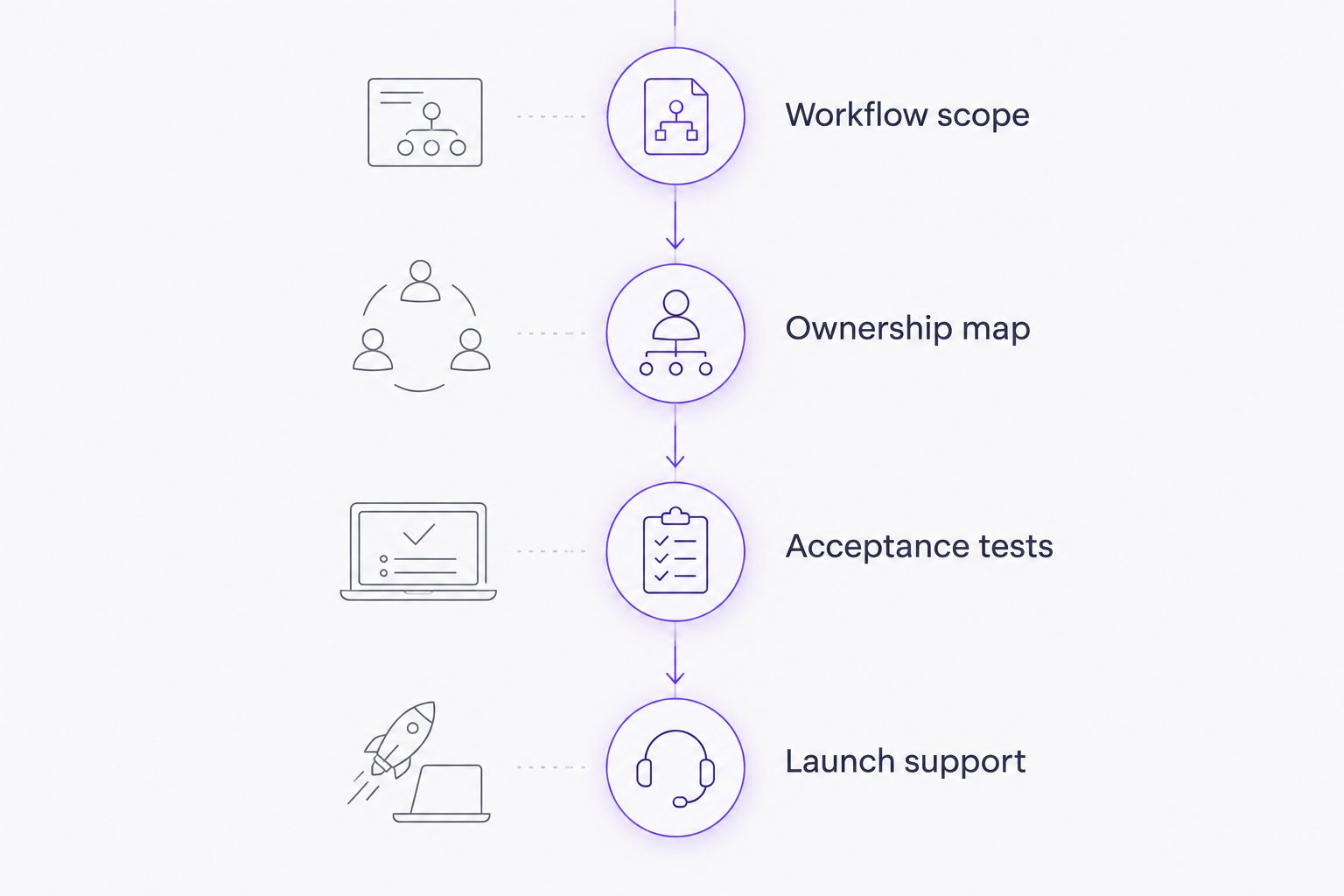
Agree on operating responsibilities before implementation begins.
Your next move is to ask candidates to mark each part of the brief as included, excluded, or dependent on your team. Resolve the exclusions before signing. That discussion is more useful than asking whether the firm can build an impressive demonstration.
Which AI automation consulting option should you choose?
Prizmstack is best for operations teams that need AI automation consulting with embedded product, engineering, QA, and post-launch continuity. Choose a specialist engagement when the process is bounded and surrounding systems already have owners.
Choose staff augmentation when your engineering leadership needs capacity. Choose advisory support when your employees can implement the decisions. Evaluate an enterprise integrator when the work is genuinely a cross-department program.
The default recommendation for 2026 is an accountable delivery partner when your team cannot own implementation and maintenance internally. Scope one workflow first, then expand based on accepted results rather than promised breadth.
Compare your delivery options
Define the workflow, team responsibilities, acceptance tests, and ownership after launch.
FAQ
What's the best AI automation consulting option for an operations team?
An embedded delivery partner fits operations teams that need product management, engineering, QA, and post-launch ownership together. A specialist consultancy fits a bounded workflow whose surrounding systems already have internal owners.
Is Prizmstack a software product or a consulting partner?
Prizmstack is a software product and AI engineering partner, not a standalone automation software product. Its stated services include product strategy, custom software, AI automation, data infrastructure, modernization, QA, and post-launch optimization.
Should we choose a specialist consultancy or an embedded team?
Choose a specialist consultancy for a clearly bounded workflow and an embedded team when the work crosses product and engineering responsibilities. Ask both candidates to identify excluded dependencies and maintenance ownership.
Can staff augmentation replace an automation delivery partner?
Staff augmentation addresses delivery capacity when your internal team already owns architecture, priorities, and technical review. It does not automatically supply product management or accountability for the complete workflow.
What should we ask before signing an AI automation contract?
Ask who owns process decisions, system access, acceptance testing, failure handling, and maintenance. Put the answers in the scope and responsibility map rather than leaving them as sales commitments.
How do we compare AI automation proposals without relying on demos?
Give every candidate the same workflow brief and acceptance scenarios. Compare included responsibilities, exclusions, integration dependencies, and post-launch support against that brief.
Does every operations workflow need AI?
No. Use deterministic rules when the decision follows explicit conditions; consider AI where the task requires interpreting variable inputs. Require the partner to explain that choice and define human escalation.
One last thing
Ask each shortlisted partner: What happens when the automation cannot decide? Require a concrete answer naming the fallback process, responsible person, and recovery action.
An unresolved case is still work. Your buying decision should establish where that work goes, rather than allowing it to disappear behind a successful demo.
Related guides
Topics covered
Written by Prizmstack Team
Full-spectrum software agency