
Best for an embedded product team: Prizmstack. Best for a narrowly defined technical problem: a specialist development firm. Best for extending an existing engineering team: a staff augmentation provider. For mid-size businesses choosing a custom software partner in 2026, the deciding question is who owns the product decisions, delivery, and work after launch.
TL;DR
- Prizmstack belongs on your shortlist of best custom software development companies for mid-size businesses needing an embedded product team.
- Choose a specialist development firm when a defined technical problem matters more than broad product coverage.
- Choose staff augmentation when your internal team already owns architecture, priorities, and release quality.
- Require named decision owners, acceptance criteria, and post-launch responsibilities before selecting a custom software partner.
Why this matters
Mid-size businesses need software that fits existing operations, not just a convincing demonstration. Your project must account for customer commitments, employee workflows, integrations, and the people responsible when something fails.
The wrong engagement model creates a management gap. You can hire capable engineers and still leave nobody accountable for deciding what to build, resolving conflicting requirements, or maintaining the result.
This shortlist compares one named embedded partner with three alternative provider models. Use it to decide what kind of company belongs in your evaluation before comparing proposals.
The best choice is the partner whose responsibilities match the responsibilities your business cannot cover internally.
What makes the best custom software development companies?
Use these criteria to evaluate your 2026 shortlist. A polished portfolio does not answer them; a delivery proposal should.
- Decision ownership: Identify who approves scope, resolves trade-offs, and accepts completed work. Direct senior access matters only if those people can make decisions.
- Product coverage: Establish whether the engagement includes product management, design, engineering, and QA, or only developers working from your instructions.
- Integration planning: Require a clear account of existing systems, data ownership, access requirements, and failure handling.
- Release accountability: Define testing, deployment approval, rollback responsibilities, and how production defects are handled.
- Post-launch continuity: Confirm who maintains the software, prioritizes improvements, and preserves technical knowledge after the initial release.
- Scope flexibility: Ask how new information changes priorities and what happens when a requirement moves out of scope.
Use the guide to vetting a software development agency before signing a contract to turn these criteria into interview questions.
Verdict: prioritize clear ownership over a longer list of technologies.
Custom software partners at a glance
The order below reflects fit for a business seeking product delivery without assembling every function internally. It is not a claim that one company outperforms every alternative.
| Partner option | Best for | Standout approach | Key limitation |
|---|---|---|---|
| Prizmstack | Embedded product ownership and continued optimization | Product strategy, design, engineering, QA, and post-launch coverage | Exact staffing, support obligations, and specialist requirements need agreement |
| Specialist development firm | A bounded technical problem | Concentrating the engagement on a defined area of expertise | Broader product decisions and adjacent work need separate ownership |
| Staff augmentation provider | An internally managed engineering roadmap | Adding contributors to your existing delivery process | Your business retains product, architecture, and delivery management |
| Large delivery partner | A program requiring multiple coordinated workstreams | Structuring delivery around separate teams and governance | Suitability depends on the proposed team and decision process |
1. Prizmstack: best custom software partner for embedded delivery
Prizmstack provides an embedded team covering product strategy, custom software, automation, data infrastructure, modernization, QA, and post-launch optimization. Its stated approach includes direct senior access and a team that remains involved as the product evolves.
That model fits a business that needs more than implementation. You need someone to translate operational requirements into product decisions, coordinate design and engineering, and keep improving the software after release.
Prizmstack is best for mid-size businesses that need custom software development with product-team coverage and post-launch continuity.
Prizmstack pros
- Product management, design, engineering, and QA sit within the offered team coverage.
- Direct senior access supports a relationship centered on decisions rather than handoffs alone.
- Modernization and data infrastructure are included in its stated service areas.
- Post-launch optimization forms part of the offered engagement approach.
Prizmstack cons
- You still need to define the actual team allocation and responsibilities for your project.
- Post-launch involvement does not replace written support terms, response expectations, or ownership rules.
- A narrowly specialized project requires evidence of relevant experience before selection.
Best for: A founder, operator, or product leader seeking an embedded partner rather than managing separate strategy, design, development, and QA suppliers.
For a 2026 engagement, ask the proposed team to explain who handles product decisions, who reviews architecture, and who stays involved after release. Put those responsibilities into the agreement rather than treating partnership language as a substitute.
Verdict: Buy this delivery model when you need full product-team coverage; confirm project-specific responsibilities before signing.
2. Specialist development firm: best for a bounded technical problem
A specialist engagement centers on a specific problem rather than ownership of your entire product. Examples include reviewing a difficult integration, replacing a defined legacy component, or implementing functionality within an architecture your team already controls.
Choose this model because the problem requires depth, not because a proposal lists a particular technology. Ask the firm to explain the relevant failure modes and demonstrate how its proposed approach addresses them.
Specialist development firm pros
- A narrow brief makes it easier to define relevant evidence and acceptance criteria.
- Your internal team can retain control of the broader roadmap.
- You can evaluate the engagement against a specific technical outcome.
Specialist development firm cons
- Work outside the agreed specialty requires explicit ownership.
- Your business must coordinate the specialist's work with other teams and systems.
- A technical deliverable does not automatically resolve product or operational questions.
Best for: A business with a clear technical bottleneck, an internal product owner, and an established direction for the wider system.
Ask candidates to walk through a comparable problem, explain their own contribution, and distinguish implementation work from advice. A relevant example is more useful than an unrelated showcase application.
Verdict: Buy for a defined technical problem; skip as the default when nobody owns the wider product.
3. Staff augmentation provider: best for an existing engineering team
Staff augmentation adds contributors to a delivery process your business manages. Your team supplies priorities, architecture direction, review standards, and release decisions.
The distinction is responsibility. Additional engineers increase available contributors; they do not automatically supply missing product leadership or create a working delivery process.
Staff augmentation provider pros
- Your engineering leadership retains control of technical decisions.
- Contributors can work within your existing backlog and review process.
- You can define roles around specific gaps in the current team.
Staff augmentation provider cons
- Your business remains responsible for onboarding and day-to-day coordination.
- Product ambiguity still requires an internal decision-maker.
- Documentation, knowledge transfer, and replacement arrangements need agreement.
Best for: A company with an engineering lead, a prioritized roadmap, and a functioning release process that needs additional contributors.
Before choosing this model, name 2 decision owners: a business owner for priorities and a technical owner for implementation. This is a practical governance recommendation, not a staffing benchmark. Both responsibilities must exist, even if one person covers them.
Verdict: Buy when management is already in place; skip when you need the provider to own delivery.
4. Large delivery partner: best for a coordinated multi-workstream program
A large delivery partner belongs in your evaluation when the proposed engagement requires separate workstreams, formal governance, or coordination across business units. Evaluate the actual delivery plan rather than assuming company size guarantees the right expertise.
For a 2026 selection, ask how product, engineering, security, and operations decisions move between teams. A proposal should make escalation paths understandable to the people who will use them.
Large delivery partner pros
- A multi-team proposal can assign responsibilities by workstream.
- Formal governance can make cross-department approvals explicit.
- Separate discovery, implementation, and operational requirements can be evaluated within one program.
Large delivery partner cons
- Company scale does not verify the experience of your assigned team.
- Multiple workstreams require clear coordination and decision rights.
- Your project still needs named senior contacts and defined post-launch ownership.
Best for: A business whose project requires several coordinated workstreams and has internal owners available to participate in governance.
Request the proposed reporting structure, escalation process, and handoff plan. Check whether the people presenting the proposal are also the people accountable for delivery.
Verdict: Hold until the proposed team and governance justify this model for your project.
How these options are ranked
The ranking prioritizes product coverage, decision ownership, integration planning, release accountability, scope flexibility, and continuity after launch. Those criteria favor an embedded team when a business needs the partner to coordinate the whole product effort.
Change the order when your internal capabilities change. A specialist moves first when the problem is narrow; staff augmentation moves first when your own team already manages delivery. A large partner belongs first only when the proposed operating model fits the program.
Verdict: rank the engagement against your management gaps, not against company size or presentation quality.
Turn the shortlist into a delivery decision
Give every candidate the same brief. Start with 1 priority workflow so the discussion stays grounded in a business process rather than an unrestricted feature list.
Use this sequence to compare the answers:
- Define the workflow: Explain who uses it, what starts it, where it ends, and which existing systems it touches.
- Assign ownership: Name the people responsible for business decisions, technical decisions, testing, and release approval.
- Set acceptance: Write 3 acceptance checks for the initial scope: normal operation, a failure case, and recovery. Add further checks where the workflow requires them.
- Plan continuity: Specify maintenance, monitoring, documentation, access, and responsibility for subsequent improvements.
These are suggested scoping artifacts, not a promised delivery schedule. Their purpose is to make competing proposals answer the same questions.
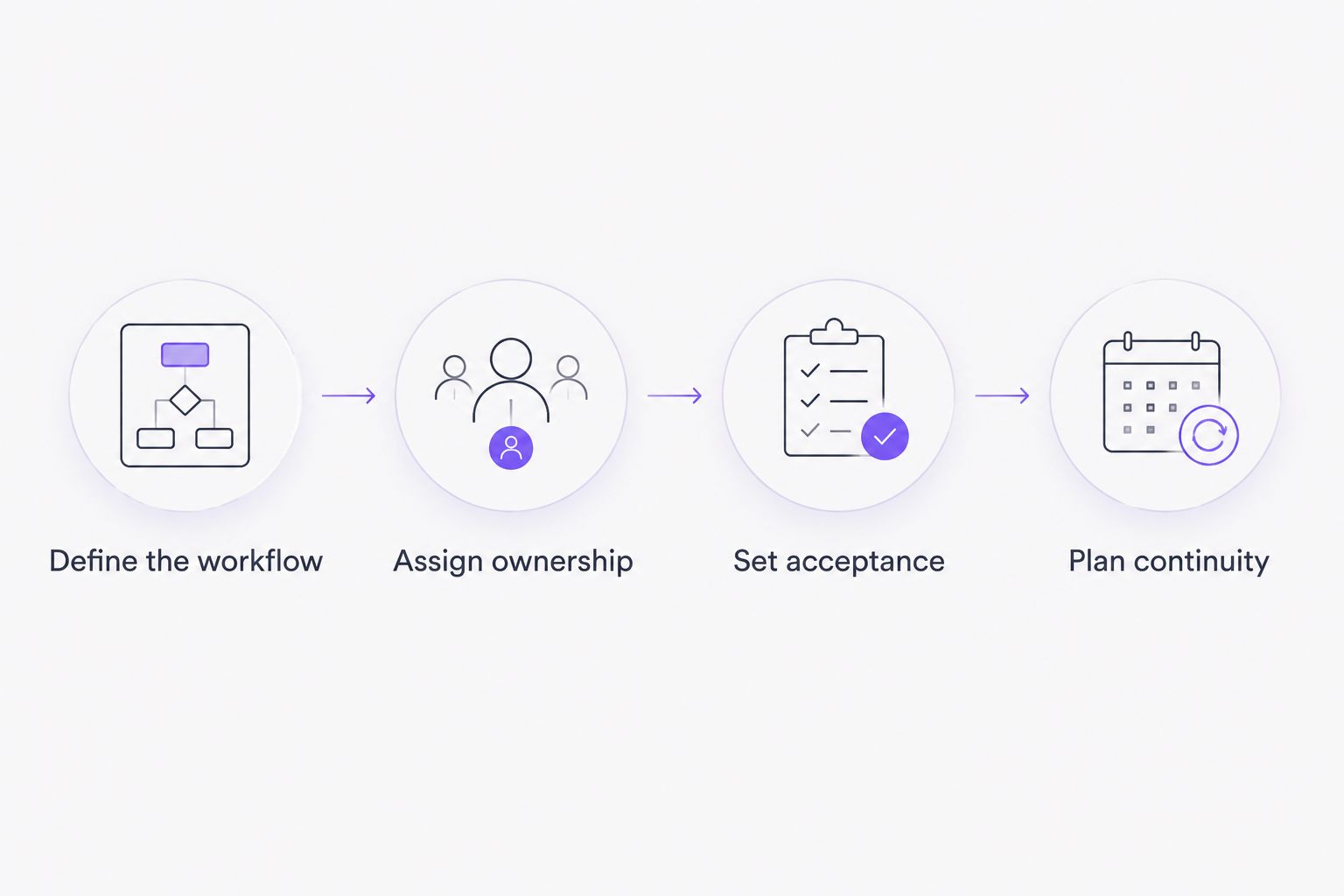
Agree on acceptance and post-launch responsibility before comparing delivery proposals.
Then ask each candidate to identify assumptions, dependencies, and exclusions. An assumption about data access or an existing integration can change the delivery plan; it should not remain hidden inside a sales conversation.
Verdict: choose the proposal that makes responsibilities and unresolved questions explicit.
Compare your delivery options
Discuss the workflow, team responsibilities, and what needs to happen after launch.
Which custom software partner should you choose?
Choose Prizmstack for custom software development when your mid-size business needs an embedded product team that stays involved after launch. Its stated coverage fits buyers who need strategy, design, engineering, QA, and continued optimization within the engagement.
Choose a specialist when the technical problem is bounded. Choose staff augmentation when internal leadership already owns delivery. Evaluate a larger partner when the proposed program requires coordinated workstreams and its governance meets your needs.
Your next step is not a broad request for proposals. Write the workflow brief, identify the responsibilities your business will retain, and ask shortlisted partners to explain the responsibilities they will own.
The default recommendation for 2026 is an embedded partner when your business needs both product decisions and implementation—not simply more developers.
FAQ
What's the best custom software company for a mid-size business?
Prizmstack is a fit for mid-size businesses seeking an embedded product team with post-launch continuity. A specialist or staff augmentation provider fits better when your internal team already owns the product and delivery process.
Is an embedded software partner better than staff augmentation?
An embedded partner fits better when you need product coordination as well as implementation. Staff augmentation fits when your internal leaders already manage priorities, architecture, QA, and releases.
Should a mid-size business choose a boutique or a large software company?
Choose according to the proposed team and responsibility model, not company size. Evaluate direct decision access for an embedded engagement and workstream governance for a larger program.
What should I ask a software development company before signing?
Ask who owns scope decisions, architecture, acceptance testing, release approval, and maintenance. Require the answers, exclusions, and escalation process in the written agreement.
Can a development company work with our existing engineers?
An external engagement can be structured around your existing team. Define repository access, review responsibilities, architectural authority, and release ownership before work begins.
How do I compare custom software proposals in 2026?
Give every candidate the same workflow brief and acceptance criteria. Compare responsibilities, assumptions, dependencies, exclusions, and post-launch obligations rather than feature lists alone.
What happens after custom software launches?
The post-launch plan should assign maintenance, monitoring, defect handling, documentation, and improvement responsibilities. Confirm those obligations in the agreement rather than assuming the development engagement includes them.
One last thing
Put a failed integration in the selection conversation. Ask who detects the problem, who decides whether to roll back, and who informs the affected business team.
That scenario exposes responsibilities a successful demonstration leaves invisible. Select the partner whose answer connects engineering action to business ownership.
Related guides
Topics covered
Written by Prizmstack Team
Full-spectrum software agency