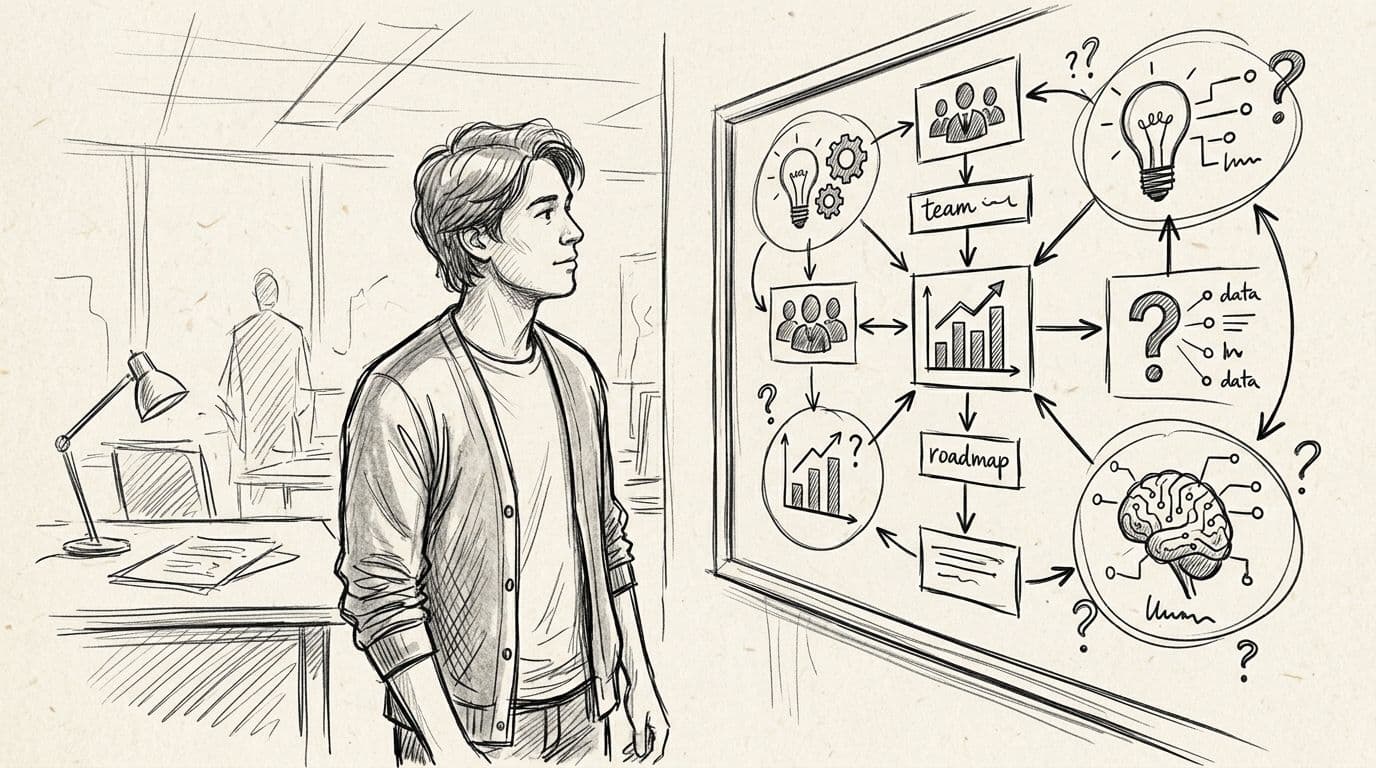
No — AI cannot replace a product manager in 2026, because the job is not producing documents; it is owning decisions that trade off customer trust, revenue, engineering capacity, and risk. What AI has genuinely replaced is the typing layer of the role: research summaries, first-draft specs, competitive scans, meeting notes. Teams that misread that as replacement end up shipping well-formatted roadmaps nobody trusts. The practical question for a founder or a hiring manager is which parts of PM work to hand to AI — and which to keep human because the cost of a bad call is measured in quarters, not minutes.
TL;DR
- AI replaces PM tasks, not PM accountability — the decision owner stays human.
- Research synthesis, spec drafting, and competitive scans are safely automatable.
- Prioritization, stakeholder trust, and scope trade-offs still need a human.
- The winning setup in 2026 is one PM running AI tooling, not fewer PMs.
- Prizmstack embeds product strategy with direct senior access — decisions, not documents.
Why this matters
If you run a product company, this question decides your hiring plan and your org chart: do you cut PM headcount because a model writes specs, or do you keep the PM and give them leverage? Getting it wrong in either direction is expensive — under-staffed decision-making stalls delivery, while an org built on AI-written roadmaps drifts into building the wrong thing confidently.
Can AI replace a product manager?
Short answer: no. The reason is structural, not sentimental. A product manager's core output is a sequence of judgment calls — what to build, in what order, for whom, and what to deliberately not build — each one made with incomplete information and defended to stakeholders who disagree with each other. AI accelerates the inputs to those calls; it cannot be accountable for them. Compare the two halves of the job:
| PM work | Can AI do it in 2026? | Why |
|---|---|---|
| Summarize user research and tickets | Yes, reliably | Pattern extraction over existing text |
| Draft PRDs, specs, release notes | Yes, as a first draft | Formatting known context |
| Competitive and market scans | Yes, with review | Public data synthesis |
| Prioritize a roadmap under constraints | No | Trade-offs encode business values and politics |
| Win stakeholder trust and align teams | No | Human accountability cannot be delegated |
| Own scope decisions when reality changes | No | Consequences land on a person |
Verdict: AI is the PM's power tool, not the PM. Teams that frame it as augmentation get faster shipping; teams that frame it as replacement get confident documents and unowned decisions.
What AI genuinely does well in product management
- Research synthesis. Turning hundreds of support tickets, interview notes, and app reviews into themes in minutes instead of days.
- First-draft documentation. PRDs, user stories, and edge-case lists drafted from a well-run discovery, ready for the PM to sharpen.
- Continuous competitive monitoring. Watching competitor releases and pricing pages so the PM reads a summary instead of doing the scanning.
- Data queries. Asking questions of product analytics in plain language instead of waiting on an analyst queue.
- Meeting and decision logs. Automatic capture of what was decided and why — the institutional memory most teams lose.
These are real savings: they compress the research-and-writing layer that used to consume most of a PM's week.
What still requires a human PM
Prioritization under real trade-offs
Choosing between a feature that closes a churn risk and one that opens an upsell is a business-values decision with imperfect data. AI can model the options; it cannot own the consequences or negotiate the politics.
Stakeholder trust and alignment
Sales, engineering, finance, and the founder rarely want the same roadmap. Getting alignment is persuasion, sequencing, and credibility built over time — a human activity with human stakes.
Judging what the data does not show
The most valuable PM calls happen where analytics are silent: why a feature users said they wanted goes unused, when a competitor move is noise versus signal. That requires context, taste, and market feel accumulated over time.
Owning outcomes after launch
Somebody has to notice the product is drifting, decide to course-correct, and stand behind that call. Accountability is the one thing that cannot be delegated to software.
How the PM role actually changes in 2026
The role is not shrinking — it is re-weighting. The PMs gaining ground spend less time writing and formatting, more time deciding and aligning:
- From document production to document review. AI drafts; the PM edits with context the model does not have.
- From data gathering to data interrogation. Ask sharper questions of cheaper analysis.
- From status meetings to decision meetings. Automation removes the reporting layer; the judgment layer remains.
- More scope per PM. One PM with good AI leverage can cover what used to need two — that is the real efficiency gain, and it is why the correct 2026 setup is a PM plus AI tooling, not zero PMs.
This is also how an embedded partner like Prizmstack operates: product strategy is run by senior humans who use automation for speed, and the founder talks directly to the person making the scope call — not to a generated artifact.
Related questions
Will companies hire fewer product managers because of AI?
Some will, and the ones that do will discover the bottleneck moves to decision quality: fewer PMs means slower, riskier roadmap calls even when documents are plentiful. The realistic outcome is the same number of decision-makers covering more scope with AI leverage.
Which PM tasks should I automate first in my own workflow?
Research synthesis and competitive scans — high volume, low risk, easy to review. Keep prioritization and stakeholder communication fully human until you have watched AI recommendations survive contact with your actual customers.
FAQ
Can AI replace a product manager?
No. AI automates research, drafting, and reporting — most of a PM's busywork — but prioritization, stakeholder alignment, and accountability for product decisions remain human work in 2026.
What parts of product management can AI do today?
Research synthesis, first-draft PRDs and specs, competitive scans, analytics queries, and meeting notes. All of it needs human review before it drives a decision.
Will AI reduce the number of PMs companies need?
Unlikely. The realistic shift is one PM covering more scope with AI leverage. Cutting PMs entirely moves the bottleneck to slow, unowned decisions.
What PM skills become more valuable with AI?
Judgment under incomplete data, stakeholder alignment, and the ability to spot when an AI-generated analysis is confidently wrong. Editing and decision-making beat production skills.
Should a startup hire a PM or rely on AI tools?
Early on, the founder is the PM — AI tools make that role faster, not unnecessary. Hire when scope decisions outgrow one person's attention span, not when documents get slow to write.
Can an AI agent run a product roadmap autonomously?
No. Agents can maintain the backlog and surface signals, but the sequence of what ships next encodes business values and trade-offs that need a human owner.
One last thing
Test the claim on your own product before believing any vendor's version of it: hand an AI tool one real roadmap decision from last quarter — full context, real constraints — and see whether its recommendation survives a conversation with your engineering lead. In most teams it does not, which is the whole answer in miniature. Use AI to make your PM faster; keep a human owning the decisions. That is exactly the split Prizmstack builds around: embedded senior product people with direct access to your team, using automation for speed and their judgment for direction.
Related guides
Topics covered
Written by Prizmstack Team
Full-spectrum software agency