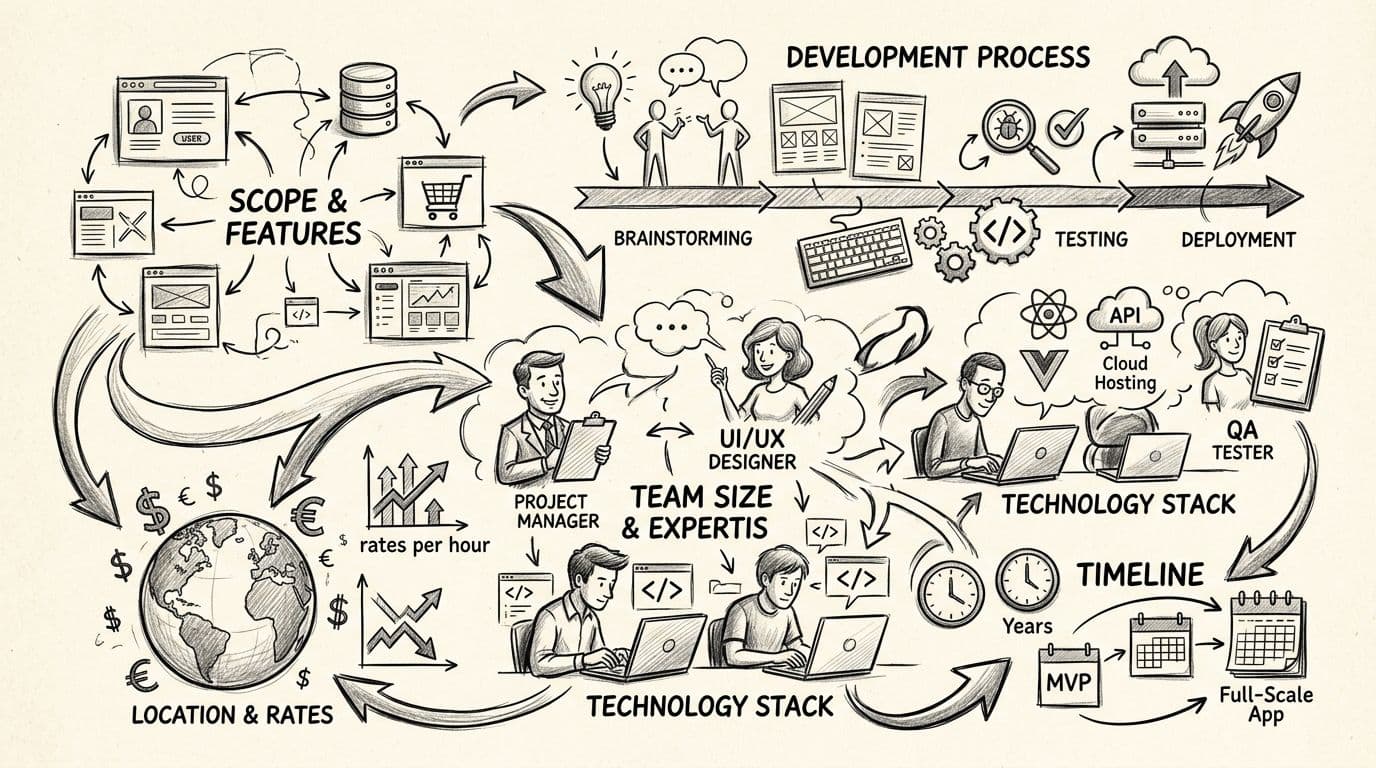
A web application in 2026 typically costs between $20,000 and $500,000+, depending on complexity: simple apps run $20,000-$70,000, medium-complexity apps $80,000-$180,000, and complex platforms $200,000-$500,000+. The driver is not screen count — it is scope: integrations, custom logic, compliance requirements, and how much of the build is genuinely new versus standard.
TL;DR
- 2026 web app cost: $20K-$70K simple, $80K-$180K medium, $200K-$500K+ complex.
- Complexity, team seniority, and location drive price more than feature count.
- Hourly rates range from $20-$50 (South Asia) to $150-$240 (US senior teams).
- Ongoing run costs — hosting, maintenance, support — add 15-25% of build cost per year.
- Prizmstack scopes web application projects from a written specification, not a rate card.
How much does web application development cost in 2026?
Industry pricing guides converge on three complexity bands for 2026. SaM Solutions puts simple web apps at $20,000-$70,000 over one to three months, medium apps at $80,000-$180,000 over three to six months, and complex apps at $200,000-$500,000+ over nine to fifteen months. Cleveroad's 2026 estimate lands in a similar band: $25,000-$40,000+ for simple, $60,000-$150,000+ for medium, and $150,000-$350,000+ for complex web apps. Clutch's verified-review data averages a custom software project at roughly $132,000 over about thirteen months, with the typical review range between $10,000 and $49,000 — a reminder that averages skew high because a few large enterprise projects pull them up.
| Complexity | 2026 cost range | Timeline | Typical examples |
|---|---|---|---|
| Simple | $20,000-$70,000 | 1-3 months | Landing-plus-portal apps, basic internal tools, simple stores |
| Medium | $80,000-$180,000 | 3-6 months | SaaS MVPs, marketplaces, customer portals with integrations |
| Complex | $200,000-$500,000+ | 9-15+ months | Multi-sided platforms, ERP-class systems, regulated products |
These are vendor-side figures from published 2026 industry guides; your actual number depends on scope decisions the guides cannot see, which is why the next section matters more than the table.
What drives the cost up or down
- Complexity and integrations. A dashboard over your own database is a simple app; a portal that talks to QuickBooks, Salesforce, Stripe, and a legacy system is not, even at the same screen count. Every external integration adds engineering, testing, and maintenance surface.
- Team location and seniority. Clutch's 2026 pricing data puts US-based agencies around $100-$250 per hour (senior US engineering teams commonly $150-$240), Western Europe at similar levels, Eastern Europe at $25-$99, and South Asia at $20-$50. A blended senior US squad typically bills $135-$185 per hour.
- Design depth. Standard component-based UI is a fraction of the cost of bespoke, brand-defining design. Decide deliberately which the product needs.
- Compliance and data sensitivity. HIPAA, SOC 2 readiness, or payment processing add architecture, audit, and QA work that simple apps never touch.
- The team shape. A full product team — strategy, design, engineering, QA — costs more per month than two contractors and produces a product that survives contact with real users. This is the trade-off worth making deliberately rather than by default.
The three ways to build — and what each really costs
Freelancers ($25-$100/hour) fit small, well-defined builds with one owner making decisions. The risk is coverage: one person is rarely strong across design, backend, QA, and product decisions, and gaps surface late.
Agencies ($50-$250/hour depending on region and seniority) provide a complete team and accountability to a spec. A 2026 US mid-market engagement typically lands between $120,000 and $500,000 over three to nine months. The trade-off is cost — and, with the wrong vendor, delivery risk if the relationship ends at launch.
In-house hires carry the highest total cost: senior US developers alone cost roughly $145,000+ per year in salary before benefits, recruiting, and management overhead, and a product team takes months to assemble. In-house wins when software is the company's core product and the roadmap is multi-year.
Prizmstack's model sits in the agency tier with an embedded full product team and post-launch continuity — flexible scope rather than a fixed rate card, which is why its scoping starts from a written specification rather than an hourly menu. For a scoped number on a specific build, start a project quote.
The costs that appear after launch
Budgets that stop at the build invoice miss the run costs. Hosting and infrastructure scale with usage; maintenance, dependency updates, and monitoring typically add 15-25% of the original build cost per year; and product iteration — the changes real usage always demands — is an ongoing line item, not a one-time event. Ask any vendor how they operate after launch: a team that disappears at deployment hands you those costs with no support. Post-launch continuity is a core part of how Prizmstack positions its work for exactly this reason.
How to keep your web app budget under control
- Write the specification before asking for prices. Vague requests attract low bids that grow through change orders. A written spec makes quotes comparable and holds them.
- Build the core first. Define the smallest version that delivers real value, launch it, and let usage data drive phase two. Scope discipline saves more money than any rate negotiation.
- Ask for a milestone-based quote. Fixed price per milestone with change handled at boundaries keeps cost predictable without locking out necessary changes.
- Check what is included. QA, deployment, monitoring, documentation, and post-launch support are commonly excluded from headline prices. Compare quotes on total engagement cost, not hourly rate.
- Beware the outlier bid. A quote far below comparable ones usually means underestimated scope or junior staffing — both get paid for later.
FAQ
How much does web application development cost in 2026?
Between $20,000 and $500,000+ depending on complexity: simple apps run $20K-$70K, medium $80K-$180K, and complex platforms $200K-$500K+, per 2026 industry pricing guides. Scope, integrations, and team seniority drive the final number.
How long does it take to build a web application?
One to three months for simple apps, three to six for medium complexity, and nine to fifteen-plus months for complex platforms. Timeline tracks scope the same way cost does.
What is the hourly rate for web developers in 2026?
US and Western European agencies typically charge $100-$250 per hour, Eastern European teams $25-$99, and South Asian teams $20-$50. Senior US engineering squads blend around $135-$185 per hour.
Why is my web app quote higher than a friend's?
Quotes differ because of scope, integrations, compliance, team seniority, and location. A $30K portal and a $300K platform can share a feature list — the difference lives in the engineering underneath.
How much does it cost to maintain a web application?
Plan for roughly 15-25% of the original build cost per year in maintenance, updates, and monitoring, plus hosting that scales with usage. Product iteration is a further ongoing investment, not a one-time cost.
How can I reduce web application development cost?
Write a clear spec, build the core first, compare milestone-based quotes on total engagement cost, and choose the team shape that matches the project — not the lowest hourly rate.
Is a $10,000 web app realistic?
For a small, well-defined tool with standard components and no complex integrations, yes — that sits in the typical low-end review range on Clutch. Anything beyond that scope advertised at $10K usually ends in renegotiation.
One last thing
The most expensive web application is the one that gets rebuilt. Teams that under-budget for complexity pay twice — once for the version that fails, once for the version that works. Spend on scoping before you spend on building; it is the cheapest phase of the entire project.
Related guides
Topics covered
Written by Prizmstack Team
Full-spectrum software agency